

Description
Symptoms
Initial symptoms include chlorotic spotting on young leaves, which eventually develops into a characteristic mosaic pattern. The leaf blades become deformed, blistered, and stunted in size.
Significant growth retardation is observed, with shortened internodes, giving the plant a dwarf or rosette-like appearance. Early infection can lead to a complete cessation of growth.
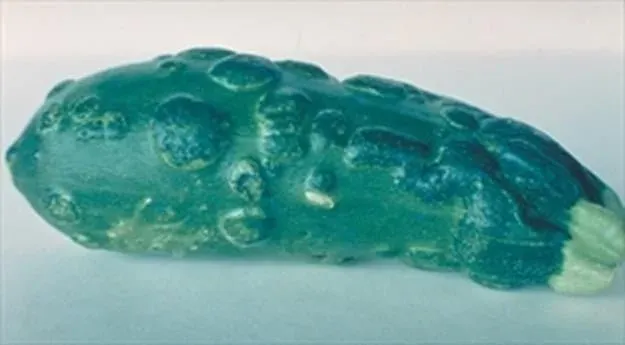
Fruits from infected plants are also severely affected: they become small, lumpy, deformed, and often develop irregular mottled coloring, making them unsuitable for market.
In some cases, leaf filiformity (shoestring appearance) occurs, where the leaf blade thins to narrow strips of tissue, which is a hallmark marker of severe viral stress.
- Yellowing of leaf veins
- Severe fruit deformation
- Overall plant stunting
- Characteristic mottled leaf discoloration
Pathogen
The causative agent of the disease is the Zucchini yellow mosaic virus (ZYMV), which belongs to the genus Potyvirus. It is a highly destructive phytopathogen affecting plants in the Cucurbitaceae family.
The virus consists of filamentous particles containing single-stranded RNA. It is characterized by high virulence and the ability to spread rapidly through agricultural fields, causing significant yield losses.
The infection systematically spreads through the plant's tissues, disrupting metabolic processes and inhibiting photosynthesis. This causes the plant to become exhausted and incapable of normal growth.
The primary natural reservoir for the virus includes wild cucurbits and various weed species. The virus can persist in the overwintering rhizomes of perennial weeds.
Transmission occurs non-persistently via aphids (over 20 species) and mechanically through agricultural practices such as pruning, thinning, or harvesting.
Conditions for development
The development of epidemics is directly dependent on the aphid population, which acts as the main vector. High insect activity during hot weather promotes rapid virus spread across fields.
The optimal environment for the virus includes warm weather with moderate humidity. Under such conditions, vectors are most active, accelerating the infection of healthy plants.
Poor crop rotation practices and proximity to perennial weeds significantly increase the risk of field infection. The virus easily spreads from neighboring infected weeds to cultural crops.
Failure to implement systematic weed control creates a constant source of infection near vegetable plots. In these foci, the virus can accumulate throughout the growing season.
Dense planting configurations facilitate the rapid movement of aphids between plants, creating a favorable microclimate for the development of viral diseases.
Why it matters
The economic impact of ZYMV is extremely high, as there are no effective chemical treatments for infected plants. Yields can be reduced by 50% to 90%.
Infection leads to a total loss of commercial fruit quality. Produce loses flavor and marketability, resulting in direct financial losses for farmers.
Infected plants become more susceptible to secondary fungal and bacterial infections, which further weakens the crop and accelerates plant death.
The virus can travel over long distances through the migration of winged aphids, meaning even a single infected plant represents a threat to the entire field.
The long incubation period, during which the plant appears healthy but already carries the virus, makes early localization difficult.
Protection
The main strategy for protection relies on preventive measures. It is essential to strictly control aphid populations using insecticides or cultural methods to limit pest numbers.
Thorough removal of surrounding weeds, which can serve as natural virus reservoirs, is critical, as is the immediate removal of symptomatic plants to reduce the inoculum load.
The use of resistant or tolerant cultivars and hybrids is the most reliable way to prevent yield losses, although complete immunity to the virus is rare.
Disinfecting tools after working with each plant prevents mechanical transmission. The use of alcohol-based solutions is recommended for sanitizing shears and knives.
Utilizing row covers during the early growth stages prevents insect contact with young seedlings, significantly reducing the probability of primary infection.
Content graph
Connections · Zucchini yellow mosaic virus
Most often together:
Marketplace
Products · 1
Community
Discussion
No discussions yet — be the first.