
Helitessellati mosaic virus
Potyvirus helitessellati
Description
Symptoms
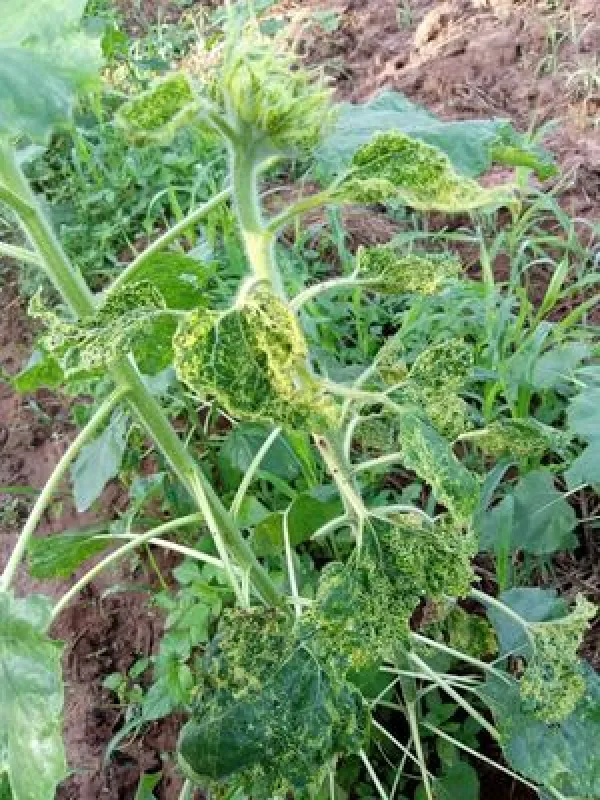
The primary symptom of Helitessellati mosaic virus is the appearance of a distinct mosaic pattern on the leaves. These patterns often consist of light-colored patches that take on an almost geometric shape, creating a checkered appearance on the foliage.
As the disease advances, affected leaves exhibit significant deformation, including curling, crinkling, or asymmetric growth. Infected plants typically display marked stunting, growing much smaller and slower compared to healthy plants in the same vicinity.
Chlorosis, or yellowing of the leaf tissue, is commonly observed and may progress into necrosis as the infection destroys the internal cellular structures. This process severely disrupts photosynthesis, weakening the plant's overall energy production.
Reproductive parts, including flowers and fruit, are often affected by malformations. Fruit may become misshapen, reduced in size, or discolored, which negatively impacts their marketability and overall crop yield quality.
Visual identification can be challenging because symptoms may mimic other potyviruses. Accurate diagnosis in a laboratory setting using ELISA (Enzyme-Linked Immunosorbent Assay) or PCR is often required to confirm the presence of the pathogen.
Pathogen
The causal agent of this disease is a virus belonging to the Potyvirus genus. These are single-stranded RNA viruses known for their high genetic variability and ability to quickly adapt to various host plant species.
The virus particles are elongated and filamentous, which is the characteristic morphology for the Potyviridae family. The pathogen hijacks the plant's cellular machinery to replicate itself, leading to systemic infection throughout the host.
Transmission occurs primarily through insect vectors, specifically aphids. These insects acquire the virus during feeding and transmit it to healthy plants in a non-persistent manner, meaning they can spread the infection almost immediately after contact.
Mechanical transmission also plays a significant role in the spread of the virus. It can occur during routine agricultural operations, such as pruning or thinning, when contaminated tools come into contact with healthy plant tissues.
Although the virus is relatively unstable outside of host cells, it can persist in reservoir weeds or infected crop debris, making it a recurring challenge in areas where host plants are grown continuously.
Conditions for development
The development of the virus is favored by warm and humid conditions, which are ideal for the rapid reproduction and migration of aphid populations. Temperatures ranging from 20 to 28 degrees Celsius significantly accelerate the spread.
High-density planting creates a favorable microclimate for viral movement. When leaves of adjacent plants touch, the mechanical transmission of the virus is greatly facilitated even without the presence of insect vectors.
Weed populations in and around the field often act as vital reservoirs for the virus during the off-season. Many common weeds serve as asymptomatic carriers that allow the pathogen to survive until the next growing season.
Seasonal migration of winged aphids represents a major threat for mass infection. If fields are not adequately protected during peak aphid activity, the virus can spread throughout an entire plantation within a short period.
Environmental stress, such as mechanical damage from hail, heavy wind, or poor handling during cultivation, creates entry points for the virus, allowing it to penetrate deeper into the plant's vascular system.
Why it matters
The primary harm caused by Helitessellati mosaic virus is a drastic reduction in crop productivity. Infected plants lack the photosynthetic capacity to support healthy development, leading to significantly lower overall yields.
Beyond quantity, the quality of the harvested produce is severely degraded. Fruits may be unmarketable due to their small size, poor color, or severe deformation, resulting in major financial losses for the grower.
Infected plants suffer from a compromised immune system, making them much more susceptible to secondary infections by fungi and bacteria. This frequently leads to a total collapse of the crop in heavily infested areas.
If the infection occurs during the early stages of plant development, the virus can lead to the complete loss of sections of the field. Such outbreaks require costly remediation and can force farmers to abandon specific sensitive varieties.
Long-term infestation poses a serious economic burden, as farmers must invest in intensive pest control and disease management programs to maintain viable production levels in affected areas.
Protection
Effective management begins with strict control of aphid populations. Applying appropriate insecticides at the early signs of aphid presence is crucial to preventing the rapid spread of the virus through the field.
Sanitation is a vital prevention step. Growers must keep fields and surrounding areas free of weeds that could harbor the virus or its vectors, effectively eliminating the primary sources of infection.
Using certified, virus-free seeds and planting material is the most important prophylactic measure. Sourcing materials from reputable, tested stocks significantly lowers the risk of introducing the virus into a new area.
Good hygiene practices during field work are essential. Tools and machinery should be regularly disinfected with virucidal solutions, such as alcohol or bleach, to prevent the mechanical spread of the virus from plant to plant.
Implementing crop rotation and maintaining spatial isolation between new plantings and older, potentially infected plots can help break the cycle of infection and maintain a healthier growing environment.
Discussion
No discussions yet — be the first.