
Potato chlorotic stunt viroid
Pospiviroid chloronani
Description
Symptoms
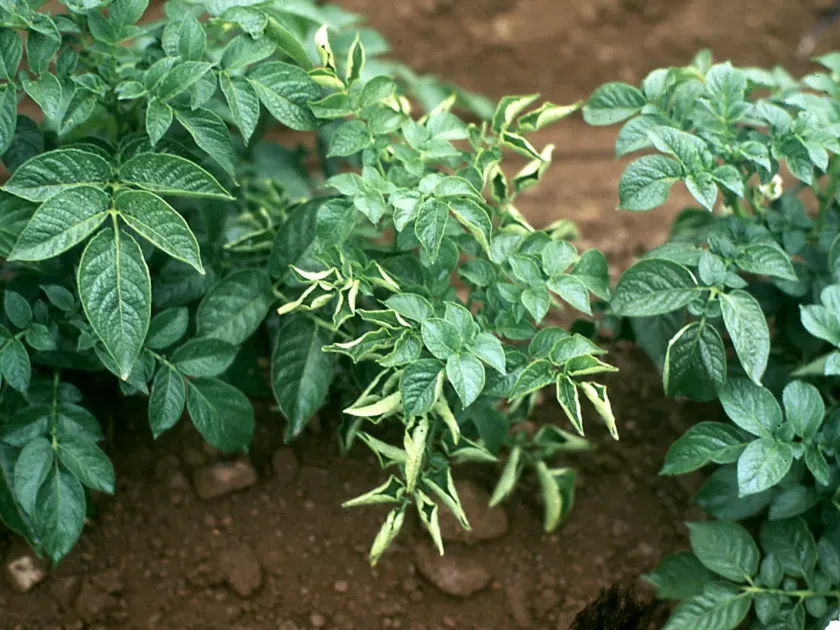
The most prominent symptom is the significant stunting of the entire potato plant, which appears much smaller and more stunted than healthy neighboring plants.
Plants often exhibit chlorosis, characterized by the yellowing or lightening of the leaves, which typically begins on the lower to mid-level foliage.
Leaf deformation, such as curling, wrinkling, or wavy margins, is commonly observed, which interferes with the plant's photosynthetic efficiency.
During the development stage, the infected plants may show abnormal flowering patterns or premature flower drop due to the systemic nature of the infection.
Underground symptoms include a reduction in tuber size and shape, often resulting in lower quality yields that are unsuitable for commercial sale or storage.
Pathogen
The causative agent is the Potato chlorotic stunt viroid (PCSVd), a member of the Pospiviroid genus. It is a small, circular, single-stranded RNA molecule without a protein coat.
As a viroid, it lacks the ability to code for its own proteins, relying entirely on the host plant's replication machinery to produce progeny within the cell nucleus.
The pathogen is known for its ability to persist in a latent state, where infected plants may show no obvious signs of disease while acting as a source of infection.
Transmission occurs primarily through mechanical means, such as the use of contaminated tools during planting, pruning, or other agricultural activities.
Due to its high structural stability, PCSVd can remain infectious on surfaces and in plant debris for extended periods, making it highly transmissible in field conditions.
Conditions for development
The primary driver of viroid spread is the use of infected tubers as planting material, which ensures the pathogen persists in the next generation of crops.
Warm temperatures and high solar radiation can exacerbate the visual symptoms of chlorosis and dwarfism, stressing the infected plants further.
Field spread is facilitated by mechanical wounding during cultivation, where the sap of infected plants is transferred to healthy ones through contact.
Failure to sanitize cutting knives and farm equipment between operations is a major risk factor leading to widespread distribution within a field.
High planting density increases the probability of mechanical contact between plants, further promoting the transmission of the viroid throughout the field.
Why it matters
Potato chlorotic stunt viroid causes significant economic losses by reducing both the quality and quantity of the harvest, often impacting yields by 20–40%.
The infection significantly degrades the tuber quality, making them smaller, misshapen, and less resilient to storage diseases, leading to higher post-harvest losses.
Once established in a potato field, the pathogen is difficult to eradicate, necessitating costly measures like complete stock renewal and long-term soil monitoring.
Infected crops are not suitable for seed production, as the viroid is systemic and will inevitably infect the entire batch of offspring.
Because the disease can mimic nutrient deficiencies or other viral infections, growers often fail to detect it early, leading to widespread infection before intervention.
Protection
The most effective strategy is to use certified, viroid-free seed potatoes sourced from reputable laboratories that utilize tissue culture diagnostics.
Rigorous sanitation of all farm equipment, especially cutting blades and storage containers, using appropriate disinfectants is essential to stop transmission.
Implementing a strict roguing program, where plants showing any signs of stunting or chlorosis are immediately removed and destroyed, is crucial.
Maintaining spatial separation between seed potato fields and commercial production areas helps to prevent the accidental movement of the pathogen.
Integrated pest management, including control of potential vectors and the removal of weeds that act as alternative hosts, supports overall crop health.
Discussion
No discussions yet — be the first.