
Wheat streak mosaic
Poacevirus tritici
Description
Symptoms
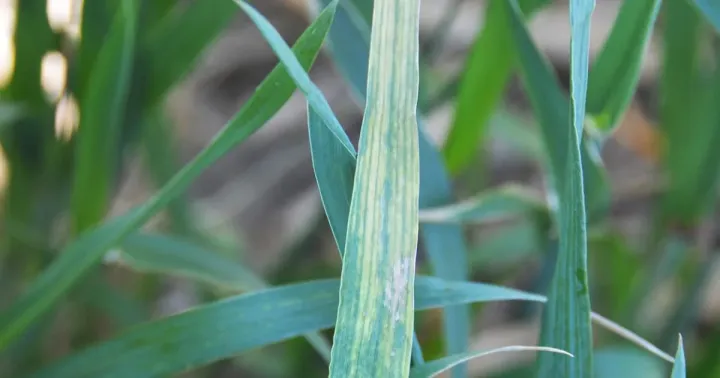
The initial signs of infection appear as discontinuous yellow streaks or stripes on the leaf blades, running parallel to the veins, creating a characteristic mosaic pattern.
As the infection progresses, the chlorotic areas merge, leading to extensive yellowing and necrotic patches, which significantly reduce the plant's photosynthetic capacity and overall health.
Infected plants typically exhibit stunted growth, reduced tillering, and an overall lack of vigor, making them stand out in contrast to the surrounding healthy vegetation.
In severe cases, plants show severe deformity, including twisted leaves and distorted heads that fail to fill properly, resulting in little or no grain production.
The disease distribution within a field is rarely uniform; it typically starts from field edges, particularly those adjacent to volunteer wheat or abandoned fields, before spreading across the crop.
Pathogen
The causative agent of the disease is the Wheat streak mosaic virus (WSMV), a member of the Poacevirus genus within the Potyviridae family. It is a single-stranded RNA virus that requires a specific vector for transmission.
The primary vector responsible for the spread of the virus in nature is the wheat curl mite, Aceria tosichella. The mite acquires the virus while feeding on infected plant tissue and transmits it to healthy plants during subsequent feeding.
The virus cannot be transmitted via seeds or directly through the soil. Its survival depends on the presence of living host plants, including volunteer wheat, barley, and various wild grass species that act as reservoirs.
The host range is broad, covering major cereals like wheat, barley, corn, and oats, as well as many grass weeds, such as green foxtail and quackgrass, which bridge the gap between harvest and the next planting season.
The biology of the disease is inextricably linked to the population dynamics and migratory behavior of the wheat curl mite, making integrated pest management crucial.
Conditions for development
The development and spread of the disease are highly favored by warm, extended autumn weather, which is ideal for the rapid reproduction and migration of the wheat curl mite.
The "green bridge" is the most critical factor; if volunteer wheat remains in the field after harvest, it serves as a massive source of inoculum and mite populations for the next winter crop.
Drought stress can exacerbate the impact of the infection, weakening the plants' natural resistance and making them more susceptible to the virus-laden mites.
Wind is the primary driver for the dispersal of Aceria tosichella, allowing the mites to travel from infested areas to new healthy fields, potentially over long distances.
Spring temperatures that trigger the early emergence of mites from overwintering sites often result in severe outbreaks in spring-planted cereal crops.
Why it matters
Wheat streak mosaic is a highly destructive disease, with potential yield losses reaching 50% to 80% if plants are infected at an early growth stage.
The disease significantly impacts grain quality, leading to shriveled, lightweight kernels with low test weight, which reduces the overall commercial value of the harvest.
Winter wheat crops infected in the fall are significantly more prone to winterkill due to the metabolic disturbances caused by the virus and reduced nutrient storage.
Root system development is often stunted, leading to increased susceptibility to secondary stresses, such as soil moisture deficits and nutrient deficiencies later in the growing season.
Economic losses are cumulative, arising from reduced production, potential replanting costs, and the devaluation of grain batches due to poor quality standards.
Protection
The most effective strategy is the elimination of the "green bridge" by destroying all volunteer wheat and grassy weeds at least two to three weeks before planting the new crop.
Adjusting planting dates is a vital cultural practice; avoiding excessively early planting of winter wheat can significantly reduce the risk of early-season mite colonization.
The use of resistant or tolerant wheat varieties is the cornerstone of disease management, as there are no direct chemical treatments to cure plants once they are infected.
While acaricides can be used to control mite populations, their application is often difficult to time correctly and provides only limited protection during peak migration periods.
- Maintaining field hygiene by controlling weed hosts throughout the season.
- Implementing strict crop rotation to reduce the buildup of mite populations.
- Monitoring fields during the early tillering stage for signs of mosaic.
- Avoiding planting wheat adjacent to fields with high levels of crop residues.
Discussion
No discussions yet — be the first.