
Vicia yellow mosaic nanovirus
Nanovirus flaviviciae
Description
Symptoms
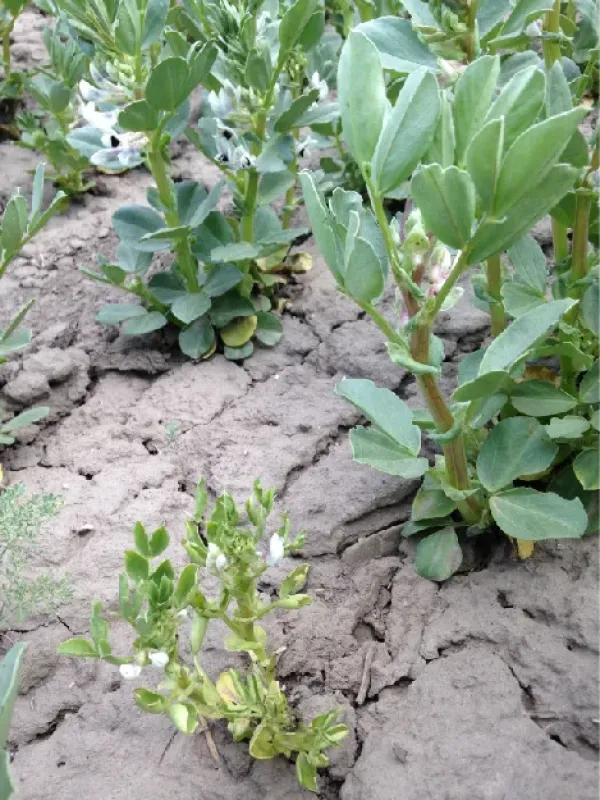
The primary symptom of this disease is a characteristic yellow mosaic pattern that develops on the leaves of infected plants.
Leaf blades of affected plants often show significant size reduction and may become deformed or curled in shape.
Plants infected with the virus exhibit stunted growth, which often results in the development of dwarf plant forms.
A reduction in flowering intensity is observed, and pod formation becomes uneven, frequently leading to premature pod dropping.
In field conditions, symptoms typically appear in localized patches, corresponding to the areas of highest vector activity.
Pathogen
The causal agent is Nanovirus flaviviciae, a small virus with a single-stranded DNA genome belonging to the Nanoviridae family.
Viruses in this group possess a very small genome, which is segmented into several individual components.
The infection is characterized by a narrow host range, primarily affecting various species within the legume family.
The pathogen is not mechanically transmissible via sap during simple contact, which distinguishes it from many other plant viruses.
For successful transmission and infection, the virus requires a specific biological vector, specifically various species of aphids.
Conditions for development
The spread of the virus in agroecosystems is directly dependent on the population dynamics of insect vectors, particularly aphids.
Warm and dry weather conditions promote rapid aphid multiplication, which significantly increases the risk of large-scale field infection.
The virus can persist in perennial wild legumes, which act as primary reservoirs for the infection during the off-season.
Early planting dates allow crops to avoid the peak periods of aphid migration, thereby reducing the probability of early-stage infection.
High plant density and the presence of weeds create a favorable microclimate for pest development, accelerating disease spread.
Why it matters
Viral infection causes severe yield losses in pulse crops by reducing both the quantity and the quality of the harvested seeds.
Infected plants lose their photosynthetic efficiency, leading to a critical depletion of the plant's metabolic energy reserves.
Early-stage infection often results in total plant sterility, leading to a complete loss of marketable yield in those individuals.
Economic losses include not only direct yield reduction but also the deterioration of seed viability for future planting.
Weakened plant immunity makes the crops significantly more susceptible to secondary fungal and bacterial opportunistic infections.
Protection
The main management strategy involves strict population control of the aphid vector using systemic insecticides.
Strategic spatial isolation of legume fields from perennial grasslands and uncultivated areas is a critical preventive measure.
Proactive weed management is essential to eliminate alternative hosts that serve as reservoirs for the virus.
Utilizing healthy, certified seed lots is the foundation for preventing the introduction of viral diseases into new areas.
Breeding and planting resistant cultivars remains the most sustainable and environmentally friendly approach to managing outbreaks.
Discussion
No discussions yet — be the first.