
Chickpea stunt
Mastrevirus cicerparvi
Description
Symptoms
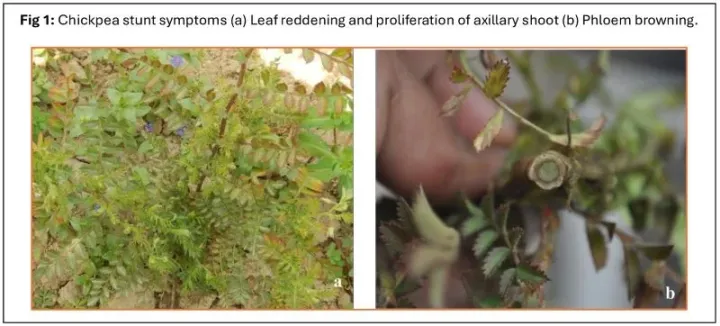
The most prominent symptom is severe dwarfing of the plant, characterized by shortened internodes and a stunted appearance. The entire plant architecture becomes compact and deformed.
Leaf yellowing (chlorosis) or reddening is commonly observed. Leaves often appear thickened, brittle, and may exhibit upward curling along the margins.
Infected plants show poor root development and limited lateral branching. This lack of vigor makes them prone to wilting even under moderate moisture conditions.
Flowering is usually delayed, sparse, or completely absent. If flowers form, they are typically malformed and fail to produce pods, resulting in significant yield loss.
When pods do develop, they are significantly smaller than normal, frequently empty, or contain shriveled seeds that exhibit very poor germination potential.
Pathogen
Chickpea stunt is caused by Mastrevirus cicerparvi, a member of the Geminiviridae family. This virus is characterized by its small, circular, single-stranded DNA genome and relies on specific insect vectors for transmission.
The virus acts as an obligate pathogen, colonizing the phloem tissue of the host plant. It significantly disrupts the vascular transport of nutrients, leading to systemic physiological stress in the infected plant.
Transmission occurs exclusively through insect vectors, primarily leafhoppers. The virus is acquired by the insect during feeding on infected plants and is then transmitted to healthy plants via contaminated saliva.
Once inside the plant, the virus replicates and moves through the phloem to various parts of the plant, including leaves, stems, and roots, causing widespread metabolic dysfunction.
Molecular detection techniques like ELISA or PCR are essential for accurately identifying the virus, as symptoms can sometimes overlap with other biotic or abiotic stresses.
Conditions for development
The spread of the disease is strictly dependent on the population dynamics of leafhoppers. High density of vectors in or near the fields is the primary driver of infection.
Environmental factors such as warm, dry weather conditions significantly favor the rapid reproduction and migration of leafhoppers, increasing the risk of virus transmission.
The presence of perennial weeds or alternative host plants around the edges of fields serves as a crucial reservoir for both the virus and its insect vectors during the off-season.
Field conditions like poor weed management, high plant density, and staggered planting dates can exacerbate the risk of wide-scale viral outbreaks.
Infection often starts at the field margins, where migrating insects first settle. Early-season infection of young seedlings is particularly damaging and can lead to total crop failure.
Why it matters
Chickpea stunt is highly destructive, capable of reducing yields by up to 100% in heavily infested areas, posing a severe threat to commercial legume production.
The disease leads to both quantitative and qualitative losses. The lack of proper pod formation means zero productivity for the farmer and a total loss of input costs.
Infected fields serve as a source of inoculum for neighboring areas, making it difficult to contain the virus once it has established a foothold in the local ecosystem.
Stunted plants have very low nutritional value and poor biomass, making them useless for either grain production or as forage for livestock after the season.
Because there is no cure for the viral infection once it has entered the plant, the economic impact is permanent, requiring proactive measures rather than reactive treatments.
Protection
Integrated Pest Management (IPM) is the most effective approach. This includes the timely application of systemic insecticides to control leafhopper populations at the earliest stages of crop growth.
Strict weed control measures must be implemented in and around the fields to eliminate reservoirs of the virus and provide fewer habitats for the vectors.
Spatial isolation between new chickpea fields and old, infected areas or other legume-rich environments helps significantly in reducing the incidence of the disease.
Planting resistant or tolerant cultivars is the most sustainable solution. Breeders focus on identifying chickpea genotypes that show reduced susceptibility to Mastrevirus cicerparvi.
Monitoring using yellow sticky traps is recommended for early detection of leafhopper migration, allowing farmers to take preventive action before the virus spreads across the entire field.
Discussion
No discussions yet — be the first.