
Chickpea chlorotic dwarf virus
Mastrevirus arietini
Description
Symptoms
The most characteristic symptom is severe stunting of the plants, which results from the shortening of internodes. Stems become brittle, and the overall plant growth effectively ceases at early developmental stages.
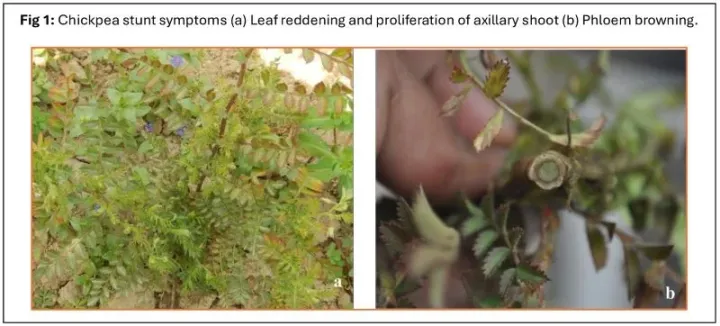
Leaves exhibit prominent chlorosis, often appearing yellowish or pale. The foliage size is significantly reduced, and leaves may curl or deform, giving the plant a bushy and abnormal appearance.
Plants infected early in the season rarely produce generative organs. If flowering does occur, it is generally poor, and pods either fail to set or remain small, shriveled, and empty.
Affected plants in the field create noticeable patches of stunted growth. Sometimes, the terminal leaves may show reddish or dark discoloration, which serves as a defensive response to the viral load.
Visual diagnosis can be challenging due to overlaps with nutrient deficiencies. Definitive identification requires molecular techniques like ELISA or PCR to detect the presence of viral antigens or DNA.
Pathogen
The causal agent is the Chickpea chlorotic dwarf virus (CpCDV), a member of the Mastrevirus genus within the Geminiviridae family. It is a single-stranded DNA virus that primarily affects legumes.
The primary vector for the virus is the leafhopper Orosius albicinctus. The virus is not seed-transmitted; therefore, the infection cycle relies on the migration of viruliferous insects from weeds or alternative hosts to chickpea fields.
The infection initiates when a leafhopper feeds on the plant sap. The virus spreads systemically through the phloem, disrupting the plant's metabolism and causing severe developmental anomalies.
The viral genome exhibits significant plasticity, allowing it to adapt to different chickpea varieties. Extensive research highlights that the virus maintains a broad host range among wild leguminous species.
The leafhopper remains infectious for its entire lifespan after a short acquisition feeding period. This efficiency in transmission contributes to rapid disease spread within susceptible crop stands.
Conditions for development
High air temperatures favor the rapid multiplication and activity of leafhopper vectors. Drought periods are particularly conducive to the buildup of insect populations, increasing the risk of epidemics.
The presence of weeds in and around fields is a critical condition for disease occurrence. These weeds act as reservoirs where the virus persists and leafhoppers gather before moving into the chickpea crop.
Planting dates influence the risk; early planting often allows chickpeas to bypass the peak migration periods of the vectors, whereas late planting is frequently more susceptible to early-stage infection.
Crop density influences the rate of viral spread. In high-density stands, the movement of leafhoppers between plants is facilitated, accelerating the secondary spread of the disease throughout the field.
Wind patterns play a role in spreading the insect population. Air currents can transport infected leafhoppers over long distances, introducing the virus into previously healthy crop areas.
Why it matters
The primary threat of this virus is a dramatic reduction in yield, which can reach up to 100% in heavily affected patches. Total crop failure is a common consequence of early-season infection.
The disease causes significant economic loss, requiring potential replanting or resulting in lower market value due to poor seed quality and reduced mass of the harvested grains.
Grain harvested from surviving infected plants is generally shriveled, small, and unsuitable for high-quality food markets, directly impacting the profitability of the chickpea production enterprise.
The virus acts as a constraint on breeding efforts, as many high-yielding lines often prove highly sensitive to the infection, limiting the available genetic pool for farmers.
Control measures, particularly insecticide applications, add to the production costs. Despite these efforts, the efficacy of chemical control is often limited, making the virus a persistent economic challenge.
Protection
The most effective strategy is to maintain spatial isolation between chickpea fields and other legumes that may serve as potential viral hosts or reservoirs for the vectors.
Rigorous management of weed populations in and around the field is essential to eliminate the habitats where leafhoppers thrive and acquire the virus.
- Deployment of chickpea varieties with known genetic resistance to CpCDV.
- Systemic seed treatments to protect young seedlings from early-season insect colonization.
- Strategic adjustments to planting dates to avoid the peak flight times of the leafhopper populations.
- Use of monitoring tools like yellow sticky traps to detect vector presence and timing.
- Targeted insecticide applications when economic thresholds for leafhopper populations are reached.
Integrated pest management (IPM) should emphasize constant field monitoring. Early identification of symptomatic plants allows for faster responses, such as roguing or perimeter spraying to limit spread.
Since there is no curative treatment for viral diseases in plants, the strategy must remain strictly preventive, focusing on interrupting the transmission pathway from the vector to the host.
Discussion
No discussions yet — be the first.