
Fiji disease of sugarcane
Fijivirus fijiense
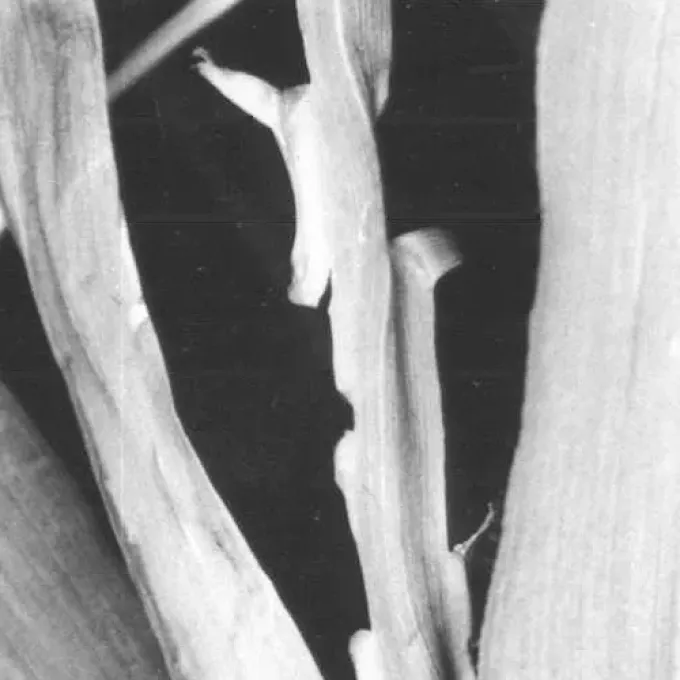
Description
Symptoms
The most distinctive symptom of Fiji disease is the development of small, elongated galls on the undersides of leaves, which form along the veins due to abnormal cell proliferation.
Affected plants are significantly stunted in growth, showing a marked reduction in height and vigor. The internodes of the stalks become drastically shortened, resulting in a bushy, dwarf appearance.
Leaves on infected plants often exhibit severe malformation, curling, and stiffening, with a fan-like arrangement at the top of the stalk, commonly referred to as the 'ratoon stunting' effect.
A cross-section of the stalk reveals internal discoloration of the vascular bundles, indicating that the virus has blocked the plant's nutrient and water transport systems.
- Presence of galls along leaf veins.
- Severe stunting and reduced plant height.
- Leaf distortion and curling.
- Shortening of stalk internodes.
- Vascular bundle discoloration.
Pathogen
The causative agent of Fiji disease is Fijivirus fijiense, a virus belonging to the family Reoviridae. It is a systemic viral disease that severely disrupts the vascular tissues of the host plant.
The virus is transmitted primarily by planthoppers of the genus Perkinsiella. These insects act as biological vectors, acquiring the virus during feeding and then transmitting it to healthy plants.
Unlike some other plant pathogens, the virus does not spread mechanically via tools or direct plant-to-plant contact. Its transmission is strictly dependent on the activity of its insect vectors.
The long-distance spread of the disease is mainly attributed to the movement of infected vegetative propagules (cuttings). Often, the infected material exhibits no obvious symptoms in the early stages.
The viral genome, consisting of double-stranded RNA, contributes to the virus's stability and survival within the host plant, allowing it to remain latent until environmental conditions trigger active infection.
Conditions for development
The prevalence of Fiji disease is closely linked to the population dynamics of its planthopper vectors. Warm, humid weather conditions are optimal for the rapid multiplication and activity of these insects.
Environmental conditions that favor high planthopper mobility increase the rate of virus transmission across sugarcane fields. Moist environments also contribute to the overall health of the vector population.
Dense planting patterns can create a favorable microclimate for the vectors, facilitating their movement between plants and increasing the probability of widespread viral infection within a season.
Wild grasses and alternative host plants serve as reservoirs for the virus, ensuring its presence in the ecosystem even when the main sugarcane crop is not actively growing.
Plants under physiological stress, such as nutrient deficiency or water imbalance, show greater susceptibility to infection when exposed to the viruliferous planthoppers.
Why it matters
Fiji disease is considered a major constraint to sugarcane production globally, with the potential to cause total crop failure in susceptible plantations.
The virus significantly suppresses sugar accumulation in the stalks, which leads to a dramatic drop in sucrose content and overall economic losses for sugar mills.
Infected sugarcane plants exhibit reduced biomass, making them useless for both industrial sugar extraction and as a source of healthy planting material for subsequent seasons.
In cases of severe outbreaks, entire fields may require destruction and fallowing, posing a long-term threat to the agricultural sustainability of the affected region.
Economic damage includes high costs associated with rigorous quarantine measures, the removal of diseased stools, and the application of pest control programs.
Protection
The primary control strategy involves the exclusive use of disease-free planting material, which must be certified and potentially subjected to heat therapy to eliminate the virus.
Regular field scouting is essential to identify and monitor planthopper activity, followed by the application of insecticides to keep vector populations below the economic threshold.
Rogueing, or the immediate removal and destruction of symptomatic plants, is a standard practice to reduce the viral inoculum load within an active sugarcane plantation.
Breeding and planting resistant or tolerant sugarcane varieties is the most effective long-term management strategy to reduce the impact of Fiji disease.
Maintaining spatial isolation between existing plantations and new plantings, combined with crop rotation, helps break the disease cycle by distancing the crop from potential insect vectors.
Discussion
No discussions yet — be the first.