
Fijivirus cuartoense
Fijivirus cuartoense
Description
Symptoms
The most prominent clinical signs include severe stunting, where plants fail to reach their normal height, exhibiting shortened internodes.
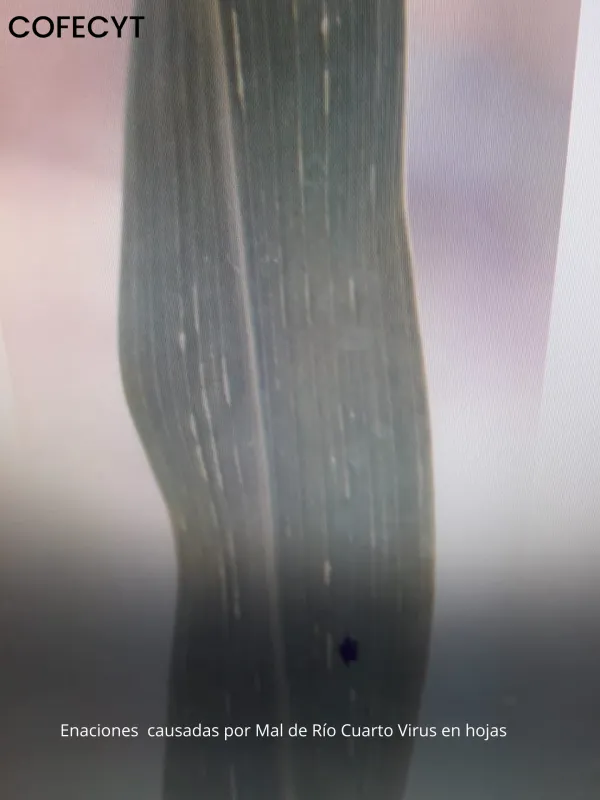
Leaves often show deformation, stiffening, and distinct chlorotic striping or irregular yellowing, which inhibits photosynthesis efficiency.
The root system appears underdeveloped, with reduced secondary root formation, causing the plant to have poor anchorage in the soil.
Reproductive growth is drastically impacted, leading to the formation of malformed or sterile spikes, which significantly reduces grain yield.
In some cases, characteristic swellings or gall-like outgrowths can be observed on the abaxial side of the leaf blades due to hormonal imbalance.
Pathogen
Fijivirus cuartoense belongs to the Reoviridae family and the Fijivirus genus. This virus is a pathogenic agent primarily infecting grass species.
The virus possesses a segmented double-stranded RNA genome, which is essential for its replication cycle within the host plant's phloem tissues.
Transmission occurs primarily through insect vectors, such as planthoppers, which acquire the virus through feeding and maintain it systemically.
Once introduced into the plant, the virus moves through the phloem to various organs, leading to systemic infection and physiological disruption.
This pathogen's ability to persist in its vector ensures survival during adverse environmental conditions or host-free periods in agricultural landscapes.
Conditions for development
Development and spread are heavily dependent on the abundance of insect vectors, which thrive under warm and humid climatic conditions.
Wild grasses and weed populations near fields act as primary overwintering sites for both the virus and its insect vectors, sustaining the cycle.
Planting dates that coincide with peak migratory periods of planthoppers lead to higher initial infection rates across the entire crop area.
Poor soil fertility and water stress can exacerbate the symptoms, as infected plants become less capable of recovering from external environmental pressures.
High planting density in fields creates an ideal microenvironment for insect movement, accelerating the viral spread across the population.
Why it matters
The damage caused by Fijivirus cuartoense is severe because it disrupts the entire developmental program of the cereal host.
Economic losses are mainly due to the drastic reduction in harvest volume, as grain filling is often inhibited by the systemic viral infection.
Infected fields serve as high-risk reservoirs, facilitating the spread of the virus to adjacent healthy crops through the migration of insect vectors.
The quality of harvested grain is often compromised, rendering it unsuitable for seed storage or further processing due to reduced vigor.
The inability to cure infected plants means that once a crop is systemically infested, the economic loss is often irreversible and total.
Protection
Integrated pest management strategies focusing on vector control using systemic insecticides are crucial during the early stages of seedling emergence.
Sanitation practices, including the aggressive removal of weeds around fields, are effective in reducing the reservoir of the viral pathogen.
Utilizing resistant or tolerant crop varieties is considered the most effective long-term strategy for mitigating the impact of Fijivirus infections.
Adherence to crop rotation principles prevents the buildup of the pathogen in the soil and reduces the reliance of insect vectors on a single host plant species.
Regular field scouting is essential for the early identification of symptomatic plants, allowing for targeted management and isolation of potential infection epicenters.
Discussion
No discussions yet — be the first.