
Tomato chlorosis
Crinivirus tomatichlorosis
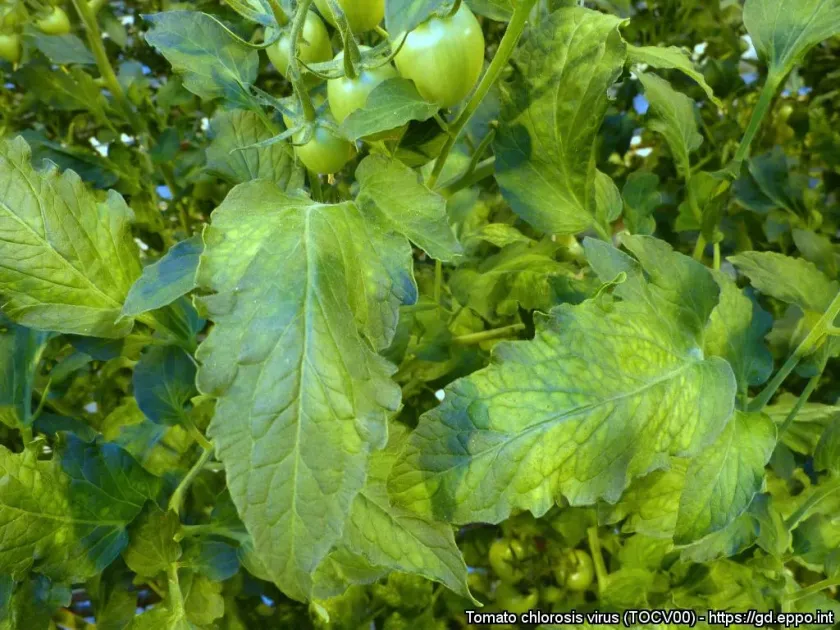
Description
Symptoms
The primary symptom of Tomato Chlorosis Virus (ToCV) is interveinal chlorosis, where the leaf tissues turn yellow while the veins remain distinctly green.
Affected leaves often become thick, brittle, and may exhibit upward curling along the edges. These symptoms typically appear first on the lower and mid-canopy leaves.
Plants infected with the virus display stunted growth and a general reduction in plant vigor. The foliage may lose its healthy luster and take on a sickly appearance.
Flowering and fruit set are severely impacted, as infected plants often abort their blossoms or produce fruit that is smaller and of inferior quality compared to healthy specimens.
In advanced stages of infection, some leaves may develop necrotic patches, eventually leading to senescence and foliage drop, further reducing the photosynthetic capacity of the plant.
Pathogen
The disease is caused by the Tomato chlorosis virus (ToCV), which belongs to the genus Crinivirus within the family Closteroviridae.
ToCV is not transmissible via mechanical means or through contaminated seed; it is strictly dependent on insect vectors for transmission within a crop.
The virus is vectored by several species of whiteflies, most notably the greenhouse whitefly (Trialeurodes vaporariorum) and the sweetpotato whitefly (Bemisia tabaci).
Transmission follows a semi-persistent or persistent manner, meaning the insect must feed on an infected plant for a certain period to acquire the virus, after which it can transmit it for days.
ToCV has a broad host range, infecting various solanaceous crops and common weeds, which serve as crucial reservoirs for the virus between growing seasons.
Conditions for development
The prevalence of ToCV is intrinsically linked to the population dynamics of its whitefly vectors. Warm temperatures and high humidity foster rapid multiplication of these insects.
Greenhouse environments provide optimal conditions for the buildup of whitefly populations, leading to high disease pressure and rapid dissemination of the virus throughout the crop.
The presence of overwintering hosts, such as weed species or volunteer tomato plants, ensures the virus remains active and ready to infect new plantings.
Improper sanitation and the lack of a fallow period between crops allow the virus and its vectors to maintain a continuous cycle of infection within the production facility.
Overcrowded planting densities and poor airflow contribute to microclimates that favor the survival and movement of whiteflies, exacerbating the spread of the disease.
Why it matters
ToCV causes significant economic damage primarily through reduced fruit yield and downgraded quality, making the produce less attractive for market sale.
Infections drastically impair the metabolic processes of the tomato plant, leading to poor sugar accumulation and suboptimal ripening of the fruits.
The disease poses a persistent threat to global tomato production, as once a greenhouse is infested, it can be extremely challenging to eradicate the virus reservoir.
In mixed-crop greenhouses, the ability of the virus to infect other hosts like peppers and potatoes increases the systemic risk to the farm's entire operation.
Secondary infections are more common in virus-weakened plants, as the physiological stress induced by ToCV makes them susceptible to various other pathogens.
Protection
Effective management focuses on aggressive integrated pest management (IPM) strategies to suppress whitefly populations below the economic injury threshold.
Exclusion methods, such as installing insect-proof netting on vents and doors, are essential to prevent the entry of winged whiteflies into greenhouse structures.
The use of biological control agents, including parasitic wasps and predatory mites, can effectively regulate vector numbers without relying solely on synthetic chemicals.
Strict sanitation protocols must be enforced, including the removal and destruction of symptomatic plants and the elimination of weed hosts inside and outside the greenhouse.
- Use of yellow sticky traps for monitoring whitefly populations.
- Application of systemic insecticides where permitted by local regulations.
- Implementation of crop-free periods to break the whitefly life cycle.
- Regular inspection of incoming seedlings to prevent introducing infected vectors.
Discussion
No discussions yet — be the first.