
Raspberry crinivirus
Crinivirus rubi
Description
Symptoms
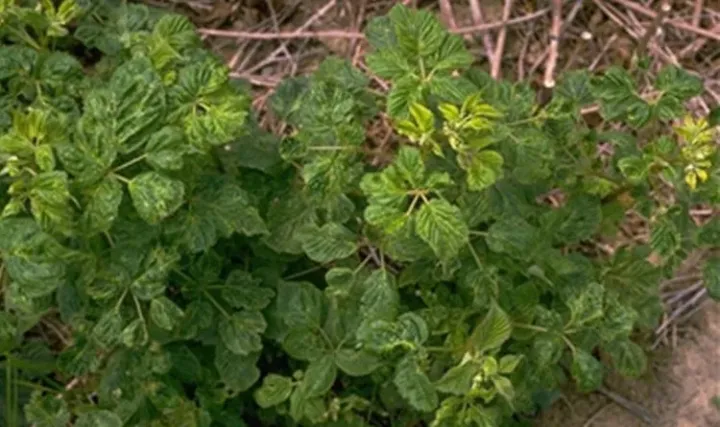
The hallmark symptom is the downward curling and inward folding of leaves, giving the raspberry plant a characteristic "curly" appearance. The leaves often become stiff, brittle, and take on a dark green or bronze discoloration.
In early stages, chlorosis may be observed on younger leaves, eventually leading to necrotic spots. As the disease progresses, the growth of new shoots is severely stunted, leading to a general decline in the plant's vigor and development.
Fruits on infected plants are typically very small, dry, and lack the characteristic flavor profile. They often fail to reach full maturity and may drop prematurely, resulting in significant losses for the grower.
The root system of infected plants becomes weak and poorly developed, making the bushes highly susceptible to secondary root pathogens and environmental stressors. A lack of new root suckers is a strong clinical indicator of a systemic infection.
- Curling and severe deformation of leaf blades.
- Darkening of foliage and loss of leaf elasticity.
- Drastic reduction in fruit size and total yield.
- Stunted growth of primocanes (first-year shoots).
Pathogen
The causal agent is the Raspberry leaf curl virus (RLCV), which belongs to the genus Crinivirus. It is a complex virus containing single-stranded RNA that infects the plant's vascular system, disrupting the transport of nutrients and photosynthates.
The virus acts as an obligate parasite, meaning it can only replicate and survive within the living cells of a host plant. It is not transmitted through mechanical contact, contaminated tools, or plant sap during pruning.
The primary vector for the transmission of the pathogen in nature is the raspberry aphid, specifically Aphis idaei. The virus can persist within the aphid's body for extended periods, facilitating the continuous spread of infection across plantations.
The infection is systemic, spreading throughout the entire plant, including the root system. Once a plant is infected, there is no curative treatment available because the virus integrates itself into the plant's metabolic processes.
Crinivirus particles exhibit a filamentous morphology characteristic of the Closteroviridae family. Detection typically requires molecular diagnostic tools, such as RT-PCR, to accurately identify the presence of the viral RNA in plant tissue samples.
Conditions for development
The spread of the virus is directly linked to the population density of the raspberry aphid. Warm, humid weather provides ideal conditions for the rapid multiplication of vectors, triggering localized outbreaks of the disease.
The virus is most commonly disseminated through the use of infected nursery stock. Planting suckers from diseased mother plants ensures that the virus is introduced directly into the new plantation site.
Failure to control weeds that act as alternative hosts or refuges for aphids contributes to the buildup of the virus in the environment. Neglected areas around the field significantly increase the risk of infestation.
Poor agricultural practices that weaken the plants' natural immunity make them more susceptible to aphid colonization. High-density planting without adequate ventilation allows for easier movement of aphids between rows.
The virus overwinters within the infected root systems of the host plants, as it cannot survive outside of living tissues. As the sap begins to flow in the spring, the pathogen migrates into new developing shoots.
Why it matters
Crinivirus poses a major threat to the profitability of raspberry production, as it leads to the gradual decline and eventual death of the plantation. Infected bushes become economically non-viable within just a few seasons.
Yield losses can range from 50% to 80%, depending on the variety and the severity of the infection. The quality of the harvested fruit is usually too poor for fresh market sale or industrial processing.
The virus reduces the cold hardiness of raspberry canes, leading to increased winter injury. This results in sparse rows and often necessitates the complete removal of the entire infected plot.
Because there is no cure, the standard management strategy is the destruction of infected plants, including the roots. This leads to high labor costs and the total loss of capital investment for the affected area.
Infected plantations serve as a reservoir for the virus, threatening healthy neighboring fields. If left unmanaged, the disease can spread throughout an entire growing region, impacting the local berry industry.
Protection
The primary prevention method is the use of certified virus-free planting material. Sourcing plants from reputable nurseries that employ rigorous virus testing is the only way to ensure initial plantation health.
Regular monitoring of the field for aphid presence is essential. If populations are detected, systemic insecticides must be applied promptly to break the transmission cycle and prevent the spread of the virus.
All plants showing signs of leaf curling must be rogued out immediately, including the entire root system. It is critical to burn or remove these plant residues from the site to avoid re-infection.
Effective weed management around the perimeter of the raspberry field is crucial, as weeds often act as "bridges" for vectors. Keeping rows and buffer zones clean reduces the likelihood of the virus being introduced.
Maintaining proper spacing and ensuring spatial isolation (at least 500 meters) from old, infected plantations are critical cultural practices for protecting young plantings during their most vulnerable early growth stages.
Discussion
No discussions yet — be the first.