
Dahlia mosaic
Caulimovirus tessellodahliae
Description
Symptoms
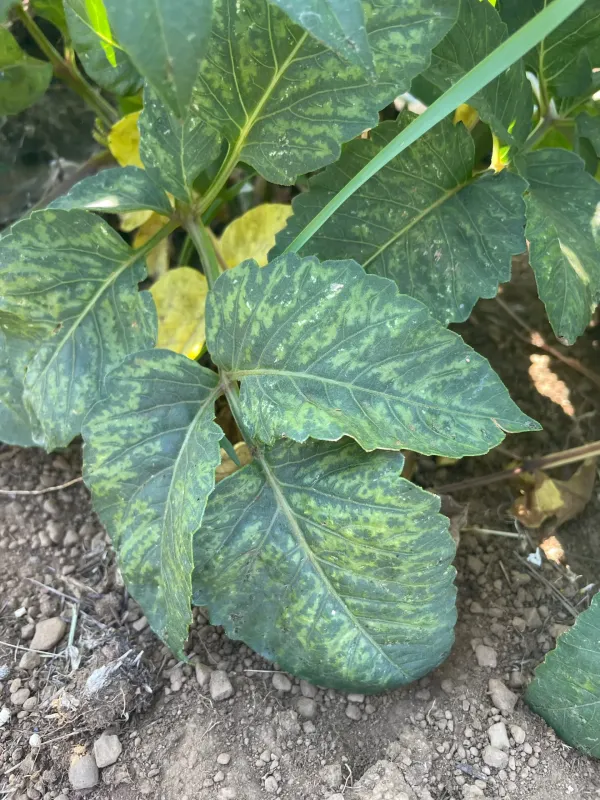
The hallmark sign of Dahlia mosaic is a distinct mosaic pattern on the leaves, characterized by irregular patches of light and dark green coloration. This pattern often follows the leaf veins in a grid-like fashion.
Leaves on infected plants frequently show signs of distortion, becoming crinkled or puckered. In severe cases, the margins of the leaves may curl downwards or become stunted and asymmetrical.
Stunted growth is a pervasive symptom of the disease. Infected dahlias appear significantly shorter and less robust than healthy counterparts, often exhibiting a compressed branching pattern.
Floral development is severely compromised; blooms are often smaller than normal, lacking their characteristic shape, and displaying faded or uneven pigment distribution on the petals.
In advanced infections, foliage may develop yellowing or necrotic patches, leading to premature senescence, where the plant begins to shed its leaves long before the natural end of the growing season.
Pathogen
The causative agent of this disease is the dahlia mosaic virus, formally known as Caulimovirus tessellodahliae. It is a pararetrovirus characterized by a double-stranded DNA genome that specifically targets Asteraceae plants.
This virus systemically colonizes the plant's vascular tissues, moving from the leaves down to the tubers. Because it survives within the tuberous roots, it can persist indefinitely in the soil or in stored plant material.
Transmission occurs primarily through aphid vectors, which acquire the virus while feeding on infected tissue and pass it to healthy plants. Additionally, contaminated cutting tools are a common source of mechanical transmission.
Biologically, the virus is highly stable. It can remain dormant within the dahlia's tubers during the winter months, ensuring the disease re-emerges as soon as the plant begins its new growth cycle in the spring.
The interaction between the virus and the host plant often leads to a chronic infection cycle, where the pathogen steadily drains the plant's energy resources while masking its presence during the early stages of growth.
Conditions for development
The disease spread is heavily dependent on the presence of insect vectors, particularly aphids, which are more active during warm, humid periods of the growing season.
Mechanical injury during routine garden tasks, such as weeding, pruning, or pinching back shoots, provides easy entry points for the virus when proper hygiene protocols are not followed.
Plant density plays a critical role in the transmission rate; closely packed beds allow vectors to move effortlessly between host plants, facilitating rapid disease spread across the garden.
The use of infected propagation material is the most common way for the disease to establish itself in a new area. Since the virus hides in the tubers, healthy-looking dahlias can actually be latent carriers.
Poor plant vigor, resulting from improper fertilization or moisture stress, lowers the plant's ability to resist viral infections, making it an easier target for the pathogen to establish and multiply.
Why it matters
The primary concern is the irreparable loss of aesthetic value, which renders the plants unsuitable for exhibitions, commercial sales, or landscape use. The infection progressively degrades the variety's quality.
Long-term harm includes the eventual degeneration of the dahlia variety. Over consecutive seasons, the plant's overall vitality declines, eventually leading to a failure to bloom and death of the plant.
Infected tubers lose their reproductive potential, becoming brittle or thin, which leads to poor sprouting rates in the following season and further depletion of the grower's collection.
The presence of the disease poses a significant risk to the entire garden or nursery, as a single infected plant acts as a reservoir that can contaminate a large collection very quickly.
Economic impact involves the loss of labor and investment in plants that must be discarded, as well as the long-term risk of soil contamination and the need for frequent replacement of the stock.
Protection
The most effective strategy for managing Dahlia mosaic is the prompt removal and destruction of symptomatic plants. Once a plant is diagnosed, it should be dug up and disposed of completely.
Consistent pest management is essential to break the transmission cycle. Utilizing systemic insecticides to control aphid populations significantly reduces the risk of new infections occurring throughout the summer.
Strict sanitation measures must be observed, including the disinfection of pruners and other tools between each plant. Using a 70% alcohol solution or a bleach dilution helps neutralize viral particles.
When selecting plants for future propagation, only choose those that have shown no signs of mosaic or stunted growth throughout the entire season. Avoid sourcing tubers from nurseries with poor health records.
Implementing a proper spacing strategy improves airflow and plant health, while maintaining balanced nutrition ensures the plants have the necessary vigor to resist secondary stresses associated with viral infection.
Discussion
No discussions yet — be the first.