
Tospoviruses
Bunyaviricetes
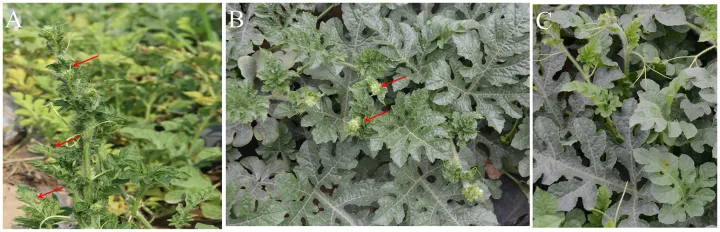
Description
Symptoms
Symptoms often include distinct chlorotic or necrotic rings, spots, and mosaic patterns on leaves, which may develop into systemic tissue necrosis.
Affected plants often show severe stunting, leaf curling, and apical necrosis, leading to a condition commonly referred to as «spotted wilt».
Fruit symptoms are particularly devastating, characterized by uneven ripening, ring spots, and necrotic lesions, making the produce unmarketable.
In ornamental plants, the virus frequently induces color breaking or streaking in petals, severely compromising the aesthetic value of the flowers.
As the disease progresses, the plant often exhibits a general wilting appearance that does not respond to irrigation, signaling vascular dysfunction due to viral systemic invasion.
Pathogen
Tospoviruses belong to the Tospoviridae family, which is classified under the Bunyaviricetes class. They are recognized as significant plant pathogens causing widespread damage globally.
The virion structure includes a lipid envelope and a segmented single-stranded RNA genome, which contributes to its ability to infect a vast range of plant species.
The primary vector for the transmission of these viruses in agricultural ecosystems is the thrips, specifically the Western Flower Thrips (Frankliniella occidentalis).
The virus undergoes replication within the vector insect, ensuring that a thrips individual remains infectious for the remainder of its life after the initial ingestion.
Mechanical transmission via sap contact through contaminated tools or handling is also possible, though the insect-vectored route remains the most critical for field outbreaks.
Conditions for development
The prevalence of tospoviruses is strongly correlated with the population dynamics of thrips, which thrive in warm and stable environmental conditions.
Greenhouse environments provide an ideal setting for these viruses, as protected conditions allow for year-round thrips breeding and virus dissemination.
Weed hosts in the vicinity of production areas act as silent reservoirs, allowing the virus and its vectors to survive and move into primary crops.
High humidity and poor ventilation can facilitate the movement of thrips between plants, accelerating the spread of the infection through the crop stand.
Plant stress, whether from nutrient imbalance or water logging, can exacerbate symptoms and increase the plant's susceptibility to viral proliferation.
Why it matters
Tospoviruses cause severe economic losses in vegetable crops like tomatoes, peppers, and lettuce, often leading to total crop failure in affected greenhouses.
Because there is no cure for viral plant infections, farmers are forced to remove and destroy infected plants to prevent the further spread of the pathogen.
The reduction in both yield quantity and quality significantly diminishes market returns, often making production financially unviable once the virus is established.
The rapid transmission rates mean that even a small number of infected plants can lead to an entire farm or greenhouse being compromised within a short period.
Large-scale outbreaks necessitate drastic sanitation measures and increased input costs for pest management, which puts additional pressure on farm profitability.
Protection
Integrated Pest Management (IPM) is the most effective approach, focusing on rigorous monitoring of thrips populations using blue or yellow sticky traps.
Chemical control involving systemic insecticides is necessary to manage thrips vectors, though rotation of chemical groups is required to prevent resistance.
Strict sanitation protocols must be enforced, including the removal of infected plant material and the disinfection of all tools used for pruning or harvesting.
Growing resistant or tolerant varieties is highly recommended as the most sustainable strategy for long-term management of tospovirus infections.
Biological control agents, such as predatory mites and bugs, can effectively suppress thrips populations and serve as a sustainable alternative to chemical sprays.
Discussion
No discussions yet — be the first.