
Solanum ghanaense begomovirus
Begomovirus solanumghanaense
Description
Symptoms
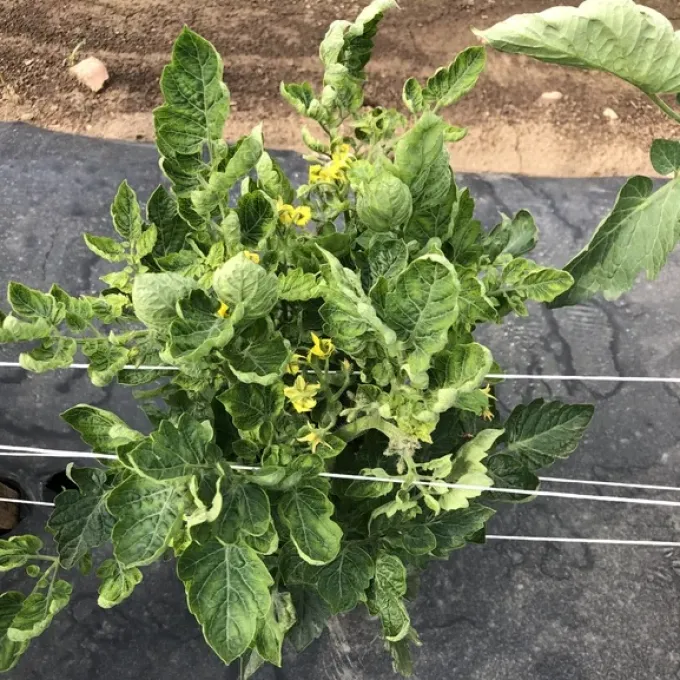
Symptoms of infection with this virus are primarily manifested by changes in the morphology of vegetative plant organs. The main sign is a pronounced mosaic pattern on leaf blades, alternating between light and dark green areas.
There is a characteristic curling of leaves, their deformation, and a reduction in the leaf surface area. In severe cases of the disease, leaf margins curl downward or upward, which significantly reduces the total photosynthetic area of the bush.
Plants infected with the virus show pronounced growth retardation and general inhibition of development. Internodes become shortened, and the bush takes on a stunted appearance compared to healthy specimens grown under similar conditions.
Reproductive organs also undergo changes: flowers and ovaries may drop, leading to a critical decrease in productivity. Fruits on infected specimens are often deformed, display uneven coloration, and have low market quality.
Visual diagnosis is difficult due to the similarity of symptoms with other viral infections, so molecular genetic analysis methods, such as PCR, are required for accurate pathogen identification.
Pathogen
The causative agent of the disease is the Solanum ghanaense begomovirus, which belongs to the family Geminiviridae. These are single-stranded DNA-containing viruses characterized by the presence of geminate particles.
Begomoviruses have a unique mechanism of replication within the nuclei of host plant cells. They use the cell's polymerase system to reproduce their genome, which leads to the disruption of the normal metabolism of the plant organism.
The main natural reservoir of the virus consists of wild species of the Solanaceae family, as well as some weeds, where the virus can persist for a long time.
Transmission of the virus occurs via a transmissive pathway through specialized insect vectors. The primary vector for the spread is the whitefly (Bemisia tabaci).
While feeding on an infected plant, the whitefly ingests viral particles along with phloem sap, after which it becomes capable of transmitting the infection to healthy plants throughout its lifespan.
Conditions for development
The spread of the virus directly depends on the population dynamics of the whitefly. The most favorable conditions for disease development are hot and dry weather, which stimulates the reproduction of insect vectors.
The scale of an epiphytotic depends on the density of crop plantings. The higher the concentration of susceptible crops in an area, the faster the pathogen spreads from primary infection centers.
The lack of crop rotation and the presence of infection sources in close proximity to fields contribute to the constant re-infection of crops. The introduction of the virus is possible through seedlings obtained from regions with endemic presence of begomoviruses.
Agrotechnical factors, such as insufficient irrigation or unbalanced nutrition, can weaken plant immunity, making them more sensitive to viral invasion.
In greenhouses, the spread of the virus occurs more intensively due to the controlled microclimate, which is favorable for the constant activity of the whitefly throughout the year.
Why it matters
Solanum ghanaense begomovirus poses a serious threat to the agricultural sector, as infection leads to significant crop losses. In areas of severe infection, losses of marketable produce can reach 50-80%.
The disease leads to a sharp decline in fruit quality, making them unsuitable for fresh market sale or industrial processing. Plants lose their vitality and often die before the end of the growing season.
Viral infections of this type are extremely difficult to manage because there are currently no effective chemical agents to treat already infected plants. Diseased bushes become a constant source of infection.
Economic damage consists not only of harvest loss but also of expenses for large-scale phytosanitary measures, including the destruction of infested areas.
Widespread occurrence of the virus can limit the export capabilities of a region by imposing quarantine restrictions on the movement of plant products and seedlings.
Protection
Effective protection is based on a comprehensive approach, the main goal of which is to prevent contact between plants and insect vectors.
- Using resistant or tolerant crop varieties and hybrids.
- Regular phytosanitary monitoring of plantings for early detection of whiteflies.
- Using protective netting in greenhouses to prevent the entry of infection vectors.
- Eliminating weed vegetation around fields, which may serve as a reservoir for the virus.
- Using high-quality, virus-free planting material that has passed laboratory verification.
Chemical control of whiteflies includes the use of systemic insecticides, but the effectiveness of this method is limited due to the rapid development of resistance in insects.
An important element of prevention is the removal and destruction of infected plants immediately after the first signs of the disease are detected to prevent further pathogen spread throughout the plot.
Discussion
No discussions yet — be the first.