
Tomato leaf curl Solanum Delhi virus
Begomovirus solanumdelhisecundi
Description
Symptoms
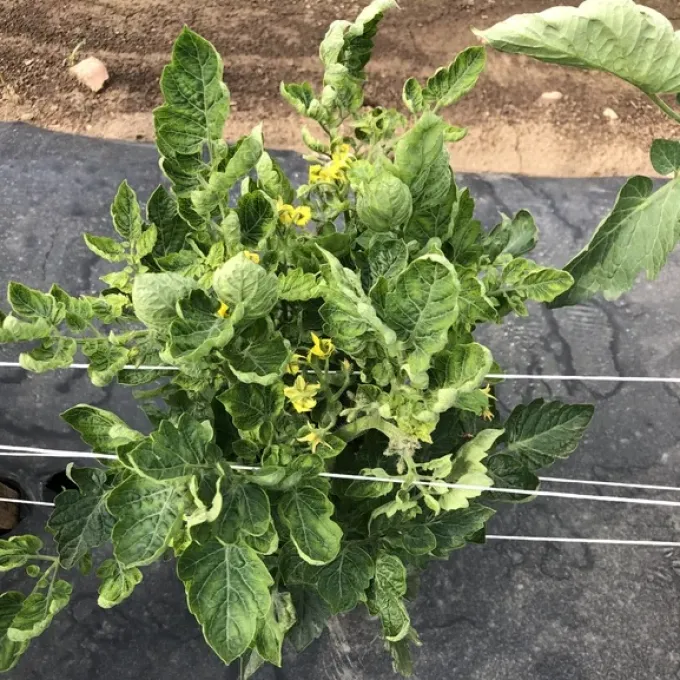
The primary symptom of infection is the characteristic upward curling or inward rolling of tomato leaves, often accompanied by severe deformation of leaf margins.
Infected plants exhibit pronounced chlorosis, which is especially noticeable on young foliage and within the interveinal leaf tissues throughout the canopy.
Significant growth retardation occurs; stems become brittle and internodes shorten, giving the plant a stunted, bushy, and compact appearance.
During the flowering stage, mass abscission of buds and flowers is observed, which effectively halts fruit set and leads to a dramatic yield reduction.
Late-season infections result in fruit that is small, deformed, poorly colored, and lacks the necessary quality for commercial marketability.
Pathogen
The causative agent is the Begomovirus solanumdelhisecundi, a member of the Geminiviridae family, characterized by a single-stranded circular DNA genome.
Virions of this pathogen possess a unique structure consisting of two fused icosahedral capsids, contributing to high stability and persistence in the environment.
The main vector for disease transmission in both natural and agricultural ecosystems is the tobacco whitefly (Bemisia tabaci), which acquires the virus through feeding.
Once ingested, the virus circulates within the hemolymph and salivary glands of the insect, maintaining infectivity throughout the lifespan of the whitefly.
Beyond tomatoes, this virus has a broad host range within the Solanaceae family, affecting peppers and eggplants, while utilizing various weeds as alternate reservoirs.
Conditions for development
The severity of outbreaks is directly correlated with whitefly population dynamics, which surge significantly during periods of hot and dry weather conditions.
Optimal ambient temperatures accelerate the whitefly life cycle, leading to rapid viral dissemination across tomato plantings in both greenhouses and open fields.
In protected cultivation, inadequate greenhouse hygiene and failure to control weeds surrounding the structures create an environment conducive to disease spread.
The introduction of contaminated planting material or seedlings grown in regions with high inoculum pressure remains a major risk for disease transmission.
Failure to implement standardized phytosanitary practices on adjacent lands facilitates the constant migration of viruliferous whiteflies into the crop.
Why it matters
The impact of this virus is severe, as it causes a critical reduction in plant productivity, leading to potential yield losses ranging from 30 to 100 percent.
Infection severely disrupts physiological processes such as photosynthesis and nutrient metabolism, preventing the plant from developing sufficient biomass.
Economic losses are compounded by the high costs associated with intensive insecticide programs aimed at suppressing the whitefly population below the threshold.
Accumulation of the pathogen in agricultural ecosystems makes it difficult to produce high-quality tomatoes, especially when cultivating susceptible hybrids.
The virus represents a significant threat to commercial vegetable production, forcing farmers to implement strict quarantine measures to protect their crops.
Protection
The primary management strategy involves an integrated pest management (IPM) approach centered on suppressing whitefly populations through targeted insecticide applications.
Regular monitoring of fields and greenhouses using yellow sticky traps is critical for the early detection of whitefly migration into the crop area.
Strict adherence to crop rotation and rigorous removal of crop residues and weed hosts are essential for disrupting the life cycle of the vector.
Agronomists strongly recommend utilizing resistant or tolerant tomato varieties capable of maintaining yield potential under pressure from this viral pathogen.
- Installation of insect-proof nets over greenhouse ventilation openings.
- Implementation of biological control agents, such as predatory insects and parasitoids.
- Immediate rogueing and disposal of symptomatic plants to minimize secondary spread within the field.
Discussion
No discussions yet — be the first.