
Tobacco leaf curl virus
Begomovirus nicotianapusaense
Description
Symptoms
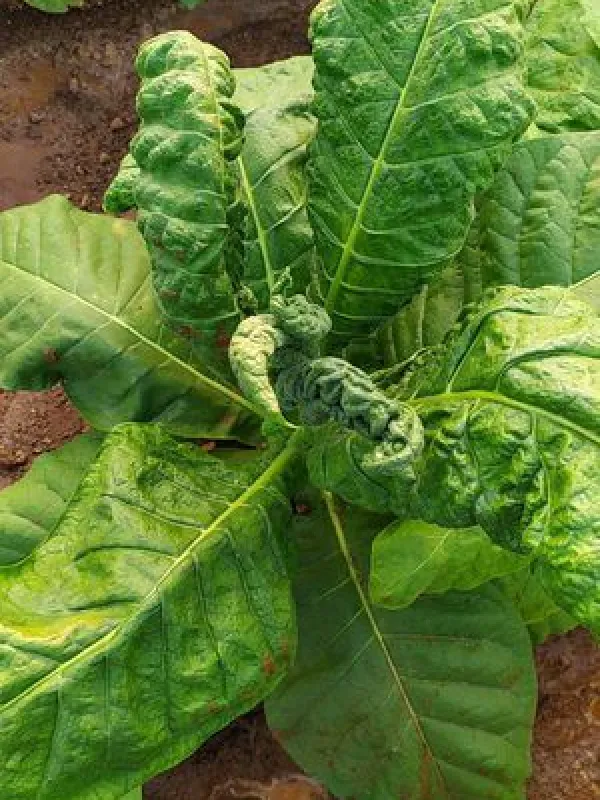
The primary symptom of this infection is the characteristic curling and severe deformation of the upper leaves. Plant tissues become leathery, stiff, and develop a yellowish or chlorotic tint, which significantly degrades the leaf quality.
In early stages, the growth of the central shoot is noticeably stunted, internodes shorten, and the plant takes on a dwarf, bushy appearance. The growing tip may cease developing entirely, forming a tight rosette of curled leaves.
Leaf blades often become wrinkled or puckered, with thickened and sometimes darkened veins. Depending on the specific strain, leaf margins may curl either upward or downward, creating a distinct twisted appearance.
Plants infected early in the season fail to reach their full potential, as their photosynthetic activity is drastically impaired. Flowering is often delayed, stunted, or completely suppressed in highly infected specimens.
Visual diagnosis can be challenging due to overlapping symptoms with other mosaic-type viruses, making laboratory-based confirmation essential for accurate management decisions in commercial production.
Pathogen
The causative agent is a virus belonging to the genus Begomovirus. It is characterized by a circular single-stranded DNA genome and requires specific environmental and biotic conditions to establish an infection.
The primary vector for this virus is the whitefly (Bemisia tabaci). The insect acquires the virus while feeding on the phloem of infected host plants and transmits it to healthy plants during subsequent feeding sessions.
Tobacco leaf curl virus is not transmitted through mechanical contact or seed, which means that management strategies must focus exclusively on breaking the cycle between the vector and the host crop.
Once introduced into the plant, the virus moves rapidly through the phloem, causing systemic infection and disrupting metabolic processes. The pathogen can persist in perennial weeds, which act as reservoirs.
The efficiency of viral transmission is highly dependent on the density of the whitefly population. Prolonged feeding periods increase the likelihood of successful transmission from the insect to the plant.
Conditions for development
The disease thrives in warm and dry environmental conditions, which are ideal for the rapid reproduction and migration of the whitefly vector. High temperatures accelerate the insect's life cycle.
Increased ambient temperatures lead to more frequent feeding cycles, which significantly enhances the rate at which the virus is spread throughout a tobacco field, potentially leading to an epidemic.
Weeds present in and around the fields act as essential overwintering reservoirs for the virus. These plants sustain the pathogen until new tobacco seedlings are planted in the spring.
Plant stress, particularly drought or nutrient deficiency, weakens the host's natural defenses, making plants more susceptible to whitefly colonization and the subsequent rapid progression of viral symptoms.
Poor crop management practices, such as continuous mono-cropping without proper rotation, lead to an accumulation of viral inoculum and persistent insect populations in the local ecosystem.
Why it matters
The economic impact of the virus is driven by a massive reduction in leaf biomass and a significant decline in the chemical quality of the tobacco, rendering it unsuitable for market requirements.
Systemic infection inhibits the plant’s photosynthetic capacity, leading to premature senescence and death of the plant, especially if the infection occurs shortly after transplanting.
Yield losses can be catastrophic, with some fields becoming entirely non-harvestable if the whitefly population remains uncontrolled during the early stages of crop development.
The degradation of flavor and aroma components makes the leaf commercially unattractive. This leads to a severe drop in the value of the harvested crop compared to healthy tobacco.
Additional costs are incurred due to intensive insecticide programs required to mitigate the whitefly pressure, which increases the total cost of production and lowers overall farm profitability.
Protection
The most effective management strategy involves comprehensive control of whitefly populations using systemic and contact insecticides registered for use on tobacco.
Farmers should maintain adequate spatial isolation between tobacco fields and vegetable crops that may serve as alternative hosts for the virus or the vector to reduce cross-contamination.
Strict weed management in field margins and surroundings is crucial, as removing these reservoirs limits the initial inoculum and reduces the population of breeding insects before they move to the crop.
- Implementing crop rotation with non-host species to break the viral cycle.
- Using fine-mesh exclusion screens in nurseries to prevent early-stage whitefly entry.
- Rogueing and destroying symptomatic plants early to reduce the source of infection in the field.
Utilizing yellow sticky traps for monitoring whitefly populations allows for timely identification of pest migration, enabling growers to apply protective treatments before the disease spreads.
Discussion
No discussions yet — be the first.