
Tobacco curly shoot virus
Begomovirus nicotianacubaense
Description
Symptoms
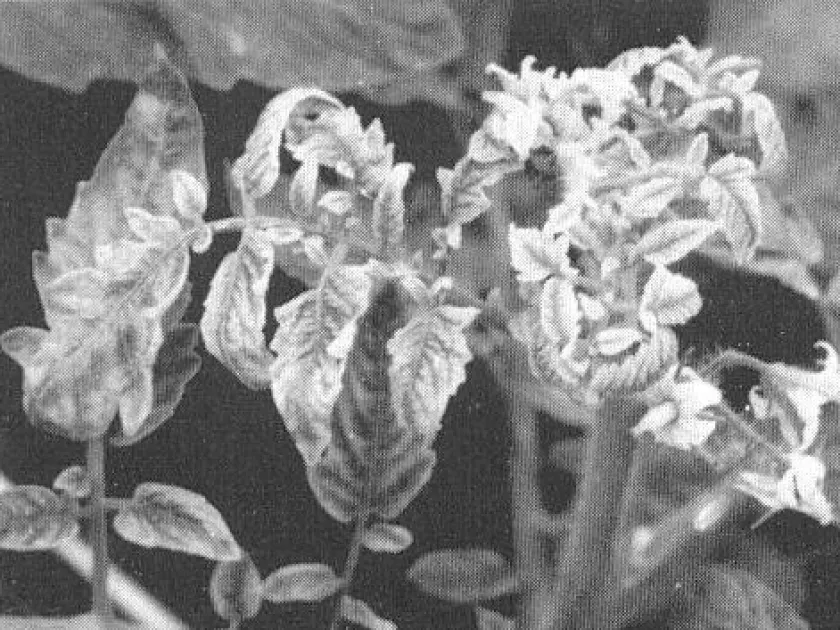
The most distinctive symptom is the curling and distortion of the leaves, particularly at the plant's apex. The leaf lamina becomes wrinkled, and the margins often curl inwards or outwards, resulting in a stunted and deformed appearance.
Infected plants exhibit significant growth retardation and dwarfing. The internodes are shortened, making the plants appear compact and weak compared to healthy individuals.
Chlorosis, often presenting as a mosaic pattern or vein clearing, is a common diagnostic feature. Over time, the chlorotic symptoms may intensify, leading to reduced photosynthetic efficiency and overall plant vitality.
Flowering is frequently delayed or suppressed in infected plants. If flowers develop, they are often abnormal in size or structure, which negatively impacts the final yield of the crop.
Disease symptoms usually appear in patches throughout the field, reflecting the localized movement patterns of the whitefly population. Severity depends heavily on the plant's stage at the time of infection.
Pathogen
The causal agent of this disease is the Tobacco curly shoot virus (TCSV), a member of the Begomovirus genus within the Geminiviridae family. It is a single-stranded circular DNA virus known for its significant genetic variability and adaptability.
The virus is transmitted in a semi-persistent manner by the tobacco whitefly, Bemisia tabaci. The virus is not mechanically transmissible via sap or seeds, making the control of its insect vector the primary strategy in disease management.
When the whitefly feeds on infected phloem, it acquires the viral particles. After a short latent period in the salivary glands, the insect becomes a carrier capable of infecting healthy host plants for the rest of its life cycle.
The virus biology is tightly linked to the life cycle of its vector, which is highly mobile and capable of spreading the virus across significant distances within agricultural fields.
Advanced molecular studies reveal that this begomovirus is prone to recombination, leading to the emergence of new strains that pose challenges for developing resistant plant varieties.
Conditions for development
The development of outbreaks is facilitated by high temperatures and moderate humidity, which provide optimal conditions for the rapid multiplication and activity of Bemisia tabaci.
Planting dates play a crucial role in disease incidence. Crops planted during the peak migration periods of the whitefly population are at a significantly higher risk of primary infection.
The presence of alternative weed hosts, particularly from the Solanaceae family, allows the virus to survive during the off-season. Whiteflies migrate from these wild reservoirs to commercial crops.
Excessive nitrogen fertilization can promote lush vegetative growth, which attracts whiteflies and creates favorable conditions for vector feeding and subsequent viral transmission.
Lack of proper crop rotation and the absence of spatial separation between subsequent plantings contribute to the accumulation of viral inoculum and persistent infection cycles in the agricultural environment.
Why it matters
The virus causes severe economic losses by reducing both the quality and quantity of the harvest. Yield reductions of 50% or more can occur under high disease pressure.
Marketability of the produce is drastically reduced due to the visible curling and chlorosis, making the leaves unsuitable for standard commercial processing and consumption.
Economic damage extends beyond yield loss to include the high costs of frequent insecticide applications required to suppress the whitefly vector populations.
Infected plants are physiologically stressed, making them more susceptible to opportunistic secondary infections, such as fungal or bacterial pathogens, which further complicate crop recovery.
Long-term presence of the virus in a region can force growers to abandon the cultivation of susceptible species, leading to agricultural instability and decreased profitability.
Protection
The primary control strategy is the integrated management of the whitefly vector. The use of systemic insecticides at early growth stages is essential to prevent primary viral inoculation.
Agronomic practices focus on the strict removal of host weeds both within the field and in surrounding borders, as these act as critical reservoirs for both the virus and the insect vector.
Ensuring the use of virus-free nursery stock is vital. Seedlings should be raised in screened greenhouses or under protective mesh to prevent early-stage whitefly colonization.
Maintaining spatial isolation between different fields and planting times helps to mitigate the spread of the virus by reducing the distance whiteflies must travel to reach new hosts.
- Selection of resistant or tolerant crop varieties.
- Monitoring whitefly populations using yellow sticky traps.
- Rogueing and immediate removal of symptomatic plants to reduce the local inoculum source.
- Optimizing planting schedules to avoid peak insect vector activity seasons.
Discussion
No discussions yet — be the first.