
Papaya leaf curl virus
Begomovirus caricachinaense
Description
Symptoms
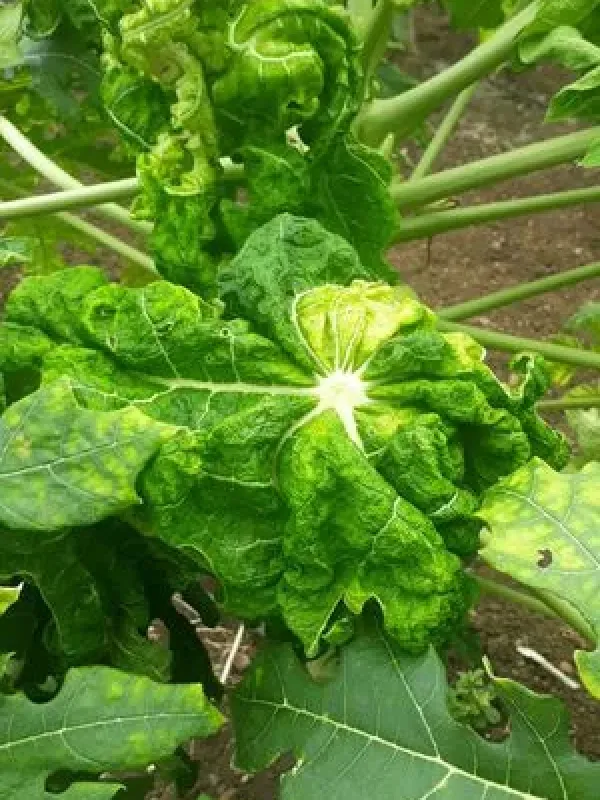
The most distinctive symptom is the downward or upward curling of the apical leaves. The leaves appear stunted, crinkled, and exhibit a leathery texture that is very easy to identify during routine field inspections.
The veins on the leaves often become thickened and distorted. Because of the uneven growth of the leaf lamina, the foliage takes on a wavy or ruffled appearance that limits its photosynthetic surface area.
The internodes of the plant become significantly shortened, resulting in a bushy or rosette-like growth habit. The entire plant looks stunted, and the upward growth of the central stem is eventually halted.
Reproductive symptoms include the dropping of flowers and failure to set fruit. If fruit does develop, it is typically misshapen, small, and lacks the proper physical characteristics required for commercial sale.
In advanced stages of infection, the terminal bud may die, leading to the cessation of apical dominance. This renders the plant unable to continue its normal life cycle and contributes to a total loss of productivity.
Pathogen
The causative agent of the disease is the Papaya leaf curl virus (PaLCuV), which belongs to the genus Begomovirus within the Geminiviridae family. It is a DNA virus known for its ability to cause severe systemic infections in tropical crops.
The virus is transmitted by the silverleaf whitefly, Bemisia tabaci. The insect acquires the virus while feeding on infected plant tissues and remains a carrier throughout its lifespan, effectively spreading the pathogen within the crop.
PaLCuV has a circular single-stranded DNA genome protected by twin-shaped (geminate) capsids. This structural characteristic contributes to its environmental stability and successful transmission by the vector.
As a systemic disease, the virus travels through the phloem to various parts of the plant. This interferes with the plant’s internal signaling and hormone production, leading to the characteristic abnormal growth patterns.
The biological complexity of the virus lies in its rapid evolutionary potential. Variations in the viral genome can emerge, potentially affecting the host range and the severity of the symptoms observed in different papaya varieties.
Conditions for development
The development of the disease is heavily dependent on the population density of the Bemisia tabaci whitefly. Warm, dry weather conditions are highly conducive to the rapid proliferation of this insect vector.
Poor sanitation within and around the papaya orchard serves as a reservoir for both the virus and the whitefly. Weeds that act as alternative hosts provide a bridge for the virus to survive between planting cycles.
Nutritional management plays a role; excessive nitrogen application encourages succulent growth that is highly attractive to whiteflies, thereby increasing the rate of viral inoculation through intensive feeding.
The movement of infected seedlings is a primary cause of outbreaks in new plantations. If nursery stocks are not screened for viral presence, the virus is introduced to the field immediately upon transplanting.
Orchard density also impacts the spread of the pathogen. High-density planting without adequate ventilation and pest management allows the whitefly to jump easily between plants, accelerating the epidemic across the plantation.
Why it matters
Papaya leaf curl virus is considered a major economic threat to papaya production worldwide. The disease results in significant yield losses, often forcing farmers to abandon heavily infected plots entirely.
Because the infection is systemic, the plant’s photosynthetic capacity is permanently compromised. Without healthy foliage, the plant cannot synthesize enough carbohydrates to support fruit development or maintain its vigor.
The fruit produced by infected trees is almost always of inferior quality. Deformities and small fruit size make the product unmarketable, causing direct financial losses for the grower.
There is currently no cure for plants once they have been infected by the virus. The primary response involves the removal and destruction of diseased plants, which reduces the total number of productive trees in the orchard.
A high infection rate creates a difficult management environment, as the constant threat of reinfection requires vigilant monitoring and costly control strategies to protect the remaining healthy crops.
Protection
Effective management begins with controlling the whitefly population. Integrated Pest Management (IPM) techniques, including the use of systemic insecticides, are necessary to break the transmission cycle.
Prevention in nurseries is crucial. Using protected structures like insect-proof nets (greenhouses) prevents whiteflies from reaching seedlings before they are transferred to the main field.
Regular field sanitation is vital. Removing host weeds and rogueing (destroying) infected plants immediately upon the appearance of symptoms prevents the virus from spreading to neighboring healthy trees.
- Monitoring whitefly populations using yellow sticky traps.
- Rotating insecticide modes of action to prevent the development of pesticide resistance.
- Ensuring proper spatial isolation from old or abandoned papaya fields.
- Training workers to recognize symptoms early to facilitate quick rogueing.
Adopting resistant or tolerant cultivars is the most sustainable long-term solution. Research into virus-resistant genetics remains a priority for scientific institutions working to improve papaya production resilience.
Discussion
No discussions yet — be the first.