
Okra yellow vein mosaic
Begomovirus abelsmoschusretorridi
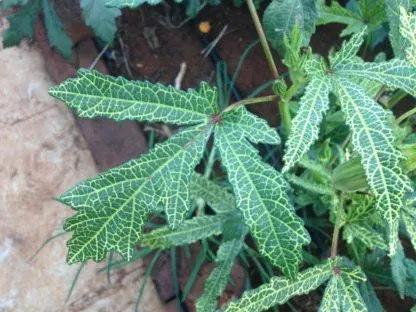
Description
Symptoms
The primary symptom of the disease is a distinct chlorotic pattern appearing on the leaves. Initially, small yellow spots form, which eventually coalesce, covering the entire leaf blade in a characteristic mosaic or vein-clearing pattern.
Affected leaves often exhibit significant deformation, becoming wrinkled or curled, which severely impairs the plant's photosynthetic capacity and physiological growth.
Infected okra plants display stunted growth and a reduced number of internodes, resulting in a dwarf and shrubby appearance that is highly atypical for healthy specimens.
Flower buds often abscise before they are able to open, which leads to a dramatic decline in the plant's overall reproductive success and fruit setting potential.
Any fruits that do manage to develop on infected plants are generally small, deformed, and tough in texture, rendering them unsuitable for commercial sale.
Pathogen
The causative agent of the disease is the Okra yellow vein mosaic virus (OYVMV), a member of the Begomovirus genus within the Geminiviridae family.
It is a monopartite or bipartite single-stranded DNA virus that is highly specialized in infecting plants of the Malvaceae family, specifically okra (Abelmoschus esculentus).
The virus does not spread through mechanical contact or contaminated seeds, making its transmission dependent entirely on specific insect vectors.
The primary vector responsible for the transmission of the virus is the whitefly (Bemisia tabaci), which picks up the virus during feeding on infected plant sap.
Once acquired, the virus persists in the whitefly vector for the duration of its lifespan, allowing it to transmit the pathogen to multiple healthy plants during its feeding cycles.
Conditions for development
The severity of an outbreak is directly proportional to the population density of the whitefly vector in the cropping area.
Warm temperatures combined with moderate humidity levels create the most favorable environment for the rapid multiplication of whiteflies, facilitating the spread of the virus.
The presence of alternative host plants, particularly weeds in the surrounding areas, provides a reservoir for the virus during the off-season, allowing for early infection of newly planted okra.
Prolonged dry spells force whiteflies to migrate from wild hosts to irrigated crop fields, leading to concentrated feeding and increased transmission of the pathogen.
Poor agricultural practices, such as lack of weed control or the overuse of nitrogenous fertilizers, make plants more susceptible and attractive to the insect vectors.
Why it matters
Okra yellow vein mosaic is widely considered the most destructive disease affecting okra production, especially in tropical and subtropical agriculture.
The virus interferes with the plant's metabolic pathways, causing a massive reduction in biomass and preventing the production of high-quality fruits.
Financial losses for farmers are significant due to the total failure of the harvest on severely infected plots and the ongoing costs associated with pest management.
Infected plants exhibit reduced resistance to secondary stressors, such as water deficit or opportunistic fungal infections, further damaging the crop yield.
The disease can cause complete failure of commercial fields, often necessitating a shift in land use if effective control measures are not implemented promptly.
Protection
Effective management of the disease relies primarily on integrated pest management (IPM) strategies to suppress whitefly populations using systemic insecticides.
Proactive measures, including the removal of potential reservoir weeds and the use of physical barriers, are essential to reduce the initial infection pressure.
- Utilizing resistant or tolerant okra cultivars and hybrid varieties.
- Deployment of yellow sticky traps to monitor and reduce adult whitefly populations.
- Regular field scouting to identify and immediately rogue out infected plants.
- Implementation of crop rotation cycles with non-host plant species.
- Maintenance of a clean field environment to minimize potential virus host sites.
A multi-faceted approach involving vector control, the use of resistant materials, and strict sanitation is critical to minimizing the impact of yellow vein mosaic.
Discussion
No discussions yet — be the first.