
Onion yellow dwarf virus
Anulavirus almmv
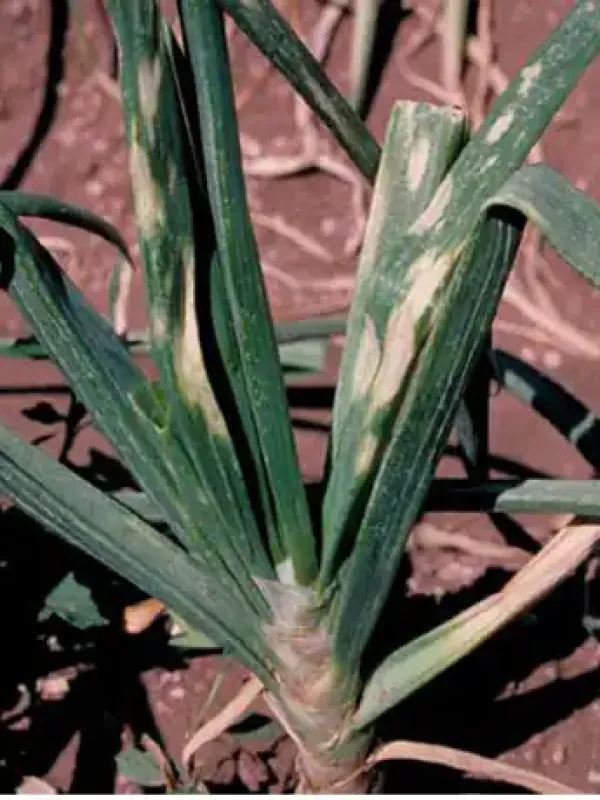
Description
Symptoms
The initial symptoms of OYDV infection appear as yellow, chlorotic streaks or stripes on the base of young leaves, often following the longitudinal veins.
As the disease progresses, leaves become severely twisted, crinkled, and flattened, losing their normal upright architecture and often sagging to the ground.
Infected plants typically display pronounced stunting, failing to reach their full potential size and exhibiting an overall unthrifty and yellowed appearance.
Seed stalks of infected plants are often curled, distorted, and shorter than healthy ones, which leads to poor seed set and reduced seed viability.
- Yellow striping and mosaic patterns on foliage.
- Leaf curling, twisting, and flattening.
- Significant stunting and reduced plant height.
- Deformed bulbs with lower marketable quality.
Pathogen
Onion yellow dwarf virus (OYDV) is a widespread and economically damaging viral pathogen that specifically affects Allium species, including onions, garlic, and shallots.
Taxonomically, it is classified within the genus Potyvirus, family Potyviridae, characterized by flexuous, filamentous particles containing single-stranded RNA.
The virus infects the plant systemically, colonizing vascular tissues and spreading throughout the entire plant, which disrupts vital physiological and metabolic processes.
It is known for its high persistence, surviving in infected bulbs and sets, which serve as the primary source of primary inoculum in commercial fields.
In addition to biological transmission, the virus is easily spread mechanically via farm equipment, tools, and human handling during cultivation and harvesting.
Conditions for development
The rapid spread of OYDV is heavily dependent on the presence of insect vectors, primarily aphids, which efficiently transmit the virus in a non-persistent manner.
Aphids acquire the virus after a brief feeding period on infected plants and can transmit it to healthy hosts within seconds or minutes of landing.
Warm, dry weather conditions tend to favor aphid migration and proliferation, leading to localized outbreaks and rapid disease spread across the field.
High-density planting increases the frequency of plant-to-plant contact, facilitating the rapid movement of the virus through the crop canopy.
Nearby perennial Allium species or volunteer onions from previous seasons act as essential reservoirs, bridging the gap between growing seasons.
Why it matters
The primary impact of OYDV is a substantial reduction in bulb yield, with losses frequently ranging from 30% to over 50% in heavily infected plantings.
Infected bulbs are often small, misshapen, and commercially unattractive, leading to severe financial losses for growers in both fresh and processing markets.
The virus compromises the plant's overall health, making the bulbs more susceptible to storage rots and secondary bacterial infections during post-harvest handling.
For seed production, the virus causes extreme damage by inducing pollen sterility and reducing the overall quality and germination rate of the resulting seeds.
Since the virus remains within the bulb tissue, it creates a cycle of infection that persists year after year if appropriate sanitary measures are not taken.
Protection
The most effective management strategy is the use of virus-free, certified seeds and bulbs, which prevents the introduction of the pathogen at the start of the season.
Implementing a rigorous roguing program to remove and destroy symptomatic plants early in the growing season is critical to slowing the spread within the field.
Effective aphid control using insecticides can reduce the number of vectors, although it may not fully prevent transmission due to the non-persistent nature of the virus.
Maintaining strict spatial isolation between new onion plantings and overwintering perennial onion sources is essential to prevent secondary spread.
Weed management and thorough removal of crop residues are vital to eliminate potential alternate hosts and prevent the carry-over of the virus through time.
Discussion
No discussions yet — be the first.