
Sida yellow mosaic
Sida yellow vein Madurai virus
Description
Symptoms
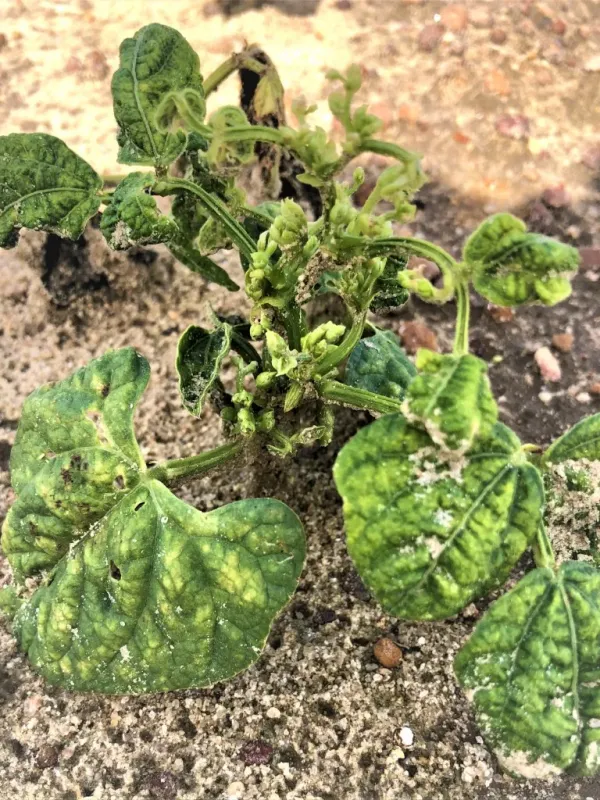
The characteristic symptoms of Sida yellow mosaic include bright yellowing of the leaf tissue, forming a distinct mosaic or mottling pattern. In severe cases, the entire leaf surface may become chlorotic.
Infected plants typically exhibit significant leaf distortion, crinkling, and a reduction in leaf size. Stunting is a common manifestation, with shortened internodes leading to a bushy or dwarfed appearance of the plant.
Flowering and fruit set are heavily impacted by the infection. Plants often exhibit flower abortion and fail to produce viable seeds, leading to a substantial decline in overall crop yields.
The presence of Bemisia tabaci populations on the underside of leaves is a hallmark indicator of the potential for viral transmission in the field environment.
The severity of symptom expression often correlates with the age of the plant at the time of infection; earlier infections generally lead to more devastating structural deformities and physiological decline.
Pathogen
The causal agent of this disease is the Sida yellow mosaic virus (SYMV), a member of the Begomovirus genus within the Geminiviridae family. The virus is characterized by a single-stranded circular DNA genome.
The virus is transmitted by the whitefly Bemisia tabaci in a persistent circulative manner. Once the whitefly acquires the virus through feeding on an infected plant, it remains a vector for the remainder of its lifespan, facilitating the spread of the disease.
The host range is primarily restricted to the Malvaceae family, including the weed Sida acuta, which often acts as a major reservoir for the virus throughout the year in tropical and subtropical climates.
The molecular biology of SYMV involves the use of satellite DNA molecules that enhance its virulence, allowing the virus to successfully infect and thrive within its host plant's tissues.
Epidemiologically, the virus relies on the migration patterns of its whitefly vector. The synergy between the virus and the vector is the primary driver of disease outbreaks in agricultural fields.
Conditions for development
The development and spread of Sida yellow mosaic are highly dependent on the ecology of the whitefly vector. Warm temperatures (25–30°C) and moderate humidity are ideal for rapid whitefly population growth.
The availability of reservoir hosts, specifically wild Malvaceae weeds, provides a continuous source of inoculum that ensures the virus persists in the ecosystem even during the off-season.
The timing of planting relative to the seasonal population peaks of whiteflies is a critical factor. Early-season crops are often at higher risk if whitefly populations migrate from neighboring weed patches.
Changes in local agricultural practices, such as the introduction of irrigation or specific fertilizers, can indirectly influence the microclimate, making it more favorable for vector colonization.
The lack of effective landscape-level weed management significantly exacerbates the pressure of the virus, creating a cycle of constant reinfection for susceptible crops.
Why it matters
Sida yellow mosaic causes severe economic damage by severely hindering plant growth and physiological function. Photosynthetic efficiency is reduced, directly affecting the plant's metabolic capacity.
The resulting crop loss can range from partial reductions in output to complete failure of the harvest, depending on the stage of infection and the susceptibility of the chosen variety.
Viral infections weaken the host plant, leaving it vulnerable to secondary infections from fungi, bacteria, and other pests, which complicates field management and necessitates increased input usage.
The disease limits the expansion of Malvaceae-based agriculture in endemic areas, forcing farmers to either switch crops or invest heavily in protective measures to sustain productivity.
Seed quality is also degraded in infected crops, creating risks for farmers who save their own seeds, as the virus can potentially compromise the germination and vigor of future seasons' crops.
Protection
Effective control requires a multi-faceted approach centered on the management of the whitefly population. Systematic use of insecticides is necessary to suppress vector numbers during peak infestation periods.
Sanitation is a vital component of control; the elimination of weed hosts like Sida acuta in the vicinity of crop fields significantly reduces the local reservoir of the virus.
Spatial isolation between fields with different planting dates can help mitigate the risks of virus spread from older, infected crops to younger, more vulnerable plants.
Breeding and deployment of resistant or tolerant cultivars remain the most sustainable strategy for long-term management of the disease, reducing the reliance on chemical interventions.
Cultural methods, such as using reflective mulches to deter whiteflies from landing on host plants, can act as a useful preventative measure to decrease initial transmission rates in early stages of crop development.
Discussion
No discussions yet — be the first.