
Rice yellow mottle
Rice yellow dwarf phytoplasma
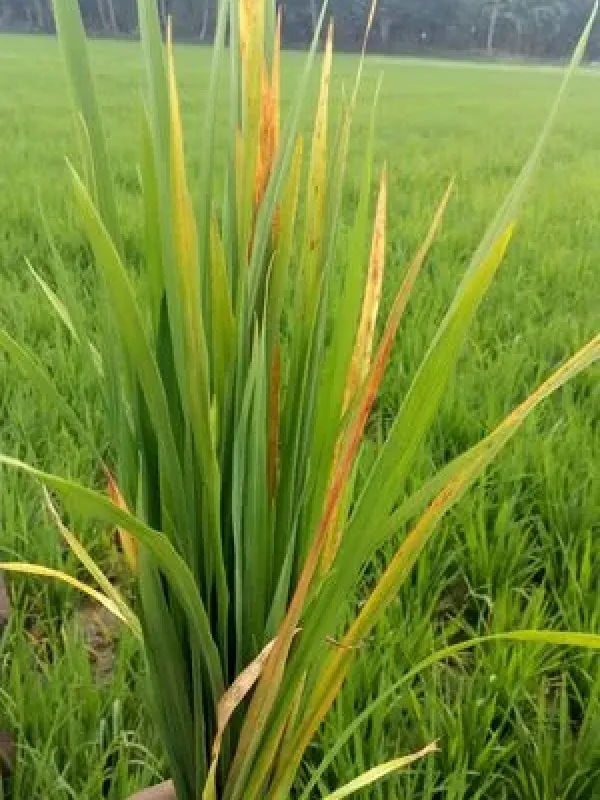
Description
Symptoms
The primary symptom of the disease is the yellowing of leaves, which typically begins at the leaf tips and gradually spreads down the blade.
Infected plants exhibit noticeable stunting, appearing significantly smaller and less developed compared to healthy plants in the surrounding field.
Tillering is severely suppressed in infected plants, leading to a reduced number of stems and, consequently, a decrease in the overall crop density.
There is a marked delay in developmental phases, with heading and grain maturation occurring much later than expected or failing to occur entirely.
Panicles in severely affected plants remain malformed or partially enclosed within the leaf sheaths, resulting in empty or shriveled grains.
Pathogen
The causative agent of the disease is the Rice yellow mottle virus (RYMV), which belongs to the genus Sobemovirus.
The virions are icosahedral in shape, with a diameter of approximately 25–30 nanometers, containing a single-stranded RNA genome.
The virus is highly contagious and spreads easily through mechanical contact, such as farm machinery or physical contact between adjacent rice plants.
In nature, the primary vectors are various insect species, particularly leaf-feeding beetles (family Chrysomelidae) like Sesselia pusilla.
The virus possesses high biological stability, allowing it to persist in infected plant debris and wild grass species during the off-season.
Conditions for development
Warm and humid environmental conditions significantly promote disease development, as they are ideal for the rapid reproduction of insect vectors.
Dense rice planting creates a favorable microclimate that facilitates the rapid horizontal spread of the virus from infected to healthy plants.
The presence of weeds along field borders and irrigation canals serves as a natural reservoir for the virus and its insect vectors throughout the year.
Intensive nitrogen fertilizer application often encourages vigorous vegetative growth, which can make crops more attractive to pest infestation.
Failure to adhere to recommended planting windows and the use of infected seed stock are critical factors triggering local outbreaks.
Why it matters
Rice yellow mottle is recognized as one of the most destructive viral infections, capable of causing up to 100% yield loss in specific fields.
Infection leads to a drastic reduction in the 1000-grain weight, rendering the harvest practically useless for commercial market demands.
Affected fields lose their agricultural productivity, and contaminated rice cannot be safely used as seed stock for future planting seasons.
Economic losses are compounded by the high costs of implementing emergency phytosanitary measures to contain the infection spread.
Widespread mortality often forces farmers to abandon or replant affected areas, causing substantial financial strain and operational disruption.
Protection
The primary preventative strategy involves the cultivation of resistant or tolerant rice varieties developed through targeted plant breeding.
Strict adherence to phytosanitary protocols is essential, including the complete removal of crop residues and the elimination of weed hosts.
Quarantine measures and restrictions on the movement of machinery between infected and healthy zones are vital to curbing viral outbreaks.
The timely application of insecticides to manage vector populations is an effective approach to containing primary infection centers.
- Implementation of crop rotation to break the virus cycle.
- Regular field monitoring during early seedling growth stages.
- Disinfection of farming tools after use in potentially contaminated areas.
Discussion
No discussions yet — be the first.