
Clubroot
Plasmodiophoraceae
The causative agent of clubroot is Plasmodiophora brassicae, an obligate parasite classified as a soil-borne protist. This organism is highly persistent and can survive in the soil for many years as resting spores.
What the section contains
Clubroot
The life cycle begins with the release of zoospores, which travel in soil water towards the root hairs of susceptible plants. Upon infection, the pathogen forms a plasmodium that feeds on the host's cellular content.
As the infection progresses, the parasite induces abnormal cell division and enlargement, known as hypertrophy and hyperplasia, which leads to the formation of characteristic root galls.
Within these gall structures, billions of new resting spores are produced. As the galls decompose, these spores are released back into the soil, replenishing the reservoir of inoculum for future seasons.
It is crucial to recognize that Plasmodiophora brassicae is not a true fungus, which explains why many traditional fungicides are ineffective against this specific pathogen.
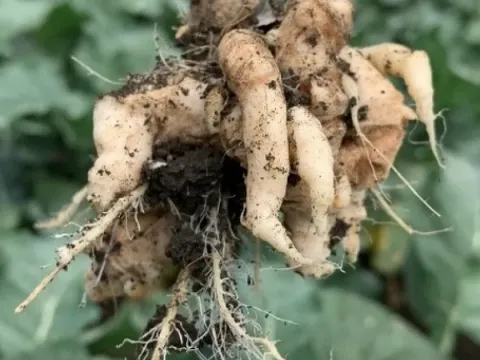
The most distinctive symptom of clubroot is the presence of large, irregular swellings or galls on the root system. These can vary from tiny spindle-shaped growths to massive, woody deformations.
Above-ground, affected plants often appear stunted and weak. During warm or dry periods, foliage may wilt even when moisture levels seem adequate, as the damaged roots fail to absorb water effectively.
As the root system is consumed by the galls, nutrient uptake is severely restricted. This leads to reduced plant vigor, poor head development in brassicas, and overall crop failure.
In wet soil conditions, the root galls are susceptible to decay by secondary organisms such as bacteria and fungi, causing the roots to become mushy and foul-smelling.
Upon examination of the root ball, one can see the severe distortion and loss of normal fibrous root structure, which is a hallmark of this disease in all susceptible cruciferous species.
Clubroot development is heavily favored by high soil moisture. Waterlogged conditions or heavy rainfall provide the necessary environment for zoospores to move and infect roots efficiently.
The optimal temperature range for the pathogen's activity is between 15°C and 25°C. These conditions often coincide with the active growing season of many vegetable crops.
Soil pH plays a decisive role in disease expression. Plasmodiophora brassicae thrives in acidic soils with a pH below 6.0, whereas neutral or slightly alkaline soils significantly suppress its development.
The spread of the pathogen is often facilitated by human activities, including the movement of contaminated soil on tractor tires, footwear, and the use of infected nursery transplants.
Continuous cropping of brassicas on the same site allows for a rapid buildup of resting spores in the soil, often leading to severe infestations within just a few growing seasons.
Clubroot is one of the most destructive diseases affecting brassica crops globally, including cabbage, broccoli, cauliflower, and oilseed rape. It causes substantial economic losses for farmers.
Under heavy infection pressure, crop yields can be reduced by 50% to 100%. Once a field is heavily infested, it may become unsuitable for growing cruciferous crops for a decade or more.
The disease negatively impacts the marketability of the produce. Stunted growth results in smaller, lower-quality yields that do not meet standard commercial requirements.
The presence of the pathogen imposes long-term limitations on land use and forces farmers to implement costly sanitation practices or abandon infected fields entirely.
The economic impact extends beyond direct yield loss, as it requires significant investment in long-term soil management, lime applications, and the development of resistant varieties.
The primary management strategy for clubroot is soil liming. Maintaining soil pH at 7.0 or higher creates an unfavorable environment for spore germination and root infection.
Implementing a strict crop rotation plan is essential. Farmers should avoid planting cruciferous crops in the same field for at least 5 to 7 years to allow spore populations to decline.
Starting with pathogen-free seedlings is the most effective way to prevent the introduction of the disease into new fields. Nurseries should use sterilized soil or peat-based media.
Strict hygiene protocols are necessary, such as washing farm equipment thoroughly when moving between fields to prevent the transfer of contaminated soil.
- Selection of clubroot-resistant cultivars and hybrids.
- Ensuring proper soil drainage to avoid water stagnation.
- Prompt removal and disposal of infected plant debris by burning or deep burial.
- Use of specific soil-applied fungicides or bio-pesticides as recommended by agricultural experts.