
Clubroot
Plasmodiophora
Description
Symptoms
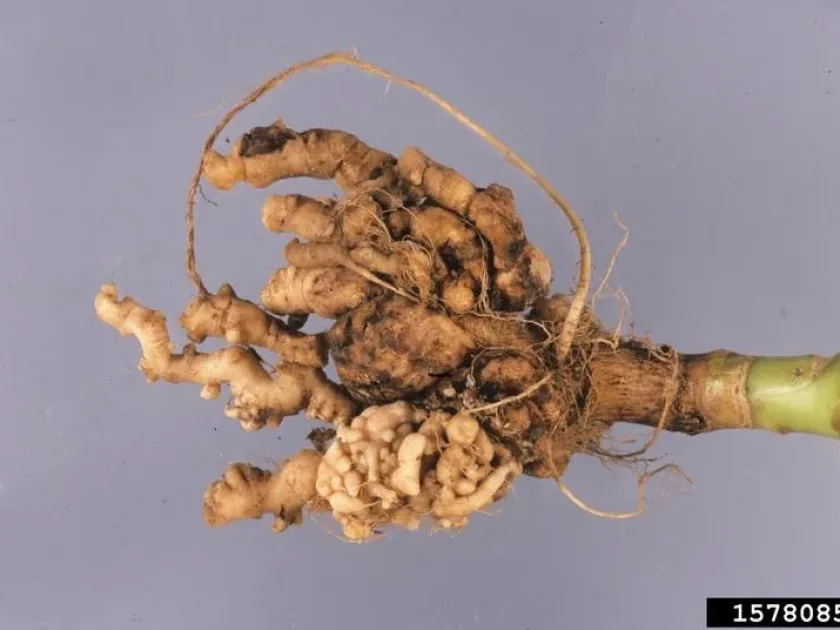
The most visible symptom is the formation of swollen, club-like galls on the primary and secondary roots. These galls disrupt the plant's ability to transport water and nutrients.
In the early stages of infection, plants may appear stunted and exhibit temporary wilting during the hottest parts of the day, even if the soil moisture is sufficient.
As the galls enlarge, the root system loses its fine feeder roots. Eventually, the galls break down, and the tissue rots due to secondary opportunistic bacteria and fungi.
Leaves of infected plants often show a characteristic yellowing or chlorosis, starting from the lower leaves and progressing upwards, which is a symptom of severe root damage.
Severely infected plants will eventually fail to form heads or mature bulbs. They are easily pulled from the ground because their root systems are virtually non-existent.
Pathogen
The disease is caused by Plasmodiophora brassicae, an obligate biotrophic protist. It exclusively infects members of the Brassicaceae family, including cabbage, broccoli, canola, and radishes.
The infection process begins when resting spores, known as cystospores, release zoospores into the soil. These zoospores enter the plant through root hairs, initiating the life cycle of the pathogen.
Inside the plant, the pathogen induces a hormonal imbalance that triggers abnormal cell division and enlargement, resulting in the characteristic galls or "clubs" on the root system.
Resting spores can persist in the soil for over a decade. They are extremely resilient and can withstand various environmental stresses, making eradication nearly impossible once the soil is contaminated.
The pathogen thrives by exploiting the root exudates of its host plants, which act as a chemical signal to trigger spore germination and root colonization.
Conditions for development
Clubroot development is highly dependent on environmental factors. The pathogen prefers acidic soil conditions, typically with a pH below 6.5, and high soil moisture levels.
Warm soil temperatures, generally between 18°C and 25°C, are ideal for the rapid growth and spread of the zoospores within the root zone.
Poorly drained fields are high-risk areas because the presence of standing water provides the necessary medium for zoospores to swim and locate new host roots.
Continuous cropping of Brassica species on the same field without adequate breaks promotes the build-up of resting spores in the soil to high population densities.
The spread of the disease across clean fields often occurs through the movement of contaminated soil attached to farm machinery, footwear, or infected seedling trays.
Why it matters
Clubroot is one of the most destructive diseases for Brassica growers globally, causing significant yield losses that can range from minor stunting to total crop failure.
The financial impact is twofold: immediate loss of harvest volume and the long-term degradation of the land, which remains unsuitable for Brassica production for many years.
Even if plants reach maturity, the quality of the harvested produce is often inferior, with small, unmarketable heads or deformed, woody roots that are unsuitable for retail.
The presence of clubroot restricts the choice of crops in a rotation, forcing farmers to avoid profitable Brassica varieties for extended periods to suppress the disease.
Because the resting spores move easily with water and equipment, a single infected patch can rapidly compromise an entire farm, leading to widespread infestation.
Protection
The most effective strategy for managing clubroot is to raise soil pH to 7.2 or higher using lime. An alkaline environment significantly inhibits spore germination and disease progress.
Implementing long-term crop rotation is essential. Rotating out of Brassicas for at least 5 to 7 years helps deplete the spore population in the soil significantly.
Good sanitation practices are vital. This includes cleaning all equipment before moving between fields and ensuring that transplants are sourced from disease-free nurseries.
Utilizing resistant cultivars can provide a buffer against the disease, though growers should be aware that different strains of the pathogen exist.
- Rogue and destroy all infected plants, including the entire root system and surrounding soil.
- Improve soil drainage to prevent the formation of pools of standing water.
- Manage cruciferous weeds like shepherd's purse and wild mustard, as they host the pathogen.
- Consider using biological amendments like specific bacteria that compete with the pathogen in the rhizosphere.
Discussion
No discussions yet — be the first.