
Puffballs
Lycoperdales
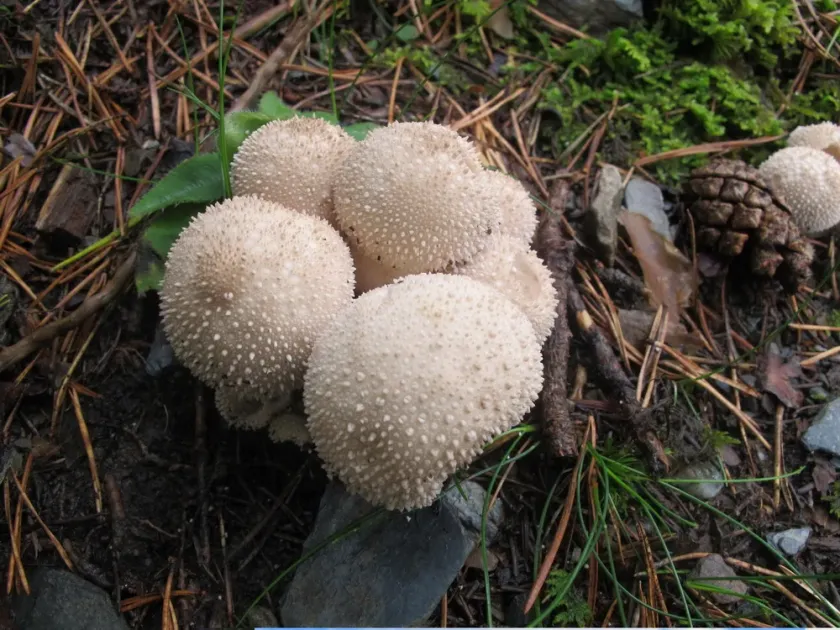
Description
Symptoms
Puffballs (Lycoperdales) are not a plant disease but an order of basidiomycete fungi commonly found on soil, decaying wood, or in grass.
Externally, they appear as spherical, pear-shaped, or club-shaped fruiting bodies, which have a white, firm, and elastic internal layer at early stages.
Upon maturation, the inner part of the fungus turns into a powdery mass of dark-colored spores, and the outer shell ruptures, releasing "dust" when pressed.
Their presence on a site is often mistakenly identified as a pathogenic infestation due to the appearance of specific spots or turf disruption in areas of active growth.
It is important to distinguish between true pathogens and puffballs, which do not form mycelia that parasitize the living tissues of agricultural crops.
Pathogen
The causative agent here is not a disease but the biological organism of a saprotrophic fungus that feeds on organic debris in the soil.
Lycoperdales do not have the ability to penetrate the vascular system of plants or destroy the healthy cell walls of cultivated crops.
These fungi are important decomposers that process dead organic matter, turning it into humus available for plant nutrition.
Their mycelium actively spreads in the upper layers of soil rich in humus or wood mulch without coming into conflict with root systems.
Unlike phytopathogens, puffballs do not produce toxins that inhibit the growth of vegetable or grain crops and are not transmitted through seed material.
Conditions for development
Intensive development of puffballs is observed during periods of high soil moisture and moderate temperatures, typical for late summer and early autumn.
The most favorable environment for their growth is loose soil with a high content of undecomposed plant residues, sawdust, or tree bark.
They often appear in areas where large amounts of fresh manure or compost that has not undergone full fermentation have been applied.
Lighting does not play a critical role, although they prefer shaded or moderately lit areas with sufficient surface aeration.
Fungi of this order are indicators of a healthy biological soil balance, indicating the presence of sufficient humus and moisture.
Why it matters
Puffballs do not cause direct harm to the harvest, as they are saprophytes, not obligate or facultative plant parasites.
The only inconvenience may be an aesthetic change in the appearance of garden beds or lawns, as well as the risk of allergic reactions during mass spore release.
In rare cases, excessive growth of the mycelium can cause a temporary local nitrogen deficiency in the soil due to active consumption by microorganisms.
They do not cause root rots, wilts, or spots that vegetable crops suffer from in agroecosystems when affected by true pathogens.
Thus, for a farmer, the puffball is more of an ally in restoring soil fertility than an object requiring chemical control.
Protection
Specific protective measures are not required, as these organisms are not pests or pathogens of agricultural plants.
If the presence of fungi is undesirable, it is sufficient to aerate the soil to reduce excessive moisture and substrate density.
It is recommended to timely remove decaying wood, old stumps, and excess organic mulch from areas where fungi are not wanted.
Balanced application of mineral fertilizers and proper crop rotation naturally regulate the microbiological composition of the soil.
- Regular weeding and loosening of soil.
- Control of soil moisture levels.
- Removal of excess plant debris.
Discussion
No discussions yet — be the first.