
Puffball mushrooms (saprotrophs)
Lycoperdaceae
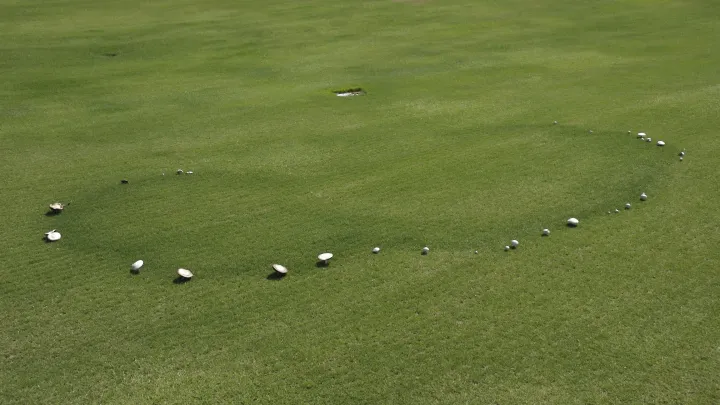
Description
Symptoms
The primary visual sign of puffball presence is the emergence of round or pear-shaped fruiting bodies on the soil surface or decaying plant debris.
In early stages, the mycelium appears as a white or yellowish thread-like network within the topsoil, which can be mistakenly identified as a harmful fungal pathogen.
Mature fruiting bodies develop a thick outer layer that eventually ruptures, releasing a large volume of spores often described as a dust-like cloud.
These fungi tend to concentrate in areas where manure or compost has been applied, making their appearance a marker of high organic content in the soil.
Unlike infections like powdery mildew, puffballs do not cause lesions, necrosis, or wilting on the stems, leaves, or roots of crop plants.
Pathogen
Puffball mushrooms (family Lycoperdaceae) are biologically classified as saprotrophic fungi. In agricultural practice, they are not direct plant pathogens, as their mycelium feeds primarily on dead organic matter, such as decomposing humus or wood.
Common representatives of this family include the genera Lycoperdon and Bovista. Their life cycle is intrinsically linked to the soil environment, where they form extensive underground networks.
While these fungi do not infect living plant tissues, their presence in fields often indicates an imbalance in soil microbiology or an excess of undecomposed organic matter.
Unlike true phytopathogens, puffballs do not secrete toxins that inhibit the growth or health of agricultural crops. Their impact on farming is indirect and related to competition for space and resources.
The biological nature of puffballs allows them to thrive in diverse soil conditions, producing spore-bearing bodies that disperse via wind and water across large areas.
Conditions for development
Puffball mushrooms develop most rapidly under conditions of high humidity and moderate temperatures. Peak emergence occurs following periods of heavy rainfall.
An abundance of woody debris, straw, or bark in the soil provides a perfect substrate for mycelial growth, as these fungi are efficient cellulose decomposers.
Dense, poorly aerated soils retain moisture longer, which creates favorable conditions for spores to germinate and establish on the soil surface.
Improper crop residue management and lack of soil tillage create a constant supply of organic food, supporting continuous fungal development.
Soil pH levels and the chemical balance of the ground can also influence the intensity and rate at which these saprotrophic fungi spread across a field.
Why it matters
There is no direct economic damage to crops caused by puffball mushrooms. They are not infectious agents for vegetables or grains and do not reduce yield or plant quality.
However, massive growth of the mycelium can temporarily alter soil structure or aeration, which might cause minor distress to delicate root systems.
Indirect harm may occur through competition for soil moisture, especially during drought conditions when the fungal network aggressively utilizes available water.
The presence of these fungi is often a sign of soil compaction or excessive organic matter that has not been properly integrated into the soil profile.
From a phytopathological perspective, they are neutral, and their presence does not necessitate the use of fungicides or other chemical interventions.
Protection
The primary control measure is to ensure that organic fertilizers are fully composted and correctly incorporated into the soil during tillage.
Regular cultivation and loosening of the soil improve aeration and prevent the mycelium from forming dense surface mats.
Clearing the field of large woody debris and plant remnants removes the essential substrate required for puffball survival.
Liming the soil can effectively alter the growing environment, making the soil less suitable for the development of these fungi.
- Optimization of irrigation schedules.
- Implementation of proper crop rotation.
- Balanced application of mineral fertilizers.
Discussion
No discussions yet — be the first.