
Wolf's milk slime mold
Lycogala epidendrum
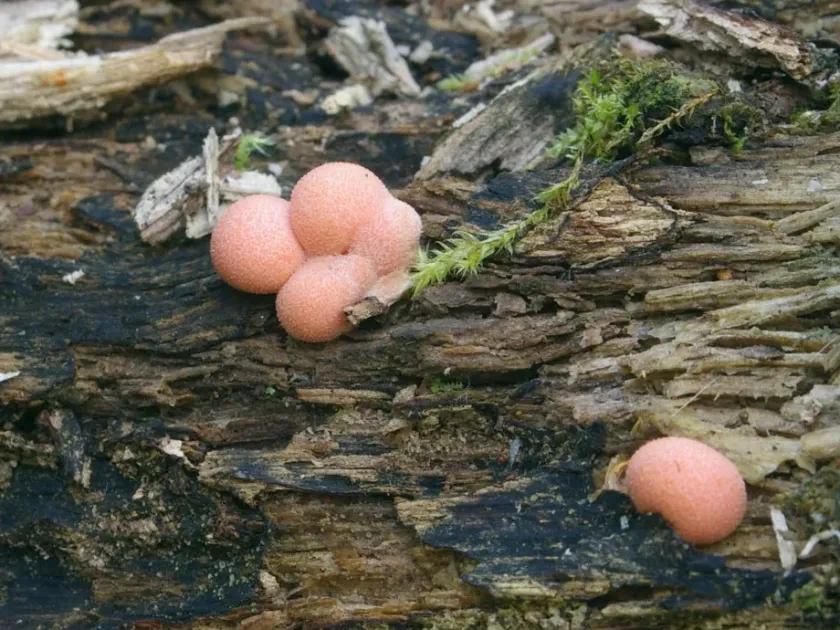
Description
Symptoms
The most recognizable sign of wolf's milk is the presence of small, hemispherical structures that appear bright pink, orange, or yellowish on bark or rotting logs.
Young fruiting bodies are soft and possess a paste-like consistency. If punctured, a thick, pinkish fluid is released, which explains the common name wolf's milk.
As the fruiting bodies mature, they transition from a bright color to a dull gray or brownish shade. The interior dries out, becoming a mass of fine, dusty spores that are easily released into the wind upon disturbance.
These slime molds are typically found in clusters on the lower parts of decaying tree trunks, stumps, or wet, rotting wood, often where moisture is trapped.
The presence of these signs is almost always a secondary indicator of wood decay. The underlying tree has likely already been compromised by wood-rotting fungi before the slime mold colonizes the site.
Pathogen
Lycogala epidendrum, commonly known as wolf's milk, is a species of myxomycete or slime mold. It is not a true fungus but a protist that undergoes a complex life cycle, featuring both amoeboid and reproductive stages.
The organism begins as a plasmodium, a mobile, multinucleated mass of protoplasm. This stage moves slowly over substrates, engulfing organic matter, bacteria, and fungal spores as its primary food source.
Reproduction involves the formation of aethalia, which are the visible, dome-shaped fruiting bodies. These structures contain the spores necessary for the organism's dispersal and survival.
Lycogala epidendrum is a saprotrophic organism. It does not possess the enzymes necessary to break down healthy living plant cells, which is why it thrives specifically on decaying wood.
Being a myxomycete rather than a fungus, its biological classification places it within the Amoebozoa group, necessitating specific management considerations compared to typical fungal plant pathogens.
Conditions for development
High moisture levels are the most critical factor for the development of Lycogala epidendrum. It thrives in environments where wood remains damp for extended periods, such as deep shade or wet forest floors.
Decaying organic material, particularly rotting wood from broadleaf or coniferous trees, serves as the primary substrate for its colonization and growth cycle.
Moderate temperatures ranging from 15°C to 25°C provide the ideal environment for the plasmodium to grow rapidly and for the fruiting bodies to mature successfully.
Poor orchard sanitation, such as leaving stumps or wood debris, creates ideal conditions for the organism to establish itself and release millions of spores into the surrounding area.
Lack of proper pruning and air circulation in gardens leads to microclimates with increased humidity, which significantly favors the growth of these organisms on weakened woody plants.
Why it matters
Lycogala epidendrum does not pose a direct threat to the health of living plants. It is incapable of parasitizing healthy trees, as it requires already dying or dead tissue to survive.
Its primary danger is as a biological indicator. Its presence warns the gardener that the tree is already suffering from significant decay, usually caused by true wood-rotting fungi or bacterial pathogens.
The slime mold can contribute to the retention of moisture in existing bark wounds. This localized humidity may further accelerate the progression of secondary decay in the structural wood.
In ornamental settings, its presence reduces the aesthetic quality of trees and shrubs, signaling a lack of proper maintenance or an underlying issue that could threaten the tree's lifespan.
While not inherently harmful to humans, the release of large quantities of spores can trigger respiratory irritation or allergies in sensitive individuals when cleaning or handling affected wood.
Protection
The most effective strategy for control is rigorous orchard hygiene. Removing rotting stumps, fallen branches, and wood debris eliminates the substrate required for the slime mold to grow.
Mechanical removal of visible fruiting bodies can prevent the dispersal of thousands of spores. This should be followed by cleaning and disinfecting the area to discourage recurrence.
Protecting the bark from mechanical damage is essential. If wounds are present, they should be cleaned back to healthy tissue, treated with a fungicide or copper-based solution, and sealed with a proper wound dressing.
Improving air circulation by thinning out dense crowns helps reduce the humidity in the garden, making the environment less hospitable for myxomycetes and other fungal organisms.
Regular maintenance, including proper fertilization and irrigation, ensures trees remain vigorous and healthy, reducing the likelihood of them developing the deadwood patches that slime molds require to thrive.
Discussion
No discussions yet — be the first.