
Japanese pear rust
Gymnosporangium haraeanum
Description
Symptoms
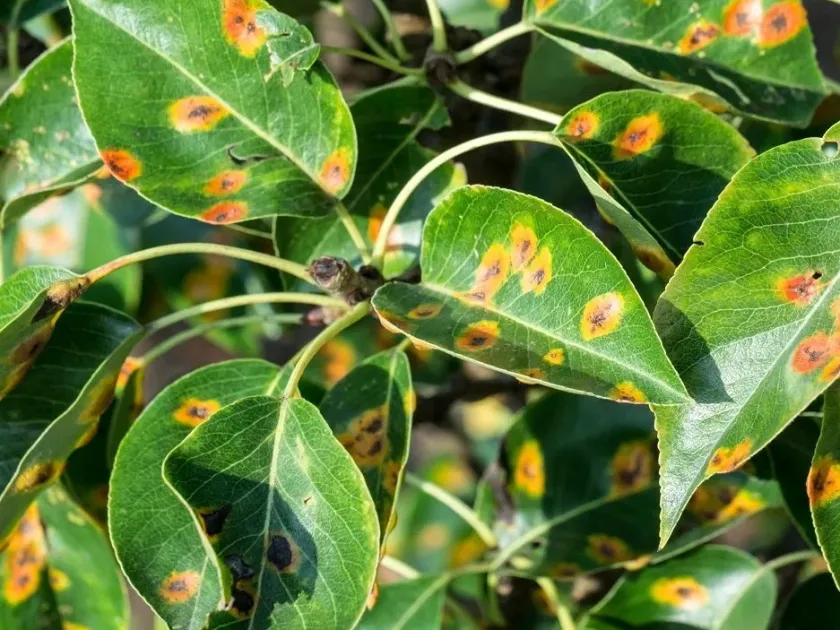
The first signs of the disease appear as small, bright yellow or orange spots on the upper side of the pear leaves during spring.
As the infection progresses, black dots known as spermogonia develop within the centers of these leaf spots.
On the undersides of the leaves, characteristic orange, conical protrusions called aecia emerge, releasing spores into the environment.
Severe infection causes premature leaf drop, which significantly weakens the tree and affects its overall vitality.
Shoots and fruits may also show deformities and swelling, often covered in a dusty layer of orange fungal spores.
Pathogen
The causative agent of this disease is the rust fungus Gymnosporangium haraeanum (syn. Gymnosporangium asiaticum).
It is a heteroecious fungus, requiring two distinct hosts to complete its complex biological life cycle: pear trees and juniper plants.
The pathogen overwinters as mycelium in the tissues of juniper branches, causing visible galls or abnormal bark swellings.
In spring, spores produced on the juniper are carried by wind or rain to infect the young foliage of nearby pear trees.
This cycle of spore production and host transfer is continuous and can cause recurring outbreaks if both hosts are present.
Conditions for development
High humidity and rainfall during the spring season are the most critical factors for the germination and spread of fungal spores.
The presence of susceptible juniper species within a range of several hundred meters significantly increases the risk of pear infection.
Moderate temperatures ranging from 15°C to 20°C facilitate the rapid development of the fungus on the leaves of pear trees.
Poor airflow within dense orchard plantings creates a microclimate that supports persistent fungal growth and infection.
Wet weather events repeatedly trigger the release of new spores, leading to multiple waves of infection throughout the growing season.
Why it matters
The disease reduces the photosynthetic capacity of the foliage, leading to a significant decrease in tree vigor and yield potential.
Premature leaf loss prevents the tree from storing necessary carbohydrates, leading to reduced winter hardiness and increased mortality.
Infected fruits suffer from distorted shapes and premature rot, rendering them unsuitable for market or consumption.
Persistent infection exhausts the tree's resources, making it more susceptible to other pests and opportunistic diseases.
Overall, heavy rust pressure leads to substantial economic losses for orchard owners due to both reduced fruit quality and quantity.
Protection
The most effective long-term preventive measure is the spatial separation of pear orchards from decorative or wild juniper plantings.
Sanitation practices such as pruning and destroying infected juniper branches or pear shoots are essential to limit spore dispersal.
Systemic fungicides belonging to triazole or strobilurin classes should be applied during the early vegetative growth phase.
Copper-based fungicides can be used early in the season to prevent the initial settlement of fungal spores on leaf surfaces.
- Maintain a buffer zone of at least 500 meters between hosts.
- Apply fungicides preventively before heavy rain forecasts.
- Use balanced fertilization to help trees resist pathogen stress.
Discussion
No discussions yet — be the first.