
Fusarium root rot
Fusarium martii
Description
Symptoms
The primary symptom is visible wilting of the plant, often appearing during the hottest part of the day while the plant may temporarily recover at night.
As the disease progresses, the lower leaves exhibit chlorosis, eventually turning yellow and necrotic, leading to permanent wilting and leaf drop as the vascular system fails.
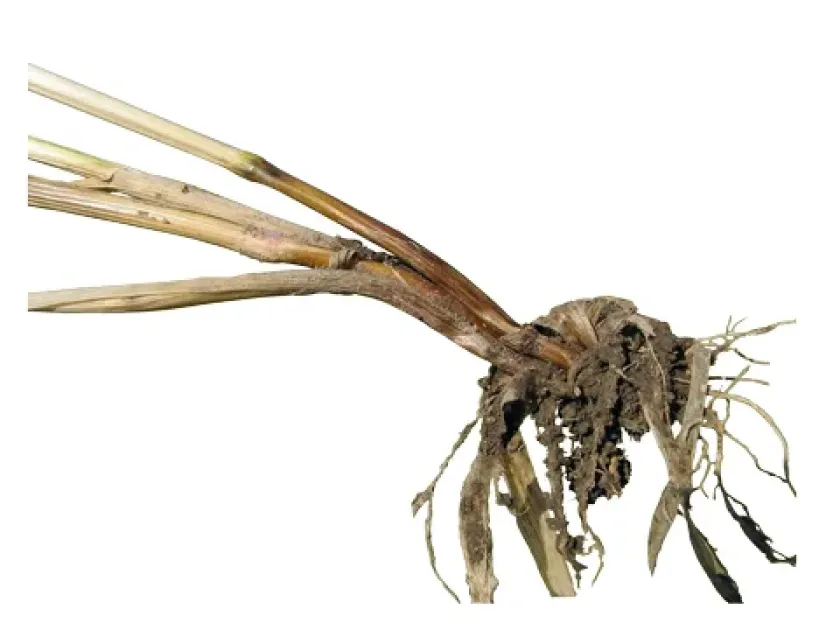
Examination of the root system reveals a characteristic brown or black discoloration of the primary taproot and secondary lateral roots, often with rotting of the cortex.
The root crown area (the junction of the stem and roots) often becomes soft and discolored, which may lead to the lodging or snapping of the plant under stress.
- Stunted plant growth;
- Yellowing and necrosis of foliage;
- Rotting and discoloration of the taproot;
- Reddish or white mold growth on stem bases in high humidity;
- Pre-emergence and post-emergence damping-off of seedlings.
Pathogen
The causative agent of this disease is the soil-borne fungus Fusarium martii, a member of the diverse Fusarium genus. This pathogen is known for its ability to persist in soil for years by forming resilient chlamydospores.
It is a facultative parasite that exists primarily as a saprotroph, decomposing organic matter in the soil until it detects the chemical signals from a susceptible host plant.
Once it colonizes the roots, the pathogen invades the vascular bundles, spreading through the xylem and xylem parenchyma, which leads to the structural breakdown of the root system.
The fungus produces masses of microconidia and macroconidia, which are easily disseminated by water splashes, contaminated soil stuck to machinery, and the movement of infected plant debris.
High genetic variability within Fusarium martii allows it to form specific physiological races, enabling it to adapt to various environmental conditions and host plant genotypes.
Conditions for development
Development of the disease is favored by moderate soil temperatures, typically ranging from 15°C to 22°C, which are optimal for the growth of the fungal mycelium.
Excessive soil moisture, poor drainage, and over-irrigation are critical factors that promote the rapid spread of the fungus and exacerbate root decay.
Physical injuries to the root system, caused by insect feeding or careless cultivation practices, create entry points for the fungal mycelium to invade the root tissues.
Soil conditions such as high acidity and low calcium content are often correlated with increased severity of the disease and a weakened plant defense response.
Lack of crop rotation and the accumulation of infested organic material in the soil significantly increase the risk of an outbreak during the planting season.
Why it matters
The disease causes significant stand reduction due to seedling death, resulting in lower plant density and lower yield potential from the start of the season.
In mature plants, the impairment of the root system limits the uptake of water and nutrients, leading to poor grain filling and reduced total biomass production.
The crop produced on infected plants is often of inferior quality, potentially contaminated with mycotoxins that make it unsafe for animal or human consumption.
Because the fungus persists in the soil, fields affected by Fusarium martii become "sick" and cannot support the same susceptible crops for multiple seasons.
The cumulative impact on the farm economy includes lost income, increased expenditure on fungicide treatments, and the forced shift to less profitable crop varieties.
Protection
Crop rotation remains the most effective management tool, as it deprives the fungus of its host, thereby reducing its population density in the soil over time.
Using certified, fungicide-treated seeds ensures that the seedlings get a healthy start, protected from the most vulnerable early stage of infection.
Soil management practices, including liming to correct acidity and improving drainage, create an unfavorable environment for the growth of the fungus.
Integrated pest management (IPM) is essential to control soil-dwelling insects that wound roots, thereby preventing the secondary entry of the pathogen into the host.
Regular monitoring of field conditions and the strategic application of systemic fungicides during the early vegetative phase can mitigate the impact of the disease.
Discussion
No discussions yet — be the first.