
Fusarium ear rot of corn
Fusarium brasiliense
Description
Symptoms
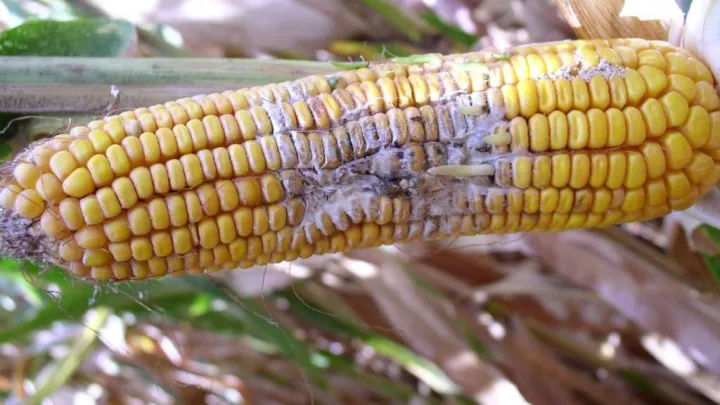
The primary symptoms of Fusarium ear rot typically appear during the grain filling and maturation stages. A characteristic pinkish or white fungal growth develops on the surface of the ears, covering individual kernels or large patches.
Internal tissues of infected ears become brittle, and dense mycelial mats are often found between the rows of kernels. Infected kernels lose their natural luster and become dull, greyish, and shriveled.
Early infections may be subtle, presenting only as discoloration of the germ or the kernel tip. As the infection spreads, it can affect the entire ear, leading to significant yield loss and contamination of the healthy grains.
If the infection reaches the cob, the internal structure may soften and rot, leading to premature death of the ear. This complication makes harvesting and grain processing particularly challenging.
- Appearance of pinkish-white mycelium on kernels.
- Discoloration, dullness, and shriveling of grains.
- Presence of dense mycelial growth between rows.
- Rotting and softening of the cob tissue.
- Premature yellowing and drying of the husk leaves.
Pathogen
The causal agent of this disease is the fungus Fusarium brasiliense, which belongs to the Fusarium fujikuroi species complex. This pathogen is known for its high resilience and ability to persist in diverse environmental conditions.
The fungus infects various parts of the corn plant, including roots, stalks, and ears. Its life cycle is heavily dependent on crop residues, which act as the primary inoculum source for subsequent seasons.
This pathogen is highly virulent and produces harmful mycotoxins, specifically fumonisins, which pose significant risks to human and animal health when consumed through contaminated grain.
The fungal mycelium colonizes the plant tissues, causing structural degradation. During the reproduction phase, the fungus produces conidia, which are disseminated by wind, rain splashes, and insect vectors throughout the field.
Unlike some other Fusarium species, Fusarium brasiliense shows particular virulence in temperate and warm climates, especially when ear husks have been damaged by external factors.
Conditions for development
The development of Fusarium ear rot is strongly favored by high humidity and moderate temperatures during the silking and grain-filling phases. Prolonged rainfall during late summer creates an ideal environment for spore spread.
Insect pests such as corn earworms and European corn borers are major contributors to the spread of the disease. By damaging the husk and kernels, they provide entry points for fungal spores to colonize the ear.
Poor crop rotation practices and high levels of crop debris left on the soil surface increase the initial inoculum levels. The fungus survives easily on stalks and cobs left from the previous season.
High planting densities and excessive nitrogen application can create a microclimate with restricted airflow, which facilitates the rapid spread of infection from plant to plant.
The optimal temperature range for the growth of Fusarium brasiliense is between 20°C and 28°C, which often coincides with the peak development period of the corn crop in many regions.
Why it matters
The direct economic impact is a substantial reduction in yield and a decrease in the thousand-kernel weight. Infected ears produce grain of lower quality and compromised nutritional value.
Grain affected by Fusarium is often unsuitable for food or feed due to high mycotoxin concentrations. Consuming contaminated grain can lead to severe health issues in livestock, including reduced feed intake and toxicosis.
The disease increases processing costs, as farmers must implement rigorous sorting and cleaning procedures to remove infected grains before storage or sale to prevent further spread in bins.
Lowered product quality severely impacts marketability, leading to significant financial losses during grain trade. Many batches may be rejected at elevators due to safety standard violations.
Continuous cropping of maize on the same field leads to the build-up of the pathogen in the soil, forcing producers to adopt intensive management strategies or change crop rotations to maintain profitability.
Protection
The primary control measure is the implementation of a diverse crop rotation, avoiding corn-on-corn production. A rotation interval of 2–3 years is recommended to break the life cycle of the pathogen.
Deep plowing and proper management of crop residues are essential to accelerate decomposition and reduce the number of fungal spores present on the soil surface for the next growing season.
Effective management of ear-feeding insects is critical. Applying insecticides during the silking stage helps protect the ears from mechanical damage and subsequent fungal entry.
Choosing hybrids with inherent resistance or tolerance to ear rots is a highly effective long-term management strategy. Modern breeding programs offer varieties designed to withstand such infections.
Seed treatment with high-quality fungicides is necessary to protect young seedlings from early-season infection, ensuring better stand establishment and more uniform plant development.
Discussion
No discussions yet — be the first.