
Wolf's milk
Enteridium lycoperdon
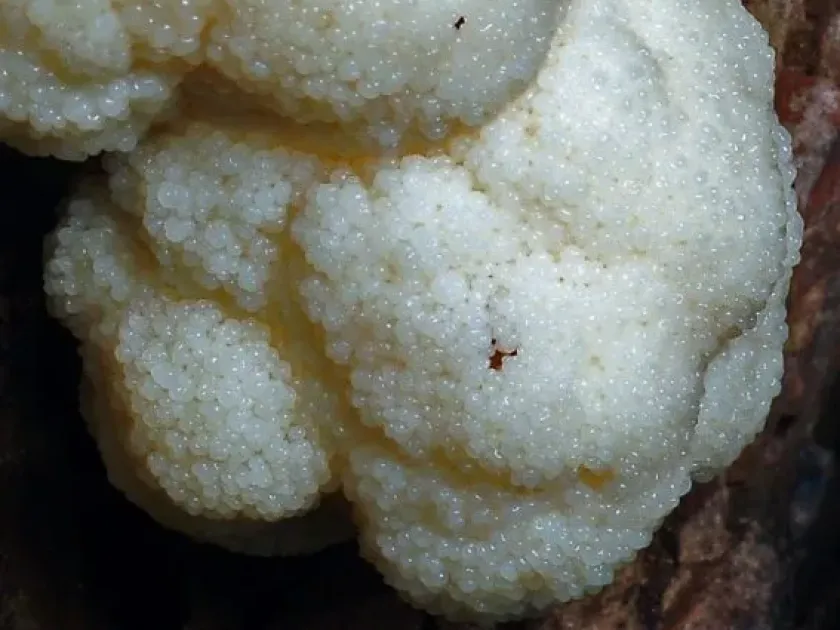
Description
Symptoms
The primary sign of its presence is the appearance of cushion-like, soft fruiting bodies on bark, logs, or stumps. These masses can be white, cream, or pink when young.
As the fruiting body matures, the outer surface darkens to brown and becomes fragile. The interior transforms into a dry, powdery mass of spores, which is easily dispersed by wind or rain.
If you observe the bark beneath the fruiting body, you will notice it is perfectly intact. There are no signs of tissue decay, rot, or necrosis under the organism, which distinguishes it from pathogenic fungi.
Often, these growths appear as smooth, rounded lumps that may look like puffball mushrooms, but they lack the distinct structural characteristics of true mushrooms.
Their texture is unique: they are soft and gelatinous in the early stages, often described as having a texture similar to toothpaste or cream, hence the common name.
Pathogen
Wolf's milk (Enteridium lycoperdon) is not a plant pathogen; it is a myxomycete, commonly known as a slime mold. It occupies an ecological niche as a saprotroph, feeding on decaying organic matter, bacteria, and fungal spores.
During its complex life cycle, it exists as a plasmodium, a mobile mass of protoplasm capable of creeping slowly over the substrate. This stage is invisible to most observers, focusing on nutrient absorption.
When environmental conditions are right, the plasmodium concentrates to form fruiting bodies called aethalia. These are the structures people often mistake for fungal infections or plant diseases.
Unlike parasitic fungi, this organism does not invade living plant tissues. It lacks the enzymatic pathways required to break down healthy plant cells, meaning it poses no risk to the host tree.
Biologically, it is more closely related to amoebae than to true fungi, representing a fascinating group of organisms that bridge the gap between simple cells and complex structures.
Conditions for development
The development of Enteridium lycoperdon is highly dependent on humidity. It thrives in damp, shaded environments, particularly after periods of persistent rainfall.
It prefers damp, decaying wood as a substrate. While it may grow on healthy-looking trees, it is almost always localized on small patches of dead bark or damaged areas where moisture accumulates.
Mild temperatures, typically ranging from 15°C to 22°C (59°F to 72°F), provide the optimal environment for the rapid formation of the aethalia stage.
Areas with moss or lichen coverage often provide the necessary moisture-retentive microhabitat for the plasmodial stage to thrive and consolidate.
Poor ventilation in the canopy or dense garden settings can create the micro-climatic conditions that favor the proliferation of slime molds on bark surfaces.
Why it matters
There is no direct harm caused to crops, shrubs, or trees by Wolf's milk. It is purely a saprotrophic observer in the garden ecosystem, utilizing dead matter.
The primary concern for gardeners is usually aesthetic, as the sudden appearance of these growths on ornamental trees can be alarming or visually distracting.
In extreme cases, covering a large area of bark might slightly inhibit gas exchange on a very localized scale, but this is biologically insignificant for the tree's overall health.
Misidentifying this organism as a disease leads to unnecessary and potentially harmful applications of fungicides, which have no effect on slime molds.
It is best to view this organism as a natural component of a healthy, damp forest-like garden environment rather than a pest to be eradicated.
Protection
Because it is not a parasite, no chemical control methods or fungicides are required or effective against Enteridium lycoperdon.
If the appearance of the slime mold is undesirable, it can be easily removed by physical scraping or washing with a jet of water, which will not harm the tree.
Routine garden maintenance, such as pruning deadwood and clearing decaying plant debris, will naturally limit the surfaces available for this organism to colonize.
Promoting good airflow throughout the garden and ensuring trees are pruned correctly to allow sunlight penetration can help reduce humidity levels, naturally discouraging slime molds.
Proper care of bark, including protection against sunscald and mechanical damage, prevents the formation of the dead tissue patches that slime molds typically inhabit.
Discussion
No discussions yet — be the first.