
Pine-pine rust
Endocronartium
Description
Symptoms
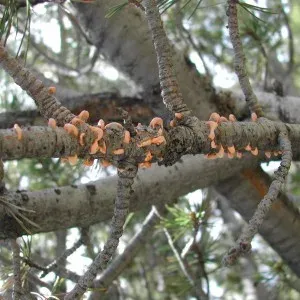
The most diagnostic sign of this disease is the development of spherical or spindle-shaped galls on the stems and branches. These galls become more pronounced as the infection progresses over years.
In spring, the galls rupture and release a bright orange powdery mass, consisting of millions of aeciospores. This stage is often referred to as a rust bloom, which is highly visible on infected trees.
Heavily infected branches may show signs of deformation or stunted growth. In severe cases, the tree may exhibit a characteristic twisting of the stem or the formation of witches' brooms.
The bark at the site of the gall often becomes thick, cracked, and rough. This damaged bark is susceptible to secondary colonization by bark beetles or wood-decaying fungi.
- Formation of woody galls on stems and branches.
- Brilliant orange spore masses emerging in spring.
- Distortion of shoots and branches.
- Premature yellowing and shedding of needles.
- Necrosis of bark tissues.
Pathogen
The disease is caused by the fungus Endocronartium harknessii, a specialized pathogen belonging to the rust fungi family. It is distinct because it is an autoecious species, meaning it does not require an alternate host to complete its life cycle.
The fungus invades the host's vascular tissues and forces the tree to produce abnormal growth. Its mycelium colonizes the branches and stems, remaining active within the host for many years.
During the sporulation stage, the fungus produces aeciospores that are disseminated by wind. These spores act as the primary inoculum for infecting healthy trees in the vicinity.
Because the fungus is perennial, it stays within the branch or stem tissue until the host dies or the infected part is removed. This long-term colonization allows it to continue producing spores annually.
Genetic studies show that the pathogen is highly adaptable and can affect various pine species. Its biological strategy focuses on maintaining long-term survival within a single host population.
Conditions for development
The disease thrives in cool, moist environments, especially during the spring when spores are being released. High humidity levels are essential for the germination of spores on the surface of pine needles or thin bark.
Stands with high planting density are particularly susceptible because the canopy creates a humid microclimate. Poor air circulation prevents the drying of moisture, facilitating spore germination.
Wind is the primary vector for long-distance dispersal of the pathogen. Infected trees act as hubs, spreading the disease to surrounding healthy plants throughout the season.
Stress factors, such as nutrient deficiencies, drought, or poor soil conditions, can make trees more vulnerable to infection. Healthy trees are often better at resisting early-stage fungal entry.
Nurseries are high-risk areas because young, tender tissues are more susceptible to infection. The high concentration of host material in these locations can lead to rapid outbreaks.
Why it matters
The primary harm is the stunted growth and reduced vitality of the tree. Galls disrupt the flow of nutrients through the cambium, which hinders the development of the crown and root system.
Stem galls pose a significant structural risk, making trees susceptible to breakage under heavy snow or wind. This significantly decreases the timber value of the affected trees.
Young seedlings are often killed by the disease, leading to significant losses in plantation stocking levels. This results in direct economic impact for forest managers and plantation owners.
In landscape gardening, the presence of galls and dead branches ruins the aesthetic appeal of the trees, often necessitating the removal of the affected specimens.
Secondary infections occur because the damaged bark serves as an entry point for other pathogens and boring insects, potentially leading to the premature death of the entire tree.
Protection
The most effective strategy is the use of disease-free planting stock. Choosing resistant varieties is the best way to prevent the establishment of the disease in new plantations.
Sanitation pruning is essential; all branches exhibiting galls should be removed and destroyed immediately. This reduces the spore load in the immediate environment.
In cases of heavy infection, entire trees should be removed and disposed of properly. This is crucial for stopping the cycle of transmission in nurseries and young stands.
Fungicide applications may be used in nurseries to protect young plants during the peak spore-release period. Proper timing and adherence to labels are vital for efficacy.
Maintaining appropriate spacing during planting improves air movement and lowers humidity around the trees, effectively discouraging the conditions required for the fungus to thrive.
Discussion
No discussions yet — be the first.