
Didymium squamulosum
Didymium squamulosum
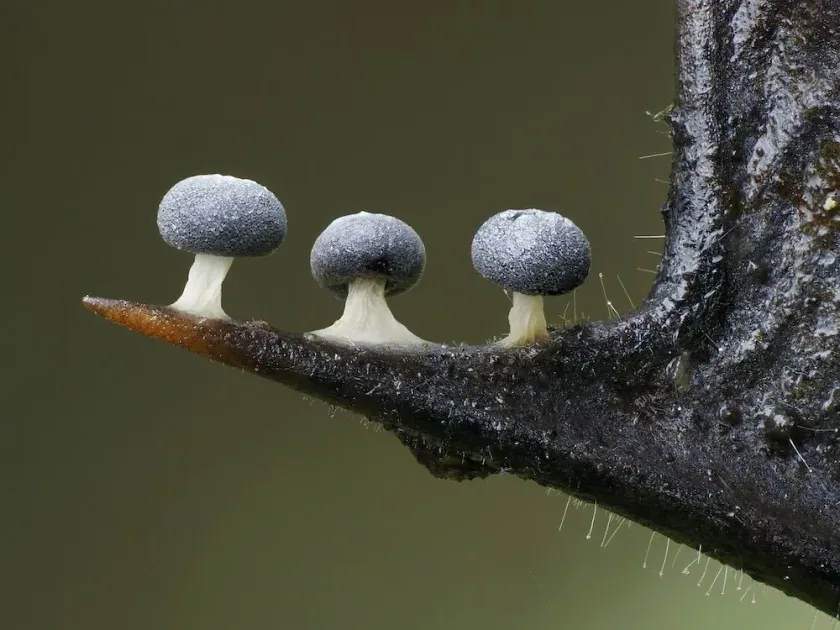
Description
Symptoms
The primary symptom of infection is the development of white or grayish-white calcareous growths on plant surfaces. These often appear as small, dusty scales, crusts, or pad-like structures adhering to stems and leaves.
Early stages of development may manifest as a slimy, viscous mass—the plasmodium—which eventually solidifies into the spore-bearing sporangia. Affected areas may look like they have been dusted with a fine white powder.
Plants affected by the presence of this slime mold may show signs of chlorosis or stunted growth. This is because the coating blocks the stomata, which are crucial for gas exchange and transpiration, leading to localized plant stress.
Under high humidity, these colonies can expand rapidly, covering large portions of the leaf surface. While the mold is easily wiped off mechanically, it often regrows quickly if the underlying environmental conditions remain favorable for the organism.
- White lime-like sporangia on the lower stem area.
- Powdery, scaly patches on leaf surfaces.
- General plant stress due to blocked photosynthetic surfaces.
Pathogen
Didymium squamulosum is a species of slime mold belonging to the Myxomycetes class. Unlike true fungi, this organism has a mobile life stage known as a plasmodium, which moves across surfaces to consume organic matter and microorganisms.
Biologically, it acts as a mixotrophic saprotroph. Although not an obligate parasite, its ability to colonize living plant tissues is a concern for gardeners and farmers, as it can interfere with the normal physiological functions of the host plant.
The reproduction process involves the formation of sporangia, which appear as tiny white, lime-like scales. These sporangia release vast amounts of spores that are easily dispersed by wind, splashing water, or garden tools, allowing for rapid colonization.
The life cycle includes stages such as myxamoebae, swarm cells, and a multi-nucleated plasmodium. This complex strategy allows the organism to survive harsh environmental conditions by forming resistant structures known as sclerotia.
While Didymium squamulosum prefers decomposing matter, it frequently moves onto the lower stems and leaves of healthy plants, creating a physical coating that complicates the plant's metabolic exchange with the environment.
Conditions for development
Excessive humidity is the primary catalyst for the development of Didymium squamulosum. It thrives in damp, shaded environments where water evaporates slowly, maintaining the moisture levels necessary for its growth.
Temperatures between +15°C and +25°C are ideal for the transition from the vegetative plasmodium stage to the spore-producing stage. In dry and hot conditions, the organism tends to slow its activity or enter a dormant state.
Abundant decaying organic matter on the soil surface provides an excellent nutrient base for slime molds. Leaving old plant debris in the field or greenhouse creates a reservoir that supports a high population density of the pathogen.
Overcrowded plantings hinder air circulation, creating a microclimate with stagnant, humid air. Such conditions are perfect for the establishment of slime mold colonies on the lower parts of the plants.
Poor soil drainage and frequent irrigation contribute to water accumulation around the base of plants. This moisture is essential for the organism to spread from the soil onto the aerial parts of the host plants.
Why it matters
The main harm caused by Didymium squamulosum is mechanical suppression. By covering the leaf surface with dense sporangia, the mold blocks sunlight, which is essential for the plant's photosynthetic processes.
The disruption of transpiration and gas exchange leads to a deficit in carbon dioxide uptake, slowing down the plant's overall development and reducing the accumulation of vegetative mass.
Slime molds often act as secondary colonizers. They typically infest tissues already weakened by other diseases or physical injuries, which complicates the recovery of the plants and makes them more susceptible to further damage.
In ornamental horticulture, the presence of these white growths significantly reduces the visual appeal of the plants, making the produce unsuitable for sale or aesthetic use.
For vegetable crops, especially those grown in greenhouses, the presence of spores on the harvested fruit increases the risk of decay and microbial contamination during storage, requiring additional cleaning and sanitation efforts.
Protection
Effective control starts with good agronomic practices. It is crucial to ensure proper soil drainage and avoid over-irrigation, which creates the damp conditions that favor slime mold growth.
Regular sanitation is essential; removing decaying plant matter, fallen leaves, and sodden mulch helps eliminate the food sources that support the organism's population.
Improving air circulation through proper spacing and pruning is a highly effective way to manage microclimate humidity. This helps the foliage dry out quickly after rain or irrigation, making it difficult for the mold to establish.
If colonization occurs, contact fungicides, particularly those based on copper, can be used to dry out the surface and inhibit spore germination, thereby reducing the spread of the pathogen.
Maintaining strict hygiene protocols during greenhouse operations, including disinfecting tools and equipment, is necessary to prevent the mechanical transfer of spores between healthy and infected crops.
Discussion
No discussions yet — be the first.