
Amanita solitaria
Amanita solitaria
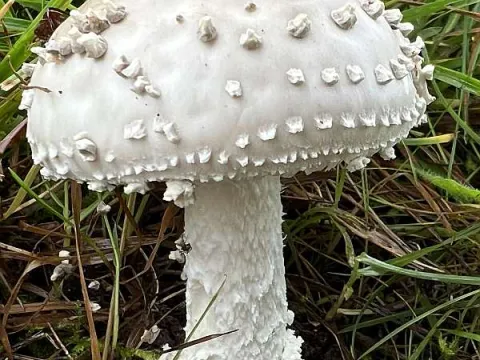
Amanita solitaria is a medium to large mushroom characterized by a white or grayish-white cap adorned with fragile, powdery scales.
What the section contains
Amanita solitaria
The stipe is robust, often featuring a bulbous base that is partially submerged in the soil or forest litter, making it stable in its habitat.
Its gills are typically white, though they may develop a slight yellowish or cream hue as the mushroom reaches full maturity.
A distinct feature of this species is its peculiar odor, which has been described by many observers as resembling chlorine or chemical bleach.
The ring on the stipe is often poorly developed or fugitive, meaning it may disappear as the fruit body expands, leaving minimal trace.
This organism is strictly a forest mushroom and is not recognized as a disease pathogen in the context of agricultural crops.
It exists as a mycorrhizal fungus, establishing a symbiotic relationship with the root systems of various broadleaf trees.
It does not possess the mechanisms to parasitize or damage field crops, vegetables, or fruit-bearing trees managed in agricultural settings.
From an agronomic perspective, this mushroom is an entirely non-harmful component of woodland biodiversity.
The biological classification of this fungus places it within the ecosystem support group rather than the plant disease category.
The fungus thrives in mature, undisturbed forest environments that provide adequate organic leaf litter and moisture.
It typically forms associations with trees such as oak and beech, relying on them for the exchange of essential nutrients and carbohydrates.
Optimal conditions for growth include stable, cool temperatures and high humidity, usually occurring in late summer and autumn.
The presence of this fungus is indicative of an established ecosystem, and it is rarely found in modified or highly cultivated landscapes.
High levels of chemical inputs, soil compaction, and frequent cultivation are factors that inhibit its natural development.
Amanita solitaria causes no harm to agricultural production or the health of cultivated plant species.
While non-pathogenic to plants, the mushroom is considered poisonous if consumed by humans and should never be considered edible.
The primary concern regarding this mushroom is the risk of misidentification by amateur mushroom hunters who might collect it for food.
It does not impact farm revenue or the quality of harvestable crops, effectively remaining invisible to traditional agricultural monitoring.
Environmental impacts are purely positive, as the fungus participates in the forest carbon cycle and improves soil nutrient availability for trees.
No agricultural control measures are necessary for this species, as it does not pose a threat to any crop management systems.
If encountered in landscaped or garden areas, mechanical removal of the fruit body is sufficient to prevent unauthorized growth.
The most effective strategy regarding this fungus is public education focused on the dangers of consuming wild mushrooms without expert identification.
Chemical intervention is neither recommended nor required, as the species does not exhibit aggressive colonization behaviors.
Maintaining standard agronomic soil management practices is entirely sufficient to keep this fungus outside of active agricultural plots.