
Description
Symptoms
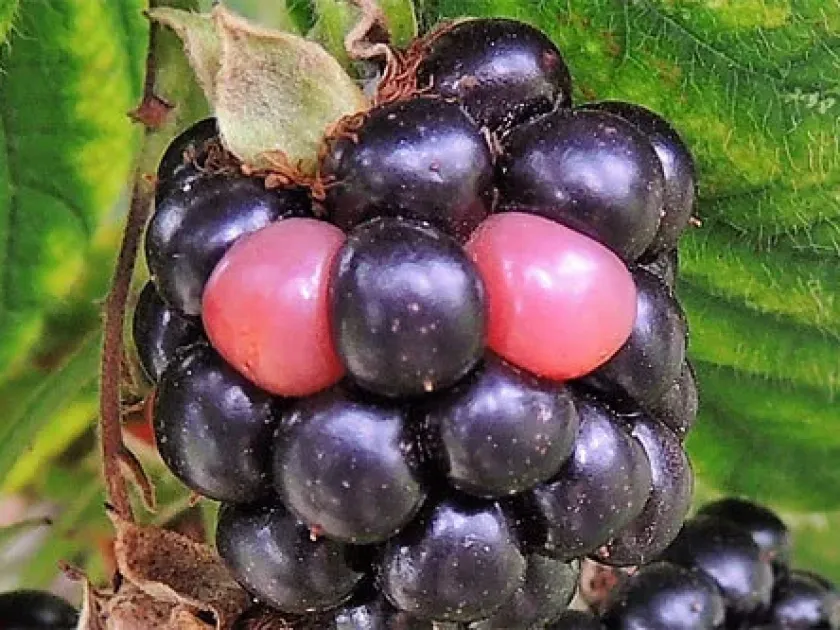
The most distinctive symptom is the irregular and bumpy development of the drupelets, commonly known as "dry berry" or distorted fruit syndrome.
Affected berries do not ripen evenly; some drupelets remain hard, pale, and tart, even while the rest of the berry turns red and appears ripe.
In addition to fruit distortion, heavy infestations may cause the general stunting of fruiting laterals or slight yellowing of leaf tissues.
Symptoms become clearly visible only after the berries begin to set and develop, often leaving little time for intervention during that season.
Careful inspection of the calyx and young drupelets during the early fruit formation stage can reveal the presence of the mite colonies.
Pathogen
The causative agent of the disorder is the microscopic eriophyid mite Acalitus essigi. It is a specialized pest that exclusively targets plants within the Rubus genus.
These mites are extremely small, measuring less than 0.2 mm, making it impossible to see them without professional magnifying equipment.
The life cycle of Acalitus essigi is synchronized with the bud and fruit development of raspberries, ensuring the pest is present when the plant is most vulnerable.
The mites reproduce rapidly during the growing season, with multiple generations overlapping, which leads to a constant pressure on the plant tissues.
The pest primarily affects red raspberries, but it is also known to cause severe deformations on blackberries and other wild Rubus species.
Conditions for development
Raspberry mites thrive in warm, humid conditions, with the temperature range of 20°C to 25°C being optimal for their rapid reproduction.
The primary transmission method is through the exchange of infested planting stock, where mites hide inside dormant buds or under the bark.
Once introduced to a field, mites are easily transported by wind, pollinators, or during routine maintenance activities like pruning and harvesting.
High plant density and lack of ventilation create a localized microclimate that significantly accelerates the spread of the pest across the plantation.
Prolonged spring rains can sometimes exacerbate the infestation by facilitating the movement of mites from their overwintering sites to new growth.
Why it matters
The primary economic damage is the severe reduction in marketability, as distorted berries are aesthetically unappealing and taste poor.
Affected fruit is often difficult to process and lacks the structural integrity required for fresh market sales, leading to substantial financial losses.
Chronic infestation weakens the raspberry plant over several seasons, making it less productive and more prone to other environmental stressors.
Yield loss can be extreme in unprotected fields, occasionally rendering the entire harvest unsellable for commercial fresh-fruit operations.
- Total loss of fruit market value
- Unpalatable fruit texture and flavor
- Reduced vigor of the host plant
Protection
Prevention is the most critical strategy; always source nursery stock from certified, mite-free nurseries to avoid introducing the pest.
Implementing a strict sanitation program, including the removal and burning of infested canes, helps keep the population at manageable levels.
Chemical control using specific acaricides is most effective when applied at the green tip stage, before the mites move deep into the developing buds.
Good agricultural practices, such as proper spacing and thinning, improve airflow and light penetration, making the environment less favorable for mites.
In organic systems, monitoring and the release of predatory mites or the use of botanical oils may provide some suppression of the mite population.
Pathogens and affected parts
Affects crops · 1
Discussion
No discussions yet — be the first.