
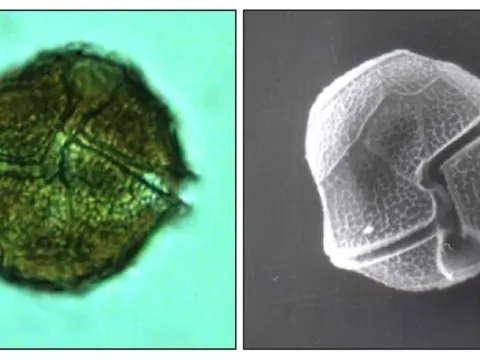
Peridinium
Peridinium
An external sign of Peridinium presence is the characteristic "blooming" of water, which acquires a cloudy, brownish, or yellowish-green tint.
What the section contains
Peridinium
During massive development, a dense foamy film forms on the water surface, which may emit a specific unpleasant odor due to decomposition processes.
Under microscopic examination, cells with a distinct armor-like structure composed of cellulosic plates are detected in the water column.
Affected aquatic plants may exhibit stunted growth and leaf decay due to the blockage of sunlight by the algal film.
Visually, massive accumulations of these algae are often accompanied by changes in the oxygen regime of the water body, noticeable in the behavior of aquatic fauna.
Peridinium (lat. Peridinium) belongs to the dinoflagellate algae division and represents a genus of single-celled planktonic organisms.
These organisms possess flagella for active movement in the water column and are mixotrophs, combining photosynthesis with the consumption of organic matter.
The cell is covered by a rigid armor (theca) consisting of individual plates, the arrangement of which is the main taxonomic feature.
Reproduction occurs primarily through asexual binary fission, which leads to rapid population spikes under favorable environmental conditions.
In their life cycle, they can form cysts capable of remaining viable for long periods in bottom sediments during unfavorable conditions.
The main factor for development is the excessive content of nutrients, especially nitrogen and phosphorus, in the water, known as eutrophication.
Peridinium actively reproduces when water temperatures rise during the summer and when there is a sufficient amount of dissolved organic matter.
Calm, stagnant water bodies or areas with poor water exchange are the most favorable zones for the formation of large algal colonies.
Light intensity also plays a key role, as Peridinium requires a certain level of solar radiation for the photosynthetic process.
A decrease in dissolved oxygen levels often correlates with the phase of intense reproduction and subsequent biomass decay.
The primary danger lies in the sudden oxygen deficit that occurs during massive algal die-offs and decay, which can lead to fish kills.
Some species are capable of producing toxic substances that negatively affect water quality and the health of aquatic organisms in aquaculture.
Intense blooming hinders normal photosynthesis of submerged higher plants, suppressing their growth and disrupting the ecosystem balance.
In industrial irrigation or fish farming systems, the development of Peridinium leads to clogging of filtration systems and reduced product quality.
Metabolic products of these algae can impart foreign tastes and odors to water and fish, reducing their market value.
An effective preventive method is managing fertilizer runoff from fields into water bodies to prevent excessive phosphate accumulation.
Implementing forced water aeration helps maintain oxygen levels and prevents stagnant conditions in the water column.
Mechanical removal of algal mats using specialized nets or filtration systems helps to quickly reduce the overall biomass.
Biological control methods include the use of specialized fish species known as bioremediators that consume phytoplankton.
The use of algaecides is permissible only in exceptional cases, as it requires strict adherence to environmental regulations and dosage protocols.