
Description
Symptoms
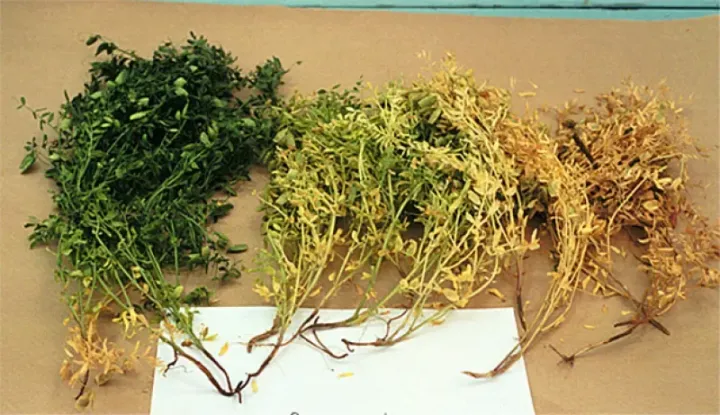
The most prominent symptom of lentil yellows is a distinct chlorosis, where the leaves turn yellow. This discoloration typically starts at the top of the plant and spreads systematically over time.
Infected plants exhibit severe stunting and reduced internode length. This gives the lentil plant a characteristic "witches' broom" or bushy appearance, which is a classic sign of severe phytoplasma infection.
Floral malformation, known as virescence, is a diagnostic feature. Flowers may turn green and leaf-like, failing to develop normally, which effectively halts the plant's reproductive cycle.
Affected plants produce few or no pods. If pods do form, they are often shriveled, empty, or contain small, non-viable seeds, leading to a significant loss in total grain yield.
- Generalized yellowing of foliage.
- Dwarfism and stunted growth.
- Virescence (green, leaf-like flowers).
- Total failure of pod set and seed production.
Pathogen
Lentil yellows is a serious disease caused by phytoplasmas, which are specialized bacteria lacking a cell wall. These pathogens colonize the phloem of host plants, disrupting the translocation of essential nutrients and sugars.
The transmission of lentil yellows is exclusively mediated by insect vectors, primarily leafhoppers. These insects ingest the phytoplasma while feeding on infected plant sap and transmit it to healthy plants during subsequent feeding.
Once inside the plant, the phytoplasma travels systemically through the phloem. Because it integrates into the vascular system, the infection becomes irreversible, causing chronic physiological stress to the entire plant.
Beyond lentils, the pathogen affects a broad range of legume crops and wild weeds. These hosts serve as reservoirs, allowing the phytoplasma to persist in the environment between growing seasons.
Since phytoplasmas lack a cell wall, they are completely resistant to conventional fungicides. Therefore, crop management must focus on breaking the transmission cycle by controlling insect vector populations.
Conditions for development
The prevalence of lentil yellows is heavily influenced by the presence and migration patterns of leafhoppers, which thrive in warm and dry environmental conditions. These weather patterns facilitate rapid insect reproduction.
Mild winters allow leafhopper populations to survive on perennial weeds surrounding agricultural fields. Once spring arrives, these insects move into lentil fields, bringing the pathogen with them.
Uncultivated field margins act as epicenters for disease outbreaks. The presence of dense weed populations provides a protected habitat for both the insect vectors and the phytoplasma reservoirs.
Crop health also plays a role in disease susceptibility. Lentil fields that are sparsely planted or suffering from moisture stress may be more attractive to foraging leafhoppers looking for food.
Outbreaks are frequently focal in nature. Initial clusters of infected plants appear at the edge of the field, and the disease gradually spreads inwards as the vector population shifts across the crop canopy.
Why it matters
The economic impact of lentil yellows can be devastating, with potential yield losses reaching 80-90% in severe cases. Infected plants contribute almost nothing to the final harvest, effectively reducing the productive area of the field.
Seed quality from partially affected plants is significantly degraded. The resulting seeds are often lightweight and have poor germination vigor, making them entirely unsuitable for use in future planting.
The disease forces farmers to implement costly and frequent insecticide spraying programs to manage the vector. This increase in production costs significantly erodes the profit margins of lentil cultivation.
Visual uniformity of the field is compromised, complicating field operations such as harvesting. The presence of dried, stunted patches makes it difficult to manage the crop during the final ripening stage.
Long-term field health is at risk due to the accumulation of inoculum in the environment. Unless weeds and crop residues are managed, the pathogen remains a persistent threat for subsequent legume rotations.
Protection
The most effective strategy for managing lentil yellows is the intensive control of leafhopper populations. Systemic insecticides are recommended to prevent the vectors from feeding and transmitting the pathogen to the crop.
Effective weed management is essential. By eliminating weeds on field perimeters and in nearby wasteland, farmers can remove the primary breeding sites for insect vectors and destroy the inoculum reservoirs.
Maintaining proper spatial isolation between lentil fields and perennial legumes can help delay the migration of leafhoppers. Strategic timing of planting can also help the crop bypass the peak activity of the vectors.
Using certified, clean seed is a fundamental practice to ensure the crop starts with the best possible vigor. While insect transmission is the main route, clean seeds are essential for building natural plant resistance.
Ongoing monitoring of leafhopper populations using yellow sticky traps is a critical management tool. Data from these traps allow for timely interventions, ensuring that insecticide applications are made before the disease becomes widespread.
Pathogens and affected parts
Affects crops · 1
Discussion
No discussions yet — be the first.