
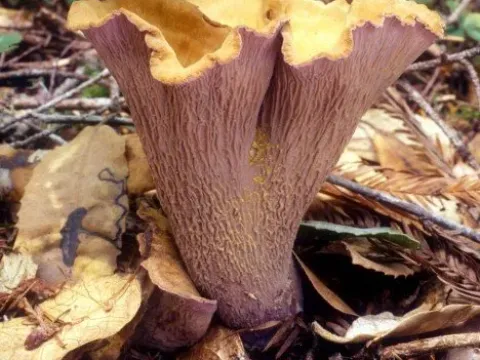
Gomphus clavatus
Gomphus clavatus
Gomphus clavatus, often known as the pig's ear, features a distinct club-shaped or cluster-like fruiting body that looks like a coral formation.
What the section contains
Gomphus clavatus
The color of the fruiting body ranges from vibrant violet to ochre-yellow, making it a visually striking specimen in the forest floor ecosystem.
Its flesh is firm and white, possessing a pleasant mushroom-like scent, which is characteristic of healthy, non-parasitic fungal species.
The fertile surface is usually smooth or slightly wrinkled, extending down the stem to create a unified structural appearance.
These mushrooms grow in clusters, often reaching up to 15 centimeters in height, standing out amidst the pine needles and forest debris.
Gomphus clavatus is not a plant disease or pathogen. It is a mycorrhizal fungus that lives in a mutualistic relationship with coniferous trees.
It does not infect or damage living plant tissues; instead, it provides essential nutrients to the trees, which in turn support the fungal mycelium.
This fungus plays a beneficial role in the forest, facilitating mineral uptake and improving the overall health of the soil and root systems.
It does not cause rots, wilts, or any necrotic lesions, and therefore should never be categorized as a plant pest or a disease agent.
Understanding its role as a symbiont is crucial, as it indicates a healthy forest environment rather than the presence of a disease outbreak.
The fungus thrives in cool, moist, and well-drained soil environments, typically within coniferous or mixed forests with high organic content.
Development is highly dependent on humidity levels and stable temperatures, with fruiting usually occurring after significant rainfall events.
It prefers undisturbed environments where human interference is minimal, allowing the delicate mycelial network to remain intact over long periods.
The fungus is highly sensitive to chemical fertilizers and agricultural runoff, which restricts its presence to ecologically stable habitats.
The presence of old-growth trees and healthy forest litter provides the necessary conditions for its continued survival and reproduction.
Gomphus clavatus causes no harm to agricultural crops or forestry plantations. It is a non-invasive species that contributes to forest stability.
The only harm occurring in relation to this species is the destruction of its habitat by logging, pollution, or soil compaction activities.
There is no economic damage associated with this fungus; in fact, its presence is a sign of high forest quality and biodiversity.
It does not compete for resources in a way that would stunt plant growth, as its primary function is the exchange of nutrients with its tree host.
Therefore, it is ecologically important to protect this species, as it is increasingly rare in many parts of the world due to environmental changes.
No control measures are necessary, as the species is not a pest. Management should focus entirely on conservation and habitat preservation.
Protecting forest areas from deep soil tillage and chemical pollution is the most effective way to ensure the survival of Gomphus clavatus.
Local authorities should prioritize monitoring populations and identifying critical habitats to prevent accidental destruction of the mycelium.
It is advised to maintain natural leaf litter layers, which act as a buffer against environmental stress for the underground fungal network.
Education is key; stakeholders and foresters should be aware that this is a beneficial organism that deserves protection rather than elimination.