
Description
Symptoms
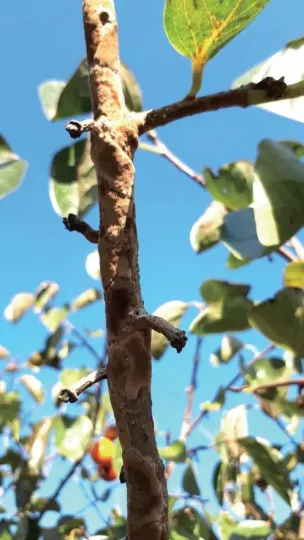
The first sign of the disease is the appearance of characteristic patches on young and old branches. Externally, they resemble a dense, velvety coating with a grayish or brownish tint.
As the fungal colonies grow, they turn into thick crust-like formations. They wrap tightly around the affected areas, resembling felt or suede in structure, which is why it is commonly known as felt fungus disease.
Upon careful inspection, colonies of scale insects can always be found under the fungal layer. The fungus completely hides the pests, making visual diagnosis of the insects impossible without removing the fungal mat.
In severe cases, affected branches are covered with a continuous layer of mycelium. This leads to cracking of the bark and disrupts the normal gas exchange of plant tissues with the environment.
Disease progression is often accompanied by general tree decline. Branches may become brittle, and their tips may gradually die back, indicating a disruption in the nutrition of plant tissues.
Pathogen
The causal agent of felt fungus disease is the fungus Septobasidium bogoriense, which belongs to the basidiomycetes class. This pathogen is an obligate parasite closely associated with colonies of scale insects.
The fungus does not penetrate deep into the plant tissues but develops on the surface of branches and trunks, forming specific fungal mats. This symbiotic relationship allows the pathogen to use insects as a source of food and a means of dispersal.
The biology of the pathogen is linked to the protective properties of scale insect colonies. The fungus creates a dense felt-like layer under which insects receive extra protection from predators and environmental conditions.
The life cycle of Septobasidium bogoriense depends directly on the activity of its symbionts. Spore dispersal occurs via wind and rain splashes, with new infections occurring primarily in areas infested by pests.
This type of infection is classified as a superficial fungal disease. Although it does not directly destroy the wood, the constant presence of the fungal mat negatively impacts the physiological processes of the bark.
Conditions for development
The development of felt fungus disease requires high air humidity and moderate temperatures. Ideal conditions are created in dense, poorly ventilated tree canopies where moisture stagnates.
In tropical and subtropical climates, where Indian mango grows, the disease manifests year-round. The absence of a distinct dormancy period allows the pathogen to constantly expand its coverage on the bark.
A critical factor is the presence of scale insect populations. Without them, the fungus cannot thrive, so the severity of the disease is directly proportional to the level of pest infestation.
Frequent rainfall facilitates the spread of basidiospores throughout the tree canopy. Water makes it easier for spores to attach to the smooth surface of the bark and establish the primary mycelial layer.
Inadequate orchard maintenance, lack of pruning, and absence of preventive treatments create a favorable microclimate for the fungus to take hold. Neglected older orchards are more prone to infection than young, well-cared-for trees.
Why it matters
The main damage consists of suppressing the metabolism of the tree bark. The dense fungal layer blocks lenticels, hindering tissue respiration and leading to localized necrosis.
The infection leads to slowed branch growth and reduced yield in fruit trees. For mangoes, this can affect fruit quality as the plant is forced to divert resources toward maintaining the affected areas.
The disease facilitates secondary infection of the bark by other pathogens. Bacteria that cause wood rot often settle in the areas damaged and covered by the felt mat.
Massive spread of Septobasidium bogoriense causes premature leaf drop and the death of fruit-bearing twigs, significantly reducing the tree's lifespan.
Economic losses arise not only from yield reduction but also from the need for expensive sanitation measures. In severe cases, heavy pruning of affected branches is necessary, which alters the tree's architecture.
Protection
The basis of control is the management of scale insect populations. The use of systemic insecticides reduces pest numbers, making conditions unfavorable for the fungus to survive.
An important step is sanitary pruning and the removal of heavily infected branches. After removal, it is necessary to ensure good canopy aeration, which is critical to preventing re-infection.
The use of copper-based fungicides helps to eliminate the superficial mycelial layer and prevent spore germination. Treatments should be applied during periods of low air humidity.
For prevention, maintain optimal tree health through balanced nutrition. Strong plants have higher resistance to colonization by pathogenic fungi.
Regular monitoring of bark condition allows for early detection of the disease. Timely removal of the fungal coating and treatment of damaged areas facilitate rapid tissue regeneration.
Pathogens and affected parts
Affects crops · 1
Discussion
No discussions yet — be the first.