
Description
Symptoms
The primary sign of a cyst nematode infestation is stunted plant growth, often mistakenly attributed to nutrient deficiency. The root system appears underdeveloped, showing excessive branching as the plant attempts to compensate for lost surface area.
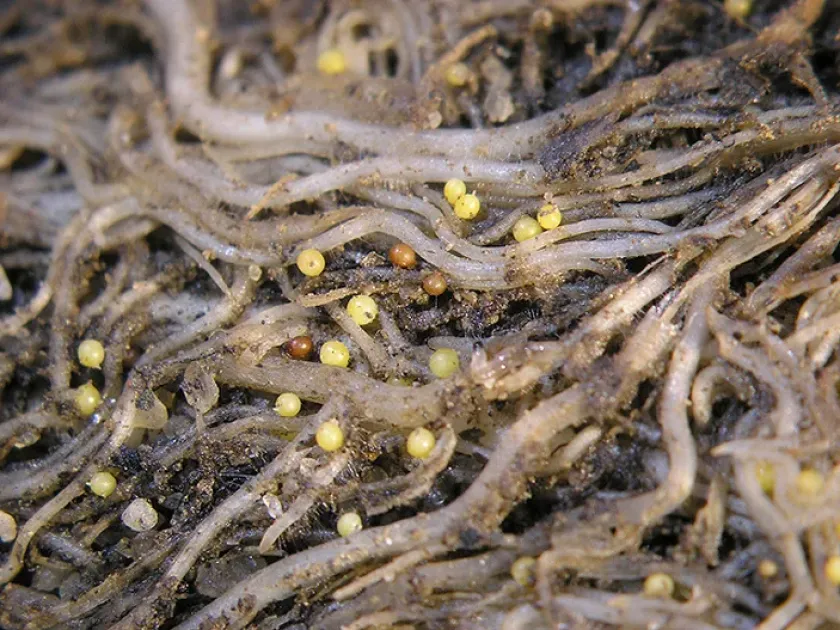
Upon close inspection of the roots during the growing season, microscopic round or lemon-shaped bodies — cysts — can be observed. These are the dead bodies of females, which contain eggs and larvae of the parasite.
The above-ground parts of the plant exhibit signs of chlorosis, leaves yellow, and premature shedding occurs. In fields, infestation spots often appear as patches of uneven growth or stunted development.
In crops like chickpeas, nematode infestation leads to weak flowering and a significant reduction in pod set. Affected plants often appear dwarf-like compared to healthy plants in adjacent rows.
On cranberries, nematodes cause general weakening of the bushes, making the plants susceptible to secondary fungal infections. Infested plantation areas lose their commercial value and show reduced berry productivity.
Pathogen
The disease is caused by microscopic parasitic worms belonging to the Heteroderidae family. These are obligate endoparasites, whose life cycle is strictly linked to root exudates of specific host plants.
The life cycle includes the egg stage, four larval stages, and the adult stage. Second-stage larvae penetrate the root, where they undergo further development and feeding.
After fertilization, females lose mobility and transform into a dense protective shell known as a cyst. In this form, the parasite can survive in the soil for several years, enduring harsh conditions.
Cyst nematodes are highly host-specific. Different species specialize in attacking particular families of crops, such as legumes, solanaceous plants, or berry crops.
Spread occurs passively: via contaminated soil, root debris, planting material, irrigation water, or agricultural machinery. Cysts are extremely resistant to mechanical damage.
Conditions for development
Nematode development is directly dependent on soil temperature. The optimal range for larval activity usually falls between +15 and +25 degrees Celsius.
Soil moisture plays a critical role in larval migration in search of plant roots. Both waterlogged and overly dry soils can slow activity, although cysts are highly tolerant to drought conditions.
Frequent cultivation of the same crop on the same field without proper crop rotation creates ideal conditions for the buildup of the infection. Population density increases exponentially each season.
Soil type also affects spread. Light sandy or loamy soils facilitate faster movement of larvae in the soil solution compared to heavy clay soils.
Soil biological activity and the presence of organic fertilizers can either suppress nematodes (due to antagonistic microflora) or support their life cycle depending on the specific ecosystem balance.
Why it matters
The main harm consists of yield loss. Parasites consume nutrients intended for fruit and seed growth, depleting the host plant significantly.
Damage to root tissues provides an entry point for fungal and bacterial pathogens. Often, nematodosis is accompanied by root rots, which exacerbate the process of plant decay.
Economic damage stems from reduced product quality and the necessity of implementing expensive protective measures. In severe cases, total crop failure is possible.
In chickpeas, nematodes reduce both the volume of pods and their quality, resulting in shriveled seeds with low germination rates and poor seedling vigor.
The prolonged presence of nematodes in a field makes it impossible to grow susceptible crops for many years due to the massive accumulation of cysts in the topsoil.
Protection
The cornerstone of protection is a well-planned crop rotation. Using crops that are not hosts for a specific nematode species allows for natural suppression of the parasite population.
Utilizing resistant cultivars and hybrids is the most effective and eco-friendly control method, minimizing the chemical burden on the soil.
Strict phytosanitary practices must be followed: thorough cleaning of machinery after working in infested fields and the use of healthy, certified planting material only.
Agrotechnical practices, such as deep plowing and the use of cover crops (e.g., specific mustard or oilseed radish varieties), help suppress nematode development in the soil.
Chemical control (nematicides) is only used in extreme cases with critical infestation levels, as these products are often toxic to soil biota and require strict adherence to regulatory standards.
Pathogens and affected parts
Affects crops · 2
Discussion
No discussions yet — be the first.