
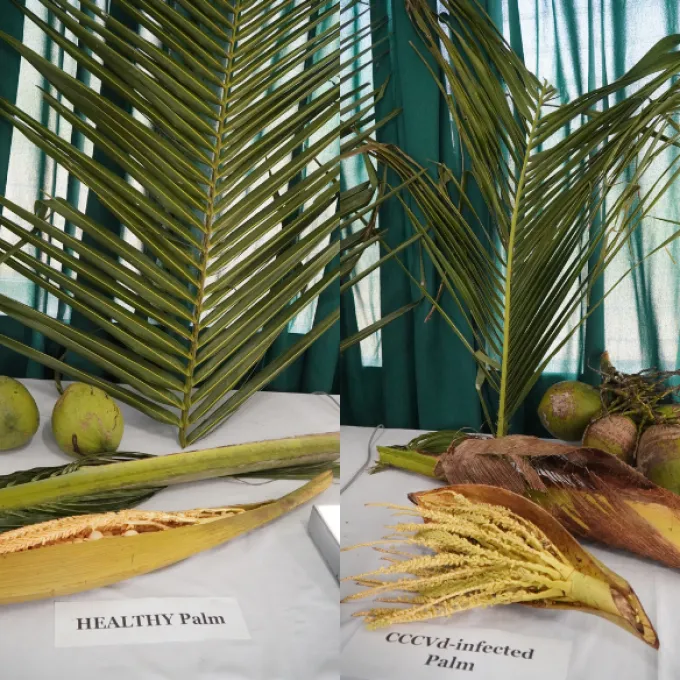
Description
Symptoms
Early symptoms include the appearance of small, water-soaked, chlorotic spots on the leaves, which gradually develop into a pervasive yellowing.
Affected palm trees show stunted growth, and the leaves become progressively smaller, deformed, and brittle as the infection advances.
Fruit production is severely impacted, with the palm producing smaller, rounded coconuts that eventually stop developing altogether.
In the final stages of the disease, the palm stops producing flowers and fruits, and the crown becomes thin, eventually leading to the death of the tree.
The progression of the disease is slow, often taking several years from initial infection to the visible manifestation of symptoms.
Pathogen
The causal agent of cadang-cadang is the Coconut cadang-cadang viroid (CCCVd), which is one of the smallest known plant pathogens, consisting solely of circular RNA.
The viroid lacks a protein coat and relies entirely on the host plant's enzymatic machinery for replication, disrupting normal cellular functions.
It is remarkably stable and can survive in plant debris, making it difficult to eradicate once it has established itself in an area.
The pathogen spreads systemically throughout the entire plant, moving through phloem tissues to infect all parts of the palm.
Extensive research has confirmed that CCCVd is the primary cause of this devastating disease, which has caused massive losses in coconut-producing regions.
Conditions for development
The disease is primarily spread mechanically through the use of contaminated tools such as saws, knives, and harvesting equipment.
Studies suggest that the viroid can also be transmitted via pollen or through root contact between adjacent palm trees in high-density plantations.
The humid and warm climate of the tropics provides optimal conditions for the viroid's survival and systemic movement within the host plant.
The lack of a known insect vector complicates management, as the spread is often linked to human agricultural activities and root systems.
High-density planting configurations significantly accelerate the spread of the viroid between trees within a localized area.
Why it matters
Cadang-cadang is lethal, and there is no known cure for infected palms; the mortality rate of diseased trees is essentially one hundred percent.
The socio-economic impact is devastating, as the disease can destroy entire plantations, leading to long-term income loss for farmers.
Global coconut oil production is at risk, as the spread of the disease limits the land area available for safe and productive coconut farming.
Replanting efforts are frequently thwarted by the presence of the viroid in the soil or local environment, making it difficult to re-establish healthy crops.
The loss of ecological stability in affected regions is significant, as coconut palms are often the primary canopy cover and economic backbone.
Protection
Management strategies focus on rigorous sanitation and prevention, as there are no chemical pesticides or treatments to eliminate the viroid.
The most effective strategy is the immediate removal and destruction of symptomatic palms to serve as a barrier to further transmission.
Strict tool sterilization protocols must be enforced, requiring disinfection between every single tree to prevent cross-contamination.
Quarantine measures are essential to limit the movement of coconut seedlings and plant material from infected regions to healthy areas.
- Continuous monitoring for early detection of chlorotic symptoms.
- Strict adherence to sanitation protocols by field workers.
- Complete eradication of infected trees including root systems.
Pathogens and affected parts
Affects crops · 1
Discussion
No discussions yet — be the first.