
Description
Symptoms
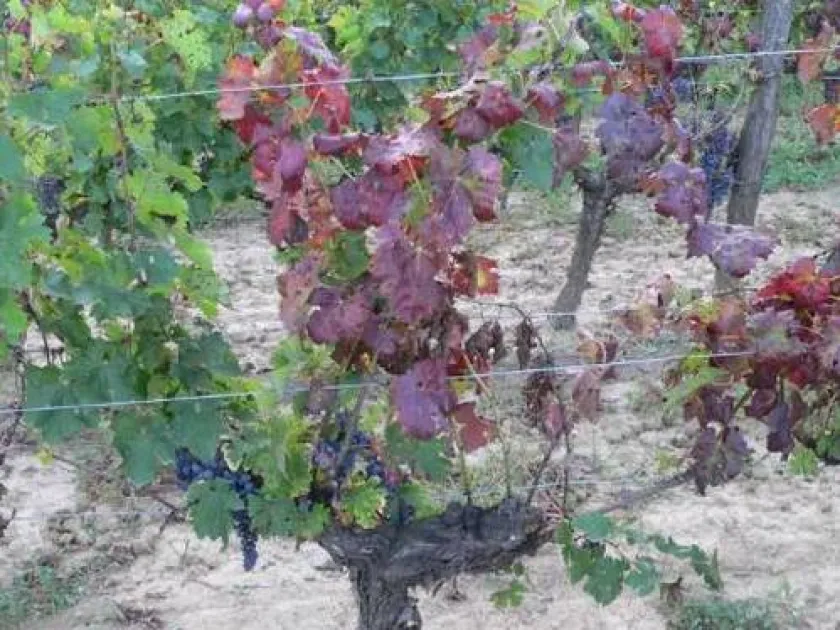
Symptoms typically appear in mid-summer, characterized by the leaf blades curling downwards and forming a pyramid-like shape.
In white grape varieties, leaves develop a yellow discoloration, while in red varieties, they turn reddish, often accompanied by necrotic spots.
Affected shoots often show poor lignification, meaning they do not harden off properly, making them highly susceptible to winter frost damage.
Inflorescences often wither or fail to set fruit, and any grapes that do form are usually small, shriveled, and of very poor quality.
Over time, the root system weakens, leading to a general decline in the vine's vigor and its eventual death over a period of a few seasons.
Pathogen
Bois noir is a serious disease of grapevines caused by the phytoplasma Candidatus Phytoplasma solani, which infects the plant's phloem tissue.
This organism belongs to the group of grapevine yellows diseases and is spread primarily by the planthopper Hyalesthes obsoletus.
The phytoplasma colonizes the sieve tubes, effectively disrupting the flow of photosynthates from the leaves to the rest of the grapevine.
Because these pathogens are obligate parasites, they rely entirely on the insect vector to move between different host plant species.
Molecular diagnostic methods, such as PCR, are required to accurately distinguish Bois noir from other similar phytoplasma-induced diseases.
Conditions for development
The disease spread is heavily dependent on the presence of wild host plants like field bindweed and stinging nettle near the vineyard.
The planthopper vector Hyalesthes obsoletus spends its larval stages on the roots of these weeds, where it acquires the phytoplasma.
Warm and dry weather conditions favor the movement of adult insects from the weed reservoir into the grape canopy to feed.
Vineyards located near abandoned fields or unmanaged meadows are at a significantly higher risk of experiencing localized outbreaks.
Water stress and poor soil management practices can exacerbate the impact of the disease by weakening the vines' natural defenses.
Why it matters
The primary economic harm is caused by significant reductions in yield and the degradation of fruit quality, making it unsuitable for winemaking.
Because there is no cure for an infected vine, the disease often leads to the premature removal and replanting of entire vineyard sections.
Increased vulnerability to frost damage often results in permanent canopy loss and the death of young vines in colder viticultural regions.
Management costs are high due to the necessity of rigorous weed control and the implementation of long-term monitoring programs.
The loss of plant productivity affects the long-term profitability of the vineyard and may force a change in the varieties grown.
Protection
Effective management focuses on breaking the disease cycle by eliminating the reservoir weeds, especially bindweed, from the vineyard periphery.
Insecticide applications aimed at controlling the vector Hyalesthes obsoletus must be precisely timed during the peak flight of adults.
Maintaining clean cultivation in and around the vineyard is a critical preventive measure against the establishment of the vector population.
It is vital to use only certified, disease-free planting material to prevent the introduction of phytoplasmas into a new vineyard site.
- Early identification of symptomatic vines.
- Prompt removal of diseased plants.
- Effective weed management strategies.
- Vector monitoring with sticky traps.
Pathogens and affected parts
Affects crops · 1
Discussion
No discussions yet — be the first.