
Description
Symptoms
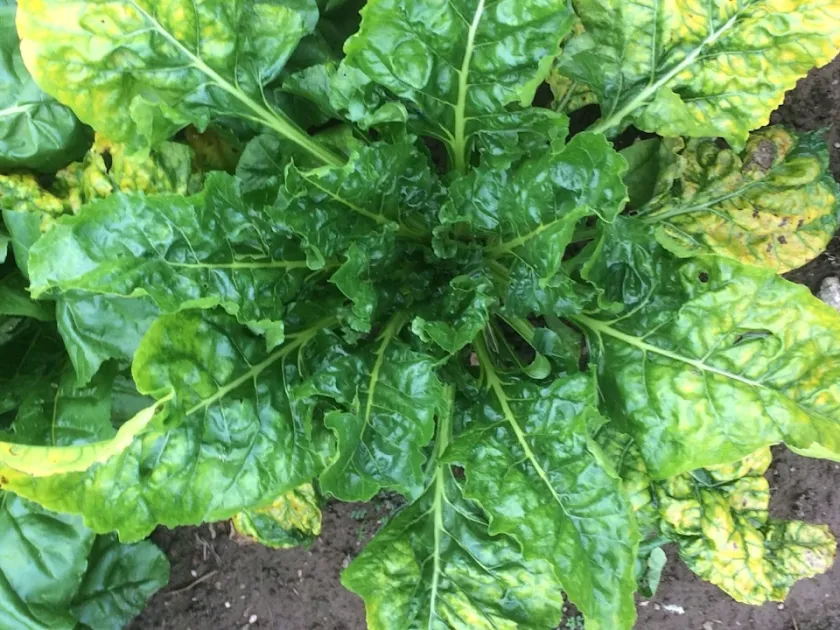
Early symptoms include a noticeable yellowing of the older leaves, typically starting from the tips and spreading towards the base.
The yellowed areas often remain thickened, leathery, and brittle, while the leaf veins usually retain their original green color.
As the disease progresses, the plants appear stunted, and the overall vigor of the crop is significantly reduced throughout the field.
Visible symptoms often appear in patches corresponding to the initial infestation areas of the aphid colonies across the planting area.
Severe infections lead to premature leaf senescence and death, causing the plant to produce a new, often weaker, leaf rosette.
Pathogen
The disease is caused by the Beet yellows virus (BYV), a member of the Closteroviridae family, which primarily infects Chenopodiaceae plants.
The virus has a semi-persistent transmission mode, meaning it is acquired and transmitted by aphids during feeding on infected plants.
The main vector for the virus is the green peach aphid (Myzus persicae), although other aphid species also contribute to the spread of the pathogen.
The virus cannot be transmitted mechanically through seeds or physical contact between plants; it requires the vector for survival and dispersal.
Overwintering sources include infected beet crops, seed crops, and various weed hosts that harbor the virus during the off-season.
Conditions for development
The spread of the disease is highly correlated with the presence and activity levels of aphid populations during the growing season.
Warm and dry weather conditions are ideal for the development and rapid migration of winged aphids, which facilitates wide-scale virus dispersal.
The proximity of new beet fields to overwintered seed crops or untreated fields significantly increases the risk of early infection.
Stress factors such as drought or poor soil management can exacerbate the symptoms and make the plants more susceptible to damage.
Optimal virus replication within plant tissues occurs at moderate temperatures, often during the peak growth phases of the beet plant.
Why it matters
The economic impact of the disease is severe, primarily due to the significant reduction in root yield and sugar content.
Infected sugar beet plants show a lower sucrose concentration, making them less valuable for processing and industrial extraction.
For fodder beet, the disease causes a reduction in biomass and changes in nutritional quality, which decreases feed value for livestock.
Plant weakened by the virus are more prone to secondary fungal infections, further complicating the agricultural management and harvest.
In cases of early-season infection, crop loss can exceed 50 percent, rendering the field economically non-viable for profitable farming.
Protection
The primary control strategy involves spatial separation between new beet plantings and old fields or seed crop locations.
Strict weed control measures, especially in surrounding areas, are essential to eliminate alternative hosts for the virus and aphids.
Integrated pest management focusing on aphid control through timely application of insecticides is critical to limit the initial spread.
Selecting and planting resistant or tolerant hybrid varieties is one of the most effective long-term strategies for managing the virus.
- Implementing proper crop rotation cycles.
- Monitoring aphid populations regularly.
- Removing volunteer beet plants after harvest.
- Ensuring healthy soil fertility to improve plant resilience.
Pathogens and affected parts
Affects crops · 1
Discussion
No discussions yet — be the first.