
Description
Symptoms
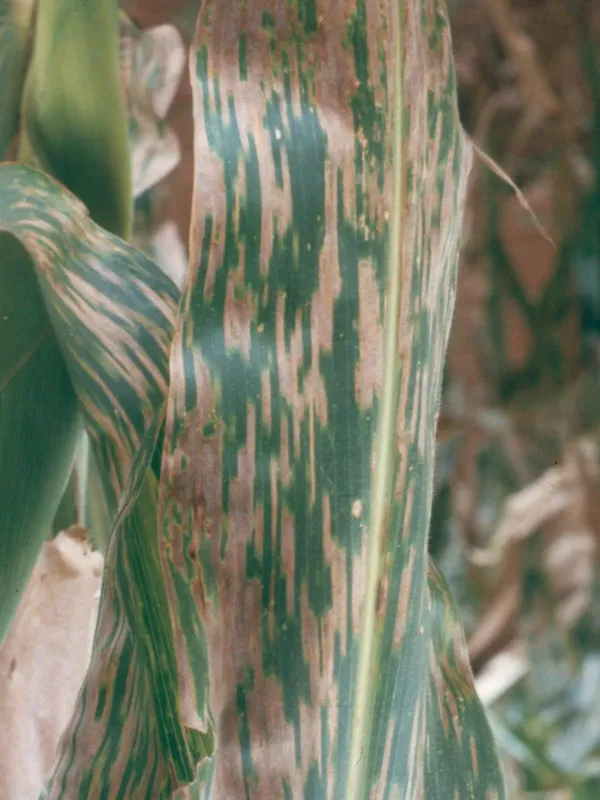
Initial visual symptoms appear as narrow, elongated stripes on the leaves, ranging from yellow to brown. These stripes run parallel to the leaf veins and span the entire length of the blade.
Over time, the affected tissue dies, turning dark brown. Necrotic stripes may merge, causing the leaves to dry prematurely and shred along the veins, giving the plant a ragged, unkempt appearance.
Infected plants exhibit stunted growth and poor tillering, often resulting in dwarfed specimens. In severe cases, the spike may be poorly developed or completely sterile, preventing any grain yield.
Under conditions of high humidity, a faint gray-olive fungal growth consisting of conidiophores and conidia may emerge on the leaf surface. This layer serves as the primary source of secondary spread within the field.
The infection of the flag leaf and glumes is of critical diagnostic importance. In these tissues, the pathogen actively produces spores that contaminate healthy grains during the flowering stage.
Pathogen
The disease is caused by the pathogenic fungus Pyrenophora graminea (anamorph Drechslera graminea). This is a highly specialized parasite that primarily targets barley, including winter varieties.
The fungus belongs to the Ascomycetes class and survives in the seed as mycelium located within the grain husks. While the pathogen can persist in the soil for a limited time, the seed remains the primary vector for transmission.
The fungus's life cycle is closely integrated with the growth of the host plant. Infection occurs during seed germination, after which the mycelium systematically colonizes the developing shoot and spreads upward.
The progression of the fungus within plant tissues is cryptic. The pathogen moves toward the growing point, invading the internodes and eventually the embryos of newly forming seeds, ensuring the survival of the fungus for the next season.
As a necrotroph, the fungus destroys plant tissue by secreting specific toxins. These metabolites inhibit plant growth and induce visible chlorotic changes on the leaf blades, severely disrupting normal photosynthetic activity.
Conditions for development
The disease develops most rapidly under moderate temperatures during the early stages of plant growth. Optimal conditions for seed and seedling infection occur at soil temperatures between 10°C and 15°C.
High air humidity during the grain-filling period promotes active sporulation. Rainfall during the flowering phase facilitates the dispersal of conidia onto healthy spikes, ensuring further transmission.
Dense planting of winter barley creates a favorable microclimate for the pathogen. Poor air circulation within the canopy facilitates spore accumulation and accelerates the spread of infection throughout the field.
The risk of infection increases significantly if untreated seeds are planted. Even a small percentage of contaminated grain can trigger an epidemic under favorable weather conditions.
Breaking crop rotation is another major risk factor. Continuous cultivation of barley in the same field encourages the build-up of the pathogen in soil and crop residues, although seed-borne infection remains the dominant mode of spread.
Why it matters
The primary damage caused by African cereal stripe is a substantial reduction in yield. Infected plants often die before reaching the booting stage, resulting in thin and uneven stands.
In surviving plants, the thousand-grain weight is significantly reduced. Due to the destruction of the photosynthetic apparatus, grain filling is incomplete, which compromises both the quantity and quality of the harvest.
Yield losses in severe cases can range from 30% to 50%. Affected areas appear severely depressed, which complicates agricultural operations and limits the efficiency of mechanical harvesting.
The disease severely impacts seed quality. Grain harvested from infected fields becomes a source of primary inoculum for the following season, making it unsuitable for use as seed without rigorous cleaning and treatment.
The economic impact involves both direct yield losses and the increased costs associated with applying protective fungicides and the need to replace poor-quality planting material.
Protection
The fundamental strategy for control is the use of healthy, pathogen-free seed. Utilizing certified seeds that have been tested for fungal infections is the most effective way to minimize field outbreaks.
Seed treatment with systemic fungicides is a mandatory practice. Preparations based on triazoles effectively suppress the mycelium residing within the grain husks, protecting the seedling during early development.
Adhering to proper crop rotation is essential to break the pathogen's life cycle. Returning barley to the same field no sooner than after a 2–3 year interval helps to naturally reduce the infection potential in the soil.
Applying good agronomic practices, such as optimal sowing dates, allows plants to pass through their most vulnerable growth stages faster, thereby minimizing the window for infection to take hold.
Regular monitoring of fields during the tillering and booting phases is crucial. If infection hotspots are identified, integrated management plans—including the selection of resistant cultivars—should be implemented for subsequent seasons.
Pathogens and affected parts
Affects crops · 1
Discussion
No discussions yet — be the first.