
Description
Symptoms
The most distinctive symptom is the bleaching and softening of the wood. Infected sections lose their structural integrity and turn into a white, fibrous mass.
When the wood is subjected to mechanical stress, it tends to peel away in long, stringy fibers, which is the defining characteristic of this specific rot type.
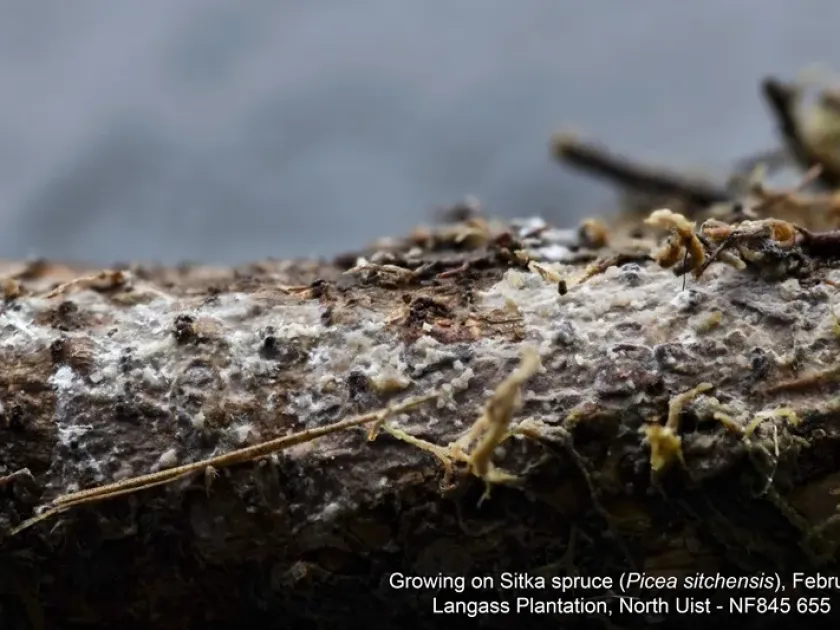
On the exterior of infected logs or tree trunks, thin, resupinate (crust-like) fruiting bodies with a creamy white to pale color may appear during periods of high humidity.
Infected Douglas fir trees often exhibit reduced vigor, premature yellowing of needles, and a noticeable decline in annual growth increments as the decay progresses.
Cross-sections of infected trunks often reveal irregular patches of decayed wood surrounded by dark, zone-like lines that isolate the active infection area.
Pathogen
The causal agent of this disease is the wood-decay fungus Resinicium bicolor, a member of the Basidiomycota phylum. It functions primarily as a saprotroph but frequently acts as a facultative parasite.
This pathogen is responsible for white rot, a process in which it enzymatically degrades lignin and cellulose components of the wood structure, leaving behind a light-colored, fibrous residue.
The fungus spreads via airborne basidiospores and through the vegetative growth of mycelium, which can travel between trees through root contact or grafted root systems.
The pathogen is highly effective at colonizing various conifer species. Its impact is particularly significant in commercial stands of Douglas fir, where it causes stem decay.
Growth is sustained by the fungal ability to penetrate through wounds or dead wood, eventually establishing itself within the heartwood and sapwood of the living tree.
Conditions for development
Development is heavily dependent on moisture. Resinicium bicolor thrives in environments with high relative humidity, such as dense, poorly ventilated stands.
Mechanical injuries caused by logging equipment or environmental damage serve as entry points for the fungus, facilitating initial colonization of healthy trees.
The presence of large amounts of coarse woody debris, such as stumps and dead logs, acts as a primary reservoir, providing a stable habitat for the fungus to multiply.
Stressed trees, whether due to drought, nutritional imbalance, or prior infestation by insects, show reduced defense mechanisms, making them prime targets for fungal establishment.
Temperature fluctuations are generally tolerated well by this fungus, allowing it to remain active throughout most of the growing season in temperate forest regions.
Why it matters
The primary economic harm is the degradation of timber quality. Infected wood loses its physical and mechanical properties, rendering it useless for structural purposes.
Douglas fir stands suffer significant productivity losses, as the rot causes structural instability that makes trees highly susceptible to windthrow during storms.
The infection creates long-term impact on forest health by acting as a source of spores that can infect neighboring, previously healthy trees within the stand.
As decay spreads within the trunk, the merchantable volume of the timber is drastically reduced, leading to financial losses for forestry operations.
In addition, the weakening of the trees often attracts secondary forest pests, which can accelerate the death of the host tree and complicate management efforts.
Protection
Sanitation is the most critical control strategy. Removing dead, dying, and diseased wood from the forest floor helps minimize the availability of substrates for the fungus.
Forestry management should prioritize the protection of standing timber by minimizing mechanical wounds to the bark and roots during thinning or harvesting operations.
Maintaining optimal stand density and promoting tree vigor through appropriate silvicultural practices helps trees build better natural defenses against fungal decay.
If an infection focus is identified, selective removal of affected trees, including the stump, may be necessary to interrupt the spread of mycelium via root contact.
Regular monitoring of forest health is essential for early detection. Prompt removal of infected specimens before they produce fruiting bodies can significantly reduce spore load.
Pathogens and affected parts
Affects crops · 1
Discussion
No discussions yet — be the first.