
Wheat streak mosaic
Tritimovirus tritici
Description
Symptoms
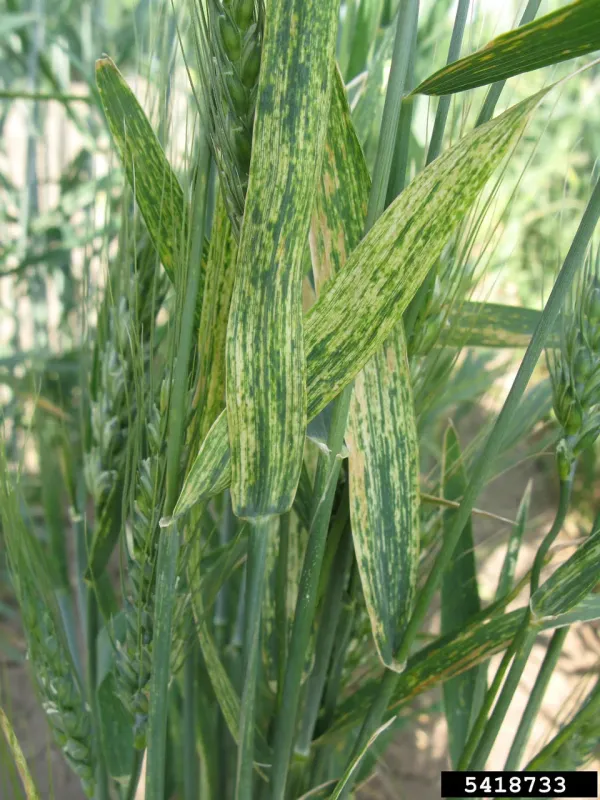
The first symptoms of wheat streak mosaic appear as discontinuous light green or yellow streaks that run parallel to the leaf veins. As the infection progresses, these streaks coalesce into a mosaic pattern that covers the entire leaf blade.
Infected plants exhibit severe stunting and often appear dwarfed compared to healthy crops. They frequently show increased tillering, but these tillers rarely develop into productive heads, leaving the crop looking uneven and sickly.
Under heavy infection pressure, leaf tips may turn yellow, curl, and die prematurely. The overall chlorotic appearance of the plant indicates a significant reduction in photosynthetic capacity, which hampers plant development.
Symptoms typically begin along the edges of fields adjacent to volunteer wheat or grassy areas. Within an individual clump, diseased leaves often appear interspersed with healthy-looking ones, making field detection challenging in early stages.
Final confirmation of the disease requires laboratory diagnostics, such as ELISA or PCR, as symptoms can easily be confused with nutrient deficiencies or other cereal viruses.
Pathogen
The causal agent of this disease is the Wheat streak mosaic virus (WSMV), a member of the Tritimovirus genus. It is a filamentous, single-stranded RNA virus that relies on specific environmental conditions for transmission.
The primary vector for the virus is the wheat curl mite (Aceria tosichella). These microscopic mites acquire the virus while feeding on infected plants and remain infectious for the duration of their lifespan.
The host range of the virus is quite broad, including winter and spring wheat, corn, millet, and various grassy weeds that act as reservoirs for the virus during the off-season.
Transmission occurs primarily through the activity of these mites, although mechanical transmission via sap contact is possible. The mites are easily carried by wind over long distances, facilitating the spread of the virus between fields.
WSMV is not soil-borne or seed-borne, meaning that the management of living plant tissue reservoirs is the most critical aspect of disease epidemiology.
Conditions for development
Epidemics of wheat streak mosaic are heavily dependent on the population dynamics of the wheat curl mite. Warm and dry autumns are ideal for mite reproduction and their migration from mature crops to emerging winter wheat.
A crucial risk factor is the "green bridge"—volunteer wheat or grassy weeds that survive between harvest and the emergence of the new crop. The virus and its vector thrive on these hosts throughout the summer.
Early planting dates for winter wheat drastically increase the likelihood of infection because seedlings emerge when mite activity is at its peak during late summer and early autumn.
Mild winters allow the virus and the vector to survive in infected plants, leading to earlier and more severe symptom expression in the spring across overwintering cereal crops.
Drought stress during the growing season further weakens plant immunity, making wheat more susceptible to viral colonization and reducing the plant's ability to tolerate the infection.
Why it matters
Wheat streak mosaic is considered one of the most destructive viral diseases in wheat, potentially causing total crop failure in heavily infected fields during epidemic years.
The primary impact is a severe reduction in both yield and grain quality. Infected plants produce shriveled, underdeveloped kernels, significantly lowering the test weight and overall grain volume.
The virus disrupts metabolic processes, leading to reduced protein and gluten content. This degradation in quality makes the grain less desirable for milling and baking purposes.
Infected plants suffer from reduced cold hardiness, making them more prone to winterkill, which leads to thin plant stands and the potential need for spring reseeding.
The economic loss involves not only direct yield reduction but also the cost of implementing extensive cultural practices to manage the disease reservoirs across the farm.
Protection
The most important control measure is the total elimination of the "green bridge" by removing all volunteer wheat and grassy weeds at least two to three weeks before planting winter wheat.
Adjusting planting dates to later in the season helps avoid the peak migration period of the wheat curl mite, significantly reducing the initial infection pressure on the seedlings.
Planting resistant wheat varieties is the most cost-effective and reliable management strategy available, providing consistent protection even when the virus is present in the environment.
Maintaining spatial separation between winter wheat fields and those containing summer crops or grassy areas helps limit the migration distance of the mite vector.
Chemical control of the mite vector is generally ineffective due to the rapid spread of the virus, making rigorous adherence to cultural and preventative practices the cornerstone of WSMV management.
Discussion
No discussions yet — be the first.