
Description
Symptoms
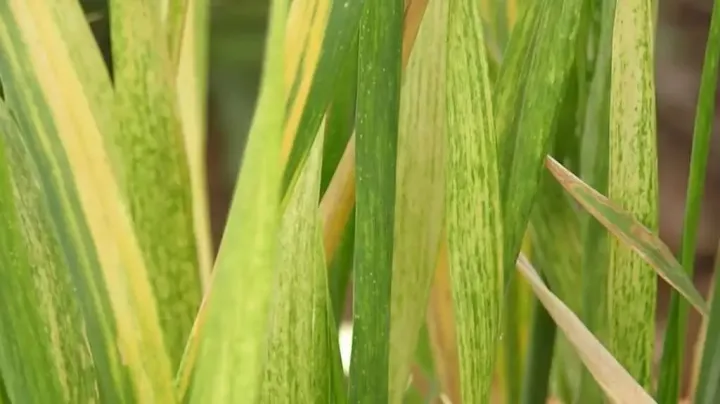
The primary symptom of the disease is the development of a characteristic pattern on leaves and sheaths, consisting of light-green or yellowish stripes and stippling.
At the beginning of the growing season, infected plants often appear chlorotic, showing stunted growth and an unusually dense tillering pattern due to hormone disruption.
As the disease progresses, the affected leaf tissue may develop necrosis, leading to premature yellowing and withering, which severely weakens the plant.
Infected plants typically exhibit smaller physical dimensions, shorter internodes, and a poorly developed root system that hinders efficient nutrient uptake.
By the heading stage, infected plants often produce shriveled grains or malformed, sterile heads, which significantly reduces overall crop yield.
Pathogen
The disease is caused by the Wheat streak mosaic virus (WSMV), which is a member of the Potyviridae family.
This virus is not soil-borne or seed-transmitted; instead, it is transmitted exclusively by the wheat curl mite (Aceria tosichella).
The virus survives in living host tissues, including volunteer wheat and barley, as well as various perennial grassy weeds found in field margins.
The mite vector migrates primarily through wind currents, allowing the virus to spread rapidly from primary sources to healthy wheat fields.
The viral biology is deeply intertwined with the life cycle of the mite, which requires green vegetation to feed and reproduce throughout the season.
Conditions for development
The spread of the disease is favored by warm, long, and dry autumns, which provide optimal conditions for the mite population to increase and migrate.
Early planting of winter wheat often leads to higher infection rates because young seedlings are exposed to the peak flight of the mite vector.
The presence of volunteer wheat or grassy weeds near newly planted fields is a critical risk factor for the development of severe outbreaks.
The period between seedling emergence and tillering is the most critical window for infection, as young plants are highly susceptible to the virus.
A mild winter that allows mites to survive in the crown of plants or on crop residues ensures an early start to the disease cycle in spring.
Why it matters
The economic impact of the virus is manifested in significant reductions in grain weight and quality, often resulting in severe yield losses.
Heavy infections can cause stand thinning due to plant death, as infected crops are less able to survive winter stress and harsh spring conditions.
Infected plants are more vulnerable to secondary infections, such as root rot pathogens, due to the suppression of the plant's overall immune response.
Yield loss can range from 10% to 50% or more depending on the severity of the infection and the timing of the initial exposure to the virus.
Damage caused by the virus renders fertilizer and pesticide applications less effective, as the physiological processes of the crop are fundamentally impaired.
Protection
The most important control strategy is maintaining adequate spatial isolation between new winter wheat fields and areas with volunteer plants.
Destroying volunteer wheat and grassy weeds at least two weeks before planting is essential to eliminate the "green bridge" that supports the mites.
Adjusting planting dates is recommended; delaying planting can reduce the contact time between vulnerable seedlings and the mite vectors.
Utilizing resistant or tolerant wheat cultivars remains the most effective and sustainable method for managing this viral disease.
Implementing consistent weed control programs in and around fields significantly reduces the reservoir of the virus and the mite population.
Pathogens and affected parts
Affects crops · 1
Discussion
No discussions yet — be the first.