
Trachelomonas volvocina
Trachelomonas volvocina
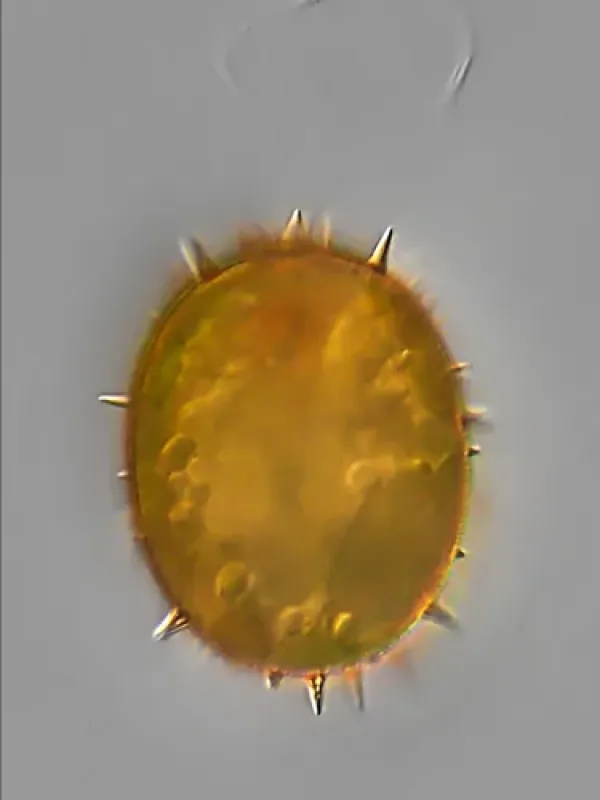
Description
Pathogen
Trachelomonas volvocina is a single-celled flagellated organism belonging to the euglenoid algae group. While it is not a direct pathogen to plant tissues, it acts as a biological contaminant in agricultural water systems.
The cell is encased in a rigid, spherical envelope known as a lorica, which often contains iron and manganese deposits, giving it a distinctive reddish-brown appearance.
In agronomy, this species is recognized as a common inhabitant of fresh water sources, including reservoirs and irrigation channels, often indicating high nutrient levels.
Its biological structure allows it to survive in various conditions, making it a persistent presence in stagnant or slow-moving water bodies used for farming.
As a planktonic organism, its proliferation is driven by environmental cues, which can interfere with precision irrigation or hydroponic nutrient solutions.
Conditions for development
The development of Trachelomonas volvocina is strongly favored by eutrophic conditions, where nitrogen and phosphorus runoff from fields provide abundant food.
Warm water temperatures, typically between 20°C and 25°C, create the ideal environment for rapid cell division and the formation of large blooms.
The presence of dissolved iron and manganese in the water is essential for the formation of the lorica, which explains why this organism thrives in mineral-rich waters.
Poor water circulation in storage tanks allows the organism to colonize the top layers of the water column, where light availability is highest.
Extended daylight hours and high solar radiation significantly enhance the photosynthetic capacity of these algae, leading to exponential population growth.
Why it matters
The primary concern regarding Trachelomonas volvocina is the physical clogging of drip irrigation lines and micro-emitters, which leads to uneven plant watering.
In hydroponic setups, a massive bloom can drastically lower oxygen levels in the nutrient solution, causing root stress and reduced nutrient uptake efficiency.
The metabolic activities of the algae can shift the pH balance of the irrigation water, making it difficult to maintain stable nutrient availability for crops.
Accumulation of dead algal biomass can encourage the colonization of secondary bacteria or fungi, which may pose a risk to the health of the plants.
The presence of these organisms often results in turbid water, making it impossible to visually inspect the condition of roots in hydroponic systems.
Protection
Implementing UV water sterilization systems is a highly effective way to manage and reduce Trachelomonas volvocina populations in irrigation lines.
Regular mechanical cleaning of water reservoirs and pipes helps prevent the buildup of algal colonies and associated organic matter.
Utilizing high-quality fine filters can physically remove cells from the water supply, preventing them from entering the irrigation system.
Managing the nutrient runoff and improving the quality of irrigation water sources can significantly curb the potential for algal blooms.
Routine monitoring of water chemistry and microscopic analysis of the water source are essential for early detection and preventative maintenance.
Discussion
No discussions yet — be the first.