
Tobacco stunt
Tobacco stunt virus
Description
Symptoms
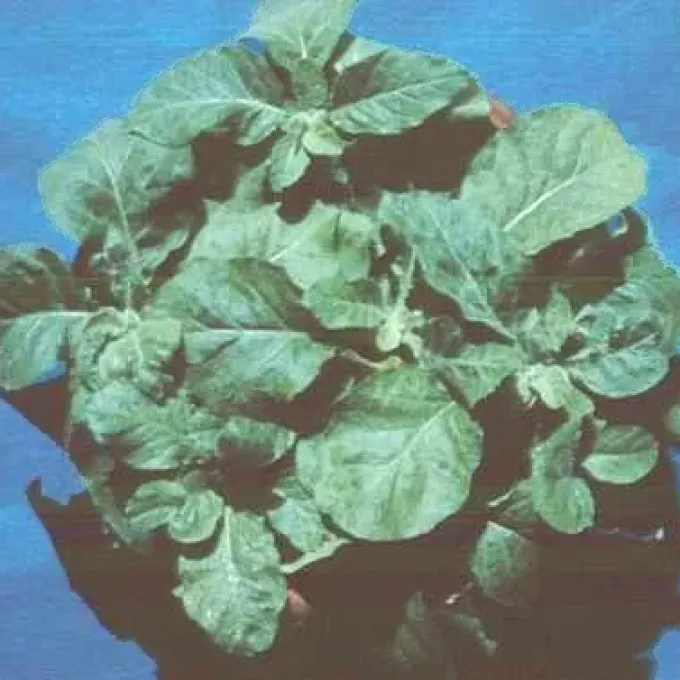
The most prominent symptom is a significant reduction in plant size, known as stunting. Affected plants appear much smaller and less vigorous than healthy ones.
Leaves on infected plants exhibit shortened internodes, which results in a rosette-like growth habit. The entire plant appears compressed and stunted.
Foliar symptoms often include yellowing (chlorosis) or necrotic spots. Leaves may also become distorted, curled, or crinkled due to the virus affecting cell growth.
Root systems show signs of damage, appearing underdeveloped and sometimes discolored or decayed, which limits the plant's ability to absorb water and minerals.
In fields, the disease typically appears in irregular, localized patches where the population density of the fungal vector is highest in the soil.
Pathogen
Tobacco stunt is a viral disease caused by the Tobacco stunt virus. It is a soil-borne pathogen that relies on a biological vector for transmission.
The virus is transmitted by the chytrid fungus Olpidium brassicae, which lives in the soil. The fungus carries the virus in its motile zoospores, allowing it to penetrate host roots.
This infection primarily affects the plant's root system, leading to systemic disruption of nutrient uptake and overall development.
The virus itself does not persist indefinitely in the soil without the fungal vector, but since Olpidium brassicae forms durable resting spores, the disease can persist for years.
Understanding the life cycle of the fungal vector is essential, as the virus cannot efficiently spread in the field without the movement of these zoospores.
Conditions for development
The development of Tobacco stunt is highly dependent on environmental conditions, specifically high soil moisture, which enables the movement of fungal zoospores.
Cooler soil temperatures are generally favorable for the activity of Olpidium brassicae, which explains why symptoms are often most severe early in the growing season.
Poorly drained soils or waterlogged areas create the perfect environment for the fungus to multiply and transmit the virus to the root zone.
Continuous cropping of tobacco in the same field encourages the build-up of both the virus and its fungal vector, leading to increased disease pressure over time.
High-density planting in nurseries can lead to rapid spread if the substrate is contaminated, potentially infecting entire batches of transplants before they reach the field.
Why it matters
Tobacco stunt causes significant economic damage by drastically reducing both the yield and the quality of the harvested tobacco leaf.
Infected plants produce smaller, lower-quality leaves that lack the necessary chemical characteristics required for high-grade commercial use.
The stunted growth leads to a longer maturation period or failure of the plants to reach technical maturity, resulting in high rejection rates at harvest.
Management costs are increased significantly due to the necessity of soil fumigation and the potential need to discard heavily infected seedling batches.
In severe cases, entire field sections may become unproductive, forcing farmers to abandon tobacco cultivation in those specific areas for several seasons.
Protection
Preventive measures focus primarily on soil management, including the use of steam sterilization or chemical fumigation of greenhouse soil and nursery beds.
Using pathogen-free growing media for seedlings is critical to prevent the introduction of the virus into new planting areas.
Implementing long-term crop rotation schemes, avoiding host species like other solanaceous crops, helps to deplete the population of the fungal vector.
Ensuring proper soil drainage is essential to reduce the movement of zoospores and limit the overall spread of the disease within the field.
- Utilizing resistant or tolerant tobacco varieties if available.
- Sanitizing all equipment to prevent the transport of contaminated soil.
- Regular monitoring of seedlings for early signs of stunted growth.
- Weed management to eliminate potential viral reservoirs near fields.
Discussion
No discussions yet — be the first.