
Phytoplasmoses
Thermoplasmata
Description
Symptoms
The most distinctive symptom is yellowing (chlorosis) of the leaves, which often progresses from the leaf margins or affects entire stems. This often gives the plants a pale, sickly appearance.
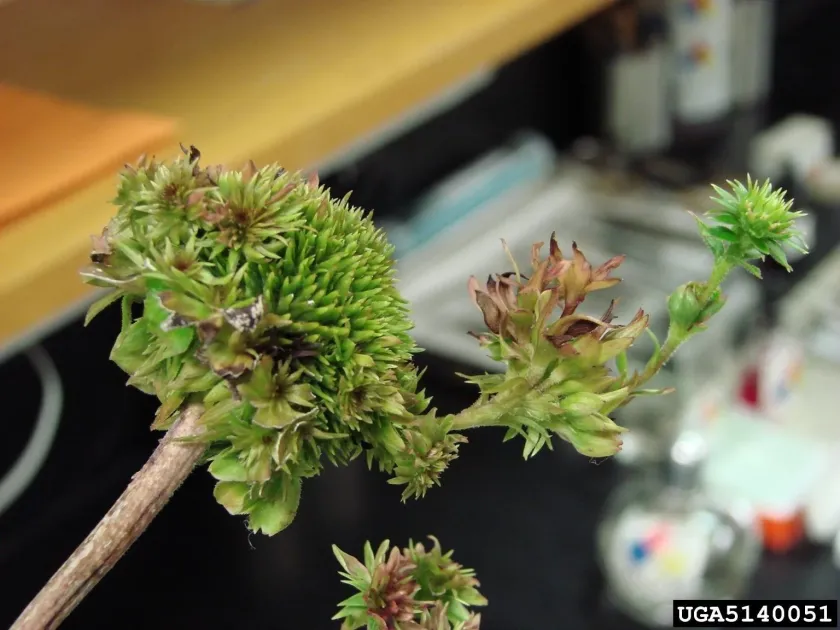
Proliferation is a key sign, where the plant produces an abnormal number of side shoots, resulting in a bushy, broom-like growth pattern known as "witches' broom."
Virescence, the transformation of flower petals into leaf-like structures, is a common indicator of phytoplasma infection. Flowers typically become deformed and sterile, failing to produce fruits or seeds.
Severe stunting and shortening of internodes are frequently observed. The plant remains low to the ground and shows stunted development compared to healthy specimens in the same field.
Roots of infected plants show poor development and may undergo early necrosis, significantly reducing the plant's ability to take up water and nutrients from the soil.
Pathogen
Phytoplasmoses are caused by phytoplasmas, which are specialized bacteria belonging to the class Mollicutes. Unlike other bacteria, they lack a cell wall and inhabit the sieve elements (phloem) of host plants.
These organisms possess a minimal genome, making them obligate parasites that rely entirely on the host plant's metabolic resources. Their survival depends on constant movement within the plant's vascular system.
In nature, phytoplasmas are transmitted by insect vectors, primarily leafhoppers, planthoppers, and psyllids. Once an insect feeds on an infected plant, it carries the pathogen and transmits it to healthy hosts during subsequent feeding.
The pathogen spreads systemically through the plant's phloem, disrupting the transport of nutrients from leaves to roots. This interference leads to significant physiological collapse of the infected plant.
Phytoplasmas have a broad host range, infecting a wide variety of monocot and dicot plants, ranging from commercial field crops to ornamental trees and shrubs.
Conditions for development
The development of phytoplasmoses is heavily dependent on the presence and activity of insect vectors. Hot, dry weather conditions generally favor the reproduction and movement of leafhoppers.
Wild plants and perennial weeds serve as vital reservoirs for phytoplasmas. Insects feeding on these reservoir plants acquire the pathogen and then spread it to neighboring agricultural crops.
The incubation period inside the plant is temperature-dependent. Warmer weather generally accelerates the replication of the pathogen and the onset of systemic symptoms within the host.
Poor sanitation and failure to manage weed populations around field borders create perfect conditions for infection cycles to thrive and persist throughout the growing season.
Phytoplasmas cannot persist in the soil independently of host tissues, so the persistence of the disease depends entirely on the survival of infected host plants or insect vectors.
Why it matters
Phytoplasmoses can cause severe economic losses, with yield reductions ranging from significant to total crop failure. Infected plants usually exhibit poor growth and lack commercial viability.
The fruit produced by infected plants is typically small, deformed, or fails to develop entirely, making the produce unsuitable for markets or processing industries.
Infection induces systemic metabolic changes that leave plants susceptible to secondary infections, including fungal and bacterial pathogens, often complicating accurate field diagnosis.
In woody perennials, phytoplasmoses lead to gradual decline and eventual death of orchards or nurseries. Growers are often forced to remove entire plantations to prevent the spread of the disease.
The inability to cure infected plants makes phytoplasmoses a major challenge in modern agriculture, as prevention is the only viable strategy to protect long-term investments.
Protection
The primary control strategy involves intensive management of insect vectors. Using systemic insecticides to control leafhopper populations at critical periods is essential for minimizing transmission.
Effective weed control around field borders is crucial, as removing reservoir hosts helps break the infection cycle and limits the source of phytoplasma inoculum.
Utilizing certified, disease-free planting material is the foundation of disease prevention. Growers should prioritize the selection of resistant cultivars whenever available in their region.
Prompt roguing (removal and destruction) of symptomatic plants is vital to limit the localized spread of the pathogen and protect the remaining healthy plants in the field.
- Installation of yellow sticky traps to monitor insect vector population dynamics.
- Implementation of spatial isolation between different age groups of crops.
- Use of protective netting or fleece to exclude vectors in high-value greenhouse crops.
Discussion
No discussions yet — be the first.